E-commerceUnit 116 min read
E-commerce: Models, Value Chains & Business Types
Unit 1 of E-commerce: Explores foundational concepts like e-commerce definitions, value chains/webs, business models (B2B, B2C, C2C), and real-world applications in Nepal’s digital economy (eSewa, Daraz, Pathao).
TAKEAWAYS:
- E-commerce is a digital marketplace enabled by the internet, transforming traditional commerce into online transactions.
- Value chains (internal processes) and value webs (external partnerships) are critical for competitive advantage in e-commerce.
- Business models like B2C (e.g., Daraz), B2B (e.g., NEPSE), and C2C (e.g., OLX) define how value is exchanged in digital ecosystems.
- Pricing models (e.g., CPC, CPM) and auction types (e.g., English, Dutch) drive revenue and customer engagement.
- Social e-commerce (e.g., Facebook Marketplace) leverages community trust and viral marketing.
- Security threats (e.g., phishing, fraud) require cryptographic tools (hash functions, encryption) to protect transactions.
1. Defining E-commerce
E-commerce (electronic commerce) refers to the buying and selling of goods/services via digital networks, primarily the internet. It includes transactions, marketing, and customer service conducted online.
Key Characteristics of E-commerce
mindmap
  root((E-commerce Characteristics))
    Digital Transactions
      Online Payments (eSewa, Khalti)
      Digital Wallets
    Global Reach
      Borderless Marketplace
      24/7 Availability
    Cost Efficiency
      Reduced Overhead (No Physical Stores)
      Automation (Chatbots, AI)
    Personalization
      Recommendation Engines (Daraz, Amazon)
      Customized Offers
    Data-Driven Decisions
      Analytics (Google Analytics, Facebook Insights)
      Customer Behavior Tracking
Types of E-commerce
E-commerce is classified based on transaction participants:
| Type | Description | Nepali Example | Global Example |
|---|---|---|---|
| B2C | Business → Consumer (Selling directly to end-users) | Daraz, Pathao | Amazon, Alibaba |
| B2B | Business → Business (Wholesale, bulk transactions) | NEPSE, NTC (bulk internet sales) | Alibaba B2B, Walmart |
| C2C | Consumer → Consumer (Peer-to-peer transactions) | OLX, Facebook Marketplace | eBay, Craigslist |
| C2B | Consumer → Business (Consumers sell to businesses) | Freelancers on Upwork | Fiverr, Freelancer.com |
| G2C | Government → Citizen (Online public services) | Online tax filing (Nepal Govt.) | USPS, UK Government Portals |
| G2B | Government → Business (Licensing, tenders) | Business registration online | EU Single Market Portal |
In the real world
- eSewa (B2C): Uses digital wallets and secure payment gateways to enable instant transactions between users and businesses. Example: Paying for a Daraz order via eSewa’s encrypted server.
- NEPSE (B2B): Facilitates auction-based trading (English auction) for stocks, where buyers bid in real-time for shares.
- Pathao (B2C): Leverages geolocation and real-time booking to match riders with customers, optimizing supply chains digitally.
2. Value Chain vs. Value Web in E-commerce
Value Chain
A value chain is the internal sequence of activities a business performs to deliver a product/service to the market. It includes:
- Inbound logistics (supplier → business)
- Operations (production)
- Outbound logistics (business → customer)
- Marketing & sales
- Service
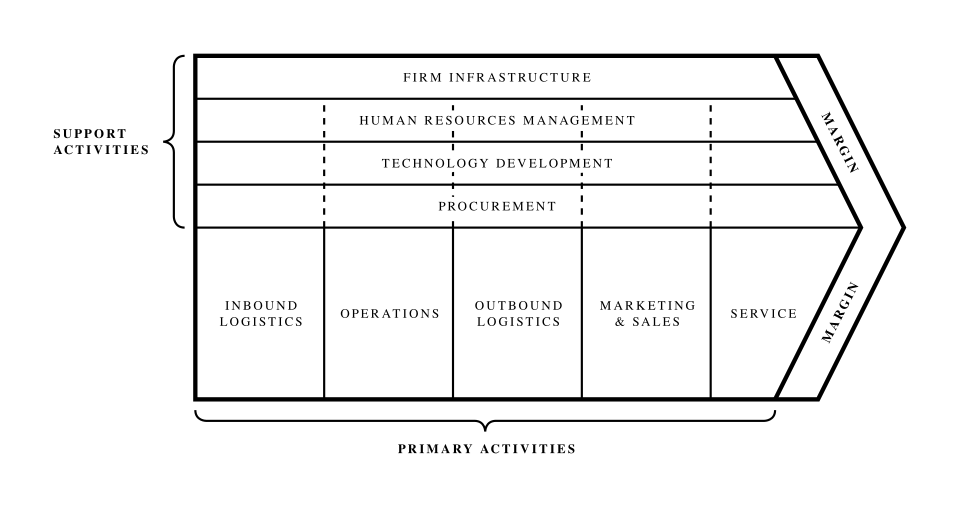 A visual breakdown of a company's internal processes from raw materials to customer service. (Image: Denis Fadeev, CC BY-SA 3.0, via Wikimedia Commons)
Value Web
A value web extends the value chain externally, involving partnerships, suppliers, distributors, and competitors working collaboratively. Example:
- Daraz (B2C) partners with Ncell (logistics) and eSewa (payments) to form a value web.
Comparison Table
| Aspect | Value Chain | Value Web |
|---|---|---|
| Scope | Internal business processes | External partnerships |
| Focus | Efficiency within the company | Collaboration with external entities |
| Example | Daraz’s warehouse operations | Daraz + Ncell + eSewa for end-to-end delivery |
| Advantage | Full control over processes | Access to broader resources |
| Disadvantage | Limited flexibility | Dependency on third parties |
Worked Example: Daraz’s Value Chain & Web
- Inbound Logistics: Daraz imports goods from suppliers (value chain).
- Operations: Warehousing and inventory management (value chain).
- Outbound Logistics: Ncell delivers packages (value web partner).
- Marketing: Facebook ads (value web, leveraging social media).
- Service: Customer support via WhatsApp (value web, using a third-party platform).
3. E-commerce Business Models
Business models define how value is created, delivered, and captured in e-commerce. Key models include:
B2C (Business-to-Consumer)
- Model: Business sells directly to end-users.
- Examples: Daraz, Amazon, Flipkart.
- Revenue Streams:
- Product sales
- Subscription fees (e.g., Amazon Prime)
- Advertising (e.g., sponsored products)
B2B (Business-to-Business)
- Model: Bulk transactions between businesses.
- Examples: NEPSE (stock trading), Alibaba B2B.
- Revenue Streams:
- Commission on trades
- Subscription-based platforms (e.g., SAP for enterprises)
C2C (Consumer-to-Consumer)
- Model: Peer-to-peer transactions.
- Examples: OLX, Facebook Marketplace.
- Revenue Streams:
- Listing fees
- Transaction commissions
Marketplace Model (Hybrid)
- Model: Platform connects buyers and sellers (e.g., Daraz, eBay).
- Revenue Streams:
- Commission per sale
- Advertising
- Subscription for premium features
Mermaid Diagram: E-commerce Business Model Flow
flowchart TD
    A["Buyer"] -->|"Purchases"| B["Marketplace (Daraz)"]
    B -->|"Commission"| C["Platform Revenue"]
    D["Seller"] -->|"Lists Product"| B
    E["Advertiser"] -->|"Ads"| B
    B -->|"Data Analytics"| F["Personalization Engine"]
In the real world
- NEPSE (B2B): Uses an auction-based model where investors bid for stocks in real-time, similar to how Daraz handles flash sales.
- OLX (C2C): Relies on user-generated listings and community trust, reducing the need for a traditional value chain.
- Daraz (Marketplace): Combines B2C (direct sales) and C2C (seller listings) under one platform, maximizing revenue streams.
4. Pricing Models in Online Advertising
Advertisers use different pricing models to display ads on e-commerce platforms. Common models include:
| Model | Definition | Example Platform | Advantage | Disadvantage |
|---|---|---|---|---|
| CPC (Cost-per-Click) | Pay per click on ad | Google Ads, Facebook Ads | Pay only for engagement | High cost if clicks are low-quality |
| CPM (Cost-per-Mille) | Pay per 1,000 impressions | Display ads on Daraz | Good for brand awareness | No guarantee of clicks/conversions |
| CPA (Cost-per-Action) | Pay per conversion (sale, signup) | Amazon Sponsored Products | High ROI if conversions are high | Requires tracking infrastructure |
| CPL (Cost-per-Lead) | Pay per lead (email signup, form fill) | Lead generation ads | Targets qualified prospects | Higher cost than CPC |
Worked Example: Daraz’s Ad Pricing
- A shoe brand runs a CPC campaign on Daraz, paying ₹20 per click.
- If 500 users click the ad but only 50 convert to sales, the brand pays ₹10,000 for clicks but may generate ₹50,000 in revenue, making it cost-effective.
5. Auctioning in E-commerce
Auctions are real-time bidding mechanisms used in e-commerce for dynamic pricing. Types include:
English Auction (Ascending Bid)
- How it works: Bidders increase bids until no one else bids.
- Example: NEPSE stock trading, eBay auctions.
- Advantage: Highest bidder wins at the highest price.
- Disadvantage: Can drive prices artificially high.
Dutch Auction (Descending Bid)
- How it works: Seller starts with a high price and reduces until a buyer accepts.
- Example: IPOs (Initial Public Offerings), some cryptocurrency sales.
- Advantage: Encourages competitive bidding from below.
- Disadvantage: May undervalue items.
Reverse Auction (B2B)
- How it works: Buyers bid downwards for a product/service.
- Example: Government tenders, procurement auctions.
- Advantage: Lowest cost for buyers.
- Disadvantage: Sellers may underprice.
Mermaid Diagram: Auction Types
stateDiagram-v2
    [*] --> English: Bidders increase bids
    English --> |Highest bidder wins| [*]
    [*] --> Dutch: Seller lowers price
    Dutch --> |First buyer accepts| [*]
    [*] --> Reverse: Buyers bid downwards
    Reverse --> |Lowest bid wins| [*]
In the real world
- NEPSE (English Auction): Investors bid upwards for stocks, similar to how Daraz handles flash sales where prices rise with demand.
- Cryptocurrency Sales (Dutch Auction): Projects like Bitcoin used Dutch auctions to set initial prices, ensuring fair distribution.
- Government Tenders (Reverse Auction): Nepal’s public procurement uses reverse auctions to get the best deals for infrastructure projects.
6. Social E-commerce and Marketing Strategies
Social e-commerce integrates social media platforms into the buying process, leveraging community trust and viral marketing.
Key Strategies
- Social Proof: Reviews, ratings, and user-generated content (e.g., Instagram posts for Daraz products).
- Influencer Marketing: Partnering with influencers to promote products (e.g., Pathao’s ride-sharing ads on YouTube).
- Community Engagement: Facebook Groups, WhatsApp Business for customer support.
- User-Generated Content: Customers post unboxing videos (e.g., TikTok for Daraz).
Drivers of Social E-commerce Growth
| Factor | Explanation | Nepali Example |
|---|---|---|
| Mobile Penetration | 90% of Nepalis use smartphones (NCA data). | Pathao, eSewa mobile apps |
| Social Media Adoption | 60% of Nepalis use Facebook/Instagram daily (Digital Nepal 2023). | Daraz Facebook Shop |
| Trust in Peers | 70% of buyers trust recommendations from friends over ads. | OLX, Facebook Marketplace |
| Low Barrier to Entry | No need for a physical store; easy to start. | Freelancers on Upwork |
Worked Example: Daraz’s Social E-commerce
- Strategy: Runs Facebook Shop and Instagram ads targeting Nepali youth.
- Result: 40% of Daraz’s sales come from social media referrals.
- Tactic: Influencers like @nepalfoodie promote Daraz’s kitchenware, driving 10,000+ clicks per post.
7. Security Threats and Protections in E-commerce
E-commerce faces cybersecurity threats that can compromise transactions. Key threats and solutions:
Security Threats
| Threat | Description | Example |
|---|---|---|
| Phishing | Fake emails/websites to steal credentials. | Fake "eSewa login" scam emails |
| Fraud | Fake transactions (e.g., chargebacks). | Fake Daraz seller accounts |
| Malware | Viruses/spyware to steal data. | Keyloggers on public Wi-Fi |
| Man-in-the-Middle | Hacker intercepts communication between client and server. | Unsecured payment gateways |
Security Measures
| Solution | How it Works | Example |
|---|---|---|
| Encryption (SSL/TLS) | Secures data in transit (e.g., HTTPS). | Daraz checkout page (🔒 icon) |
| Hash Functions | Converts data into fixed-size codes (e.g., SHA-256 for passwords). | eSewa password storage |
| Firewalls | Blocks unauthorized access to servers. | Ncell’s payment gateway security |
| Two-Factor Authentication (2FA) | Adds a second verification step (SMS/OTP). | eSewa login process |
Mermaid Diagram: E-commerce Security Layers
flowchart TD
    A["Client (User)"] -->|"HTTPS"| B["SSL/TLS Encryption"]
    B -->|"Secure Data"| C["Payment Gateway (eSewa/Khalti)"]
    C -->|"Hashing"| D["Database (Server-Side)"]
    D -->|"Firewall"| E["Secure Server"]
    F["Hacker"] -->|"Blocked"| G["Firewall"]
In the real world
- eSewa (Hash Functions): Uses SHA-256 to store passwords securely, preventing hackers from accessing plaintext data.
- Daraz (SSL/TLS): Encrypts all transactions to prevent man-in-the-middle attacks during checkout.
- Ncell (2FA): Requires SMS OTP for mobile banking, adding an extra layer of security.
8. Developing an E-commerce Website
Key elements to consider when building an e-commerce platform:
Essential Components
- User Interface (UI): Must be mobile-friendly (90% of Nepali users browse via mobile).
- Payment Gateway: Integrate eSewa, Khalti, or credit cards for secure transactions.
- Inventory Management: Real-time stock tracking (e.g., Daraz’s warehouse system).
- Search & Filtering: AI-driven product recommendations (e.g., "Customers also bought...").
- Customer Support: Live chat, WhatsApp Business, and FAQs.
- SEO Optimization: Ensure visibility on Google (e.g., Daraz ranks #1 for "buy online Nepal").
Worked Example: Pathao’s Website
- UI: Simple, one-tap booking interface.
- Payment: Supports eSewa, Khalti, and cash on delivery.
- Inventory: Real-time driver availability via GPS.
- Support: 24/7 WhatsApp chat for ride queries.
Mermaid Diagram: E-commerce Website Architecture
flowchart TD
    A["User"] -->|"Browses"| B["Frontend (UI)"]
    B -->|"API Calls"| C["Backend (Server)"]
    C -->|"Database"| D["Product Inventory"]
    C -->|"Payment Processing"| E["eSewa/Khalti Gateway"]
    E -->|"Secure Transaction"| F["Bank Server"]
    F -->|"Confirmation"| C
Exam Tip
This unit is highly conceptual but requires real-world examples to score full marks. Focus on:
- Definitions: Clearly explain value chain vs. value web, B2C vs. B2B, and auction types.
- Examples: Always tie theory to Nepali companies (eSewa, Daraz, NEPSE) or global platforms (Amazon, Alibaba).
- Comparisons: Use tables for pricing models, auction types, and security threats.
- Process Flow: Draw Mermaid diagrams for value chains, payment flows, and security layers.
- Current Trends: Mention social e-commerce (Facebook Shop) and mobile-first design (Pathao).
Common Pitfalls to Avoid:
- Overgeneralizing: Don’t say "e-commerce is just online shopping"—explain business models.
- Ignoring security: Always link hash functions, SSL, and 2FA to real examples.
- Missing Nepal-specific cases: Use eSewa, Daraz, NEPSE where possible.
Final Checklist for Full Marks ✅ Define key terms (e-commerce, value chain, B2C/B2B). ✅ Compare value chain vs. web, auction types, pricing models. ✅ Example every concept with Nepali or global platforms. ✅ Visualize processes with Mermaid diagrams or real images. ✅ Discuss security threats and solutions with real-world cases.
Based on the TU BSc CSIT syllabus for E-commerce (CSC370), unit 1.
Discussion
Loading…