Network SecurityUnit 69 min read
IPsec: Architecture, Modes, Protocols & Real-World Use
Unit 6 of Network Security explores IPsec’s architecture (AH/ESP), modes (transport/tunnel), protocols (IKEv2), authentication (X.509), and how it secures VPNs, IoT, and e-commerce traffic. Includes Ncell’s VPN tunnels, Daraz’s encrypted order routing, and a step-by-step IKEv2 handshake trace.
Key points
- IPsec secures IP traffic via **Authentication Header (AH)** for integrity and **Encapsulating Security Payload (ESP)** for confidentiality, both using symmetric keys.
- **Transport mode** encrypts payloads end-to-end (e.g., Ncell’s user-to-server traffic), while **tunnel mode** encrypts entire packets (e.g., Daraz’s site-to-site VPNs).
- **Internet Key Exchange (IKEv2)** establishes keys via **Diffie-Hellman (DH)** and **X.509 certificates**, with phases 1 (SA setup) and 2 (key derivation).
- **AH** protects headers but not payloads; **ESP** does the opposite. **AH+ESP** combines both for full security.
- Real-world: **Ncell’s VPN** uses IPsec tunnel mode to encrypt user data between towers; **eSewa’s payment gateways** use ESP for confidentiality.
- Exam focus: **IKEv2 phases**, **mode differences**, and **how AH/ESP fields work** (show the packet format!).
- ```
Core Concepts: What is IPsec?
IPsec (Internet Protocol Security) is a suite of protocols that secures IPv4/IPv6 communications by:
- Authenticating senders (preventing spoofing).
- Encrypting payloads (confidentiality).
- Ensuring integrity (detecting tampering).
- Providing anti-replay protection (stopping replay attacks).
It operates at the network layer (Layer 3), unlike TLS (Layer 4). IPsec is mandatory in IPv6 but optional in IPv4.
Why IPsec?
- VPNs: Secures remote access (e.g., Ncell employees connecting to corporate servers).
- IoT: Protects smart devices (e.g., Daraz’s warehouse sensors).
- E-commerce: Encrypts payment data (e.g., Khalti’s transactions).
IPsec Architecture: AH vs. ESP
IPsec uses two main protocols:
Authentication Header (AH)
- Provides integrity and authentication (via HMAC-SHA).
- Does not encrypt payloads (only protects headers).
- Vulnerable to replay attacks (unless anti-replay is enabled).
Encapsulating Security Payload (ESP)
- Provides confidentiality (via AES, 3DES) and integrity (via HMAC).
- Can encrypt both headers and payloads (in tunnel mode).
- Preferred for most use cases (e.g., eSewa’s encrypted transactions).
graph LR
    A["IPsec Suite"] --> B["Authentication Header (AH)"]
    A --> C["Encapsulating Security Payload (ESP)"]
    B --> D["Integrity & Authentication\n(No encryption)"]
    C --> E["Confidentiality + Integrity\n(Encryption + HMAC)"]
    C --> F["Tunnel Mode\n(Full packet encryption)"]
    C --> G["Transport Mode\n(Payload-only encryption)"]
IPsec Modes: Transport vs. Tunnel
| Mode | Use Case | Encryption Scope | Example |
|---|---|---|---|
| Transport | End-to-end security (host-to-host) | Only payload (IP header visible) | Ncell user → Ncell server |
| Tunnel | Gateway-to-gateway (VPN) | Entire IP packet (new IP header) | Daraz HQ → Daraz data center |
Transport Mode
- Original IP header is unchanged (except for ESP/AH insertion).
- Used for host-to-host security (e.g., secure email between two PCs).
- Limitation: Cannot secure routing headers (e.g., in NAT traversal).
Tunnel Mode
- Original IP packet is fully encapsulated in a new IP header.
- Used for VPNs (e.g., Pathao’s driver-to-server communication).
- Advantage: Hides internal network topology.
+---------------------+       +---------------------+
| Original IP Header  | ----> | New IP Header (ESP) |
+---------------------+       +---------------------+
|      Payload        |       | ESP Header          |
+---------------------+       +---------------------+
                          | ESP Trailer         |
                          +---------------------+
                          | ESP Authentication   |
                          +---------------------+
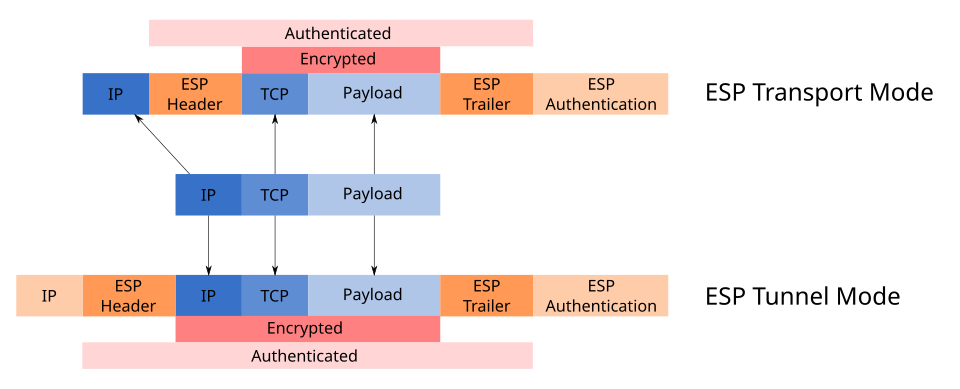 Shows original packet wrapped in a new IP header with ESP fields. (Image: Mpk1024, CC BY-SA 4.0, via Wikimedia Commons)
Internet Key Exchange (IKEv2): How Keys Are Established
IPsec uses symmetric keys (AES, 3DES) for encryption. But how are these keys securely exchanged? → Internet Key Exchange (IKEv2) does this in two phases:
Phase 1: Security Association (SA) Setup
Initial Exchange (IKE_SA_INIT)
- Peers exchange nonces (random numbers) and DH public keys.
- Agrees on cipher suite (e.g., AES-256-GCM).
- Creates IKE SA (for IKE traffic itself).
Authentication
- Uses X.509 certificates or pre-shared keys (PSK).
- Example: Ncell’s VPN uses PSK for site-to-site tunnels.
Phase 2: Child SA for IPsec
- Quick Mode
- Derives IPsec keys (for AH/ESP).
- Negotiates lifetime (e.g., 1 hour).
- Example: eSewa’s payment gateway refreshes keys every 30 mins.
sequenceDiagram
    participant A as Initiator (e.g., Ncell User)
    participant B as Responder (e.g., Ncell Server)
    A->>B: IKE_SA_INIT (Nonce, DH, Cert)
    B->>A: IKE_SA_INIT (Nonce, DH, Cert)
    A->>B: IKE_AUTH (ID, Signature)
    B->>A: IKE_AUTH (ID, Signature)
    Note over A,B: IKE SA Established
    A->>B: Quick Mode (Key Material)
    B->>A: Quick Mode (Key Material)
    Note over A,B: IPsec SA Ready (ESP/AH Keys)
Real-World Applications
1. Ncell’s VPN Tunnels (Tunnel Mode + IKEv2)
- Problem: Ncell needs to securely route voice/data between towers.
- Solution:
- Tunnel mode IPsec encrypts entire packets between gateways.
- IKEv2 Phase 1 uses PSK for authentication.
- ESP with AES-128 ensures confidentiality.
- Result: Eavesdroppers see only ciphertext.
2. Daraz’s Order Routing (Transport Mode + AH)
- Problem: Daraz’s warehouse sensors send inventory updates.
- Solution:
- Transport mode ESP encrypts only payloads (sensor data).
- AH ensures no tampering with IP headers.
- Result: Only authorized Daraz servers can read/update inventory.
3. eSewa’s Payment Security (ESP + IKEv2)
- Problem: Payment data must be confidential and untampered.
- Solution:
- ESP with AES-256 encrypts transaction details.
- IKEv2 Phase 2 refreshes keys every 30 mins.
- Result: Even if intercepted, data is unreadable.
Security Services Provided by IPsec
| Service | Protocol | Mechanism | Example Use Case |
|---|---|---|---|
| Confidentiality | ESP | AES, 3DES | Khalti’s encrypted transactions |
| Integrity | AH/ESP | HMAC-SHA | NTC’s billing data verification |
| Authentication | AH/ESP | Digital signatures, X.509 | Ncell’s user authentication |
| Anti-Replay | AH/ESP | Sequence numbers | Pathao’s ride request prevention |
Advantages and Limitations
Advantages
✅ Transparency: Works at Layer 3 (no app changes needed). ✅ Flexibility: Supports AH, ESP, or both. ✅ Standardized: Widely supported (IPv6, VPNs, IoT).
Limitations
❌ Performance Overhead: Encryption/decryption slows traffic. ❌ Complexity: IKEv2 handshakes add latency. ❌ No built-in key management: Relies on IKE or manual config.
Exam Tip: What to Focus On
AH vs. ESP
- AH: Integrity only (headers + payload).
- ESP: Confidentiality + integrity (payload only in transport mode).
- AH+ESP: Full security (rarely used due to complexity).
Transport vs. Tunnel Mode
- Transport: End-to-end (e.g., user ↔ server).
- Tunnel: Gateway-to-gateway (e.g., VPNs).
- Exam trick: Draw the packet diagrams!
IKEv2 Phases
- Phase 1: IKE SA (authentication, DH).
- Phase 2: IPsec SA (key derivation).
- Memorize: Quick Mode = IPsec keys.
Real-World Mapping
- Ncell: Tunnel mode + IKEv2.
- eSewa: ESP + IKEv2.
- Daraz: Transport mode + AH.
Common Pitfalls
- ❌ Confusing AH (integrity) with ESP (confidentiality).
- ❌ Forgetting tunnel mode adds a new IP header.
- ❌ Mixing up IKEv1 (old) vs. IKEv2 (modern).
Worked Example: Securing a Daraz Order
Scenario: A customer orders from Daraz. The order must reach the warehouse securely.
Step 1: IKEv2 Phase 1
- Daraz’s server and warehouse gateway perform DH key exchange + PSK authentication.
- Result: Secure IKE SA.
Step 2: IKEv2 Phase 2 (Quick Mode)
- Derives ESP keys (AES-128).
- Sets SA lifetime = 1 hour.
Step 3: ESP in Transport Mode
- Order data is encrypted with AES.
- Sequence numbers prevent replay attacks.
Step 4: Delivery
- Warehouse decrypts the order using the same ESP keys.
Visual Trace:
sequenceDiagram
    participant C as Customer
    participant D as Daraz Server
    participant W as Warehouse
    C->>D: Order Request (HTTP)
    D->>W: Encrypted Order (ESP Transport Mode)
    W->>D: ACK (ESP)
    Note over W,D: AES-128 decryption
Comparison Table: IPsec vs. TLS
| Feature | IPsec | TLS |
|---|---|---|
| Layer | Network (Layer 3) | Transport (Layer 4) |
| Use Case | VPNs, IoT, routing security | Web (HTTPS), email (SMTPS) |
| Key Exchange | IKEv2 (DH + X.509/PSK) | RSA/DH + Certificates |
| Encryption | ESP (AES, 3DES) | TLS Record Protocol (AES, ChaCha) |
| Headers | Modifies IP headers (AH/ESP) | Works above TCP/UDP |
| Performance | Higher overhead (Layer 3) | Optimized for web traffic |
Key Takeaways for Exams
IPsec = AH + ESP + IKEv2
- AH = Integrity, ESP = Confidentiality.
- IKEv2 = Key exchange (Phase 1 + 2).
Modes Matter
- Transport = End-to-end (e.g., user ↔ server).
- Tunnel = Gateway-to-gateway (e.g., VPNs).
Real-World = Your Friend
- Ncell = Tunnel mode.
- eSewa = ESP + IKEv2.
- Daraz = Transport mode + AH.
Draw It Out
- Packet formats (AH/ESP headers).
- IKEv2 sequence diagrams.
- Mode differences (transport vs. tunnel).
Avoid Common Mistakes
- Don’t say AH encrypts data (it doesn’t).
- Don’t forget tunnel mode adds a new IP header.
- Don’t mix up IKEv1 and IKEv2 (exams love this!).
Based on the TU BSc CSIT syllabus for Network Security (CSC416), unit 6.
Discussion
Loading…