Introduction To PsychologyUnit 514 min read
Memory & Forgetting: Processes, Theories & Real-World Applications
Unit 5 of Introduction to Psychology explores how memory functions as a biological and cognitive system—its stages, types, mechanisms of forgetting, and practical techniques to enhance retention—with direct links to everyday challenges like studying, decision-making, and emotional recall.
TAKEAWAYS:
- Memory is a three-stage process (encoding → storage → retrieval) that explains how experiences become lasting knowledge.
- Forgetting is caused by biological decay, interference, and psychological repression, each with distinct real-world examples.
- Mnemonics and chunking are evidence-based techniques to improve memory retention by organizing information.
- Eidetic memory (photographic recall) and false memories challenge our understanding of what memory truly captures.
- Neuroplasticity shows how memory is physically stored in the brain, linking psychology to neuroscience.
- Everyday tools like Google Search, WhatsApp’s chat history, and Daraz’s order tracking rely on memory principles.
1. Defining Memory: The Cognitive Process
Memory is the ability to encode, store, and retrieve information over time. It is not passive storage but an active reconstruction of past experiences, shaped by attention, emotion, and context.
The Three-Stage Model of Memory
Memory operates in three sequential stages, each with distinct mechanisms:
flowchart TD
    A["Encoding: Sensory Input"] -->|"Attention"| B["Short-Term Memory (STM): Working Memory"]
    B -->|"Rehearsal/Elaboration"| C["Long-Term Memory (LTM): Permanent Storage"]
    C -->|"Retrieval Cues"| B
    B -->|"Decay/Interference"| D["Forgetting"]
Visual: The Three-Stage Memory Model
Key Terms:
- Encoding: Converting sensory input into a usable format (e.g., visual, acoustic, semantic).
- Storage: Maintaining encoded information over time (seconds to decades).
- Retrieval: Accessing stored information when needed (e.g., recalling a phone number).
Worked Example: Remembering a Lecture Scenario: You attend a psychology lecture on memory. Your sensory memory briefly holds the speaker’s voice and slides (iconic/sensory store). If you pay attention, the information moves to STM (working memory), where you rehearse key points. If you elaborate (linking to prior knowledge), it transfers to LTM for long-term recall during an exam.
2. Types of Memory
Memory is classified based on duration, capacity, and function:
| Type | Duration | Capacity | Example | Real-World Link |
|---|---|---|---|---|
| Sensory Memory | <1 second | High (all senses) | Seeing a flash of light | Instantly recognizing a Pathao bike passing by. |
| Short-Term Memory (STM) | 20-30 seconds | 7±2 items (Miller’s Law) | Remembering a phone number temporarily | Recalling a Khalti transaction PIN. |
| Long-Term Memory (LTM) | Minutes to lifetime | Unlimited | Remembering your first day at school | Recalling how to use eSewa for payments. |
| Explicit (Declarative) | LTM | Factual/semantic | Knowing the capital of Nepal (Kathmandu) | Studying for TU exams. |
| Implicit (Non-Declarative) | LTM | Procedural/emotional | Riding a bicycle | Automatically typing on a keyboard. |
Visual: Memory Types Comparison
Why It Matters:
- STM’s limit (7±2 items) explains why phone numbers are grouped (e.g., 984-123-4567).
- LTM’s permanence is why childhood memories (e.g., first day of school) feel vivid decades later.
3. Mechanisms of Forgetting
Forgetting is not just "losing" information—it involves biological, psychological, and situational factors:
A. Trace Decay (Biological Forgetting)
- Definition: Memory fades due to neural pathways weakening over time if unused.
- Example: Forgetting a friend’s birthday if you don’t check your calendar.
- Neuroscience Link: Synapses in the hippocampus (memory center) weaken without reinforcement.
Visual: Synaptic Plasticity
B. Interference (Psychological Forgetting)
- Definition: New information competes with old memories, causing confusion.
- Proactive interference: Old memories block new ones (e.g., struggling to remember a new password after using an old one).
- Retroactive interference: New memories overwrite old ones (e.g., forgetting your old WhatsApp password after changing it).
Worked Example: Language Interference Scenario: A Nepali student learning English may confuse "color" (Nepali: rang) with "colour" (British English), showing how prior knowledge interferes with new learning.
C. Repression (Psychological Defense)
- Definition: Unconscious blocking of traumatic memories (Freud’s psychoanalytic theory).
- Example: A victim of abuse may not remember the event due to repression.
- Modern View: Criticized as overgeneralized, but dissociative amnesia (extreme repression) is clinically recognized.
Visual: Repression vs. Suppression
D. Motivated Forgetting
- Definition: Actively choosing to forget (e.g., ignoring bad news to stay positive).
- Example: Ignoring negative reviews of a Daraz product to maintain satisfaction.
Comparison Table: Causes of Forgetting
| Cause | Mechanism | Example | Real-World Impact |
|---|---|---|---|
| Trace Decay | Neural weakening | Forgetting a lecture after a week | Why cramming doesn’t guarantee long-term retention. |
| Interference | Competing memories | Mixing up two similar passwords | Why banks use multi-factor authentication. |
| Repression | Unconscious blocking | Blocking memories of childhood trauma | Therapy techniques like exposure therapy. |
| Motivated | Conscious avoidance | Ignoring a failed exam result | Self-sabotage in academic performance. |
4. Improving Memory: Techniques and Strategies
Memory is trainable—here’s how to optimize it:
A. Mnemonics (Memory Aids)
- Definition: Techniques to associate information with familiar cues.
- Types:
- Acronyms: ROYGBIV (colors of the rainbow).
- Rhymes: "30 days hath September" (calendar trick).
- Visual Imagery: Remembering a list by imagining absurd scenes (e.g., a "pink elephant" for "pink" in a grocery list).
Worked Example: Learning the Planets Method: Use the acronym "My Very Educated Mother Just Served Us Nachos" (Mercury, Venus, Earth, Mars, Jupiter, Saturn, Uranus, Neptune). Real-World Use: NASA astronauts use mnemonics to memorize complex procedures.
B. Chunking
- Definition: Grouping information into manageable units (e.g., phone numbers as 984-123-4567).
- Why It Works: Leverages STM’s 7±2 limit by reducing cognitive load.
Visual: Chunking Example
C. Spaced Repetition
- Definition: Reviewing information over spaced intervals (e.g., Anki flashcards).
- Science: Aligns with the spacing effect (Ebbinghaus’ forgetting curve).
Visual: Ebbinghaus Forgetting Curve
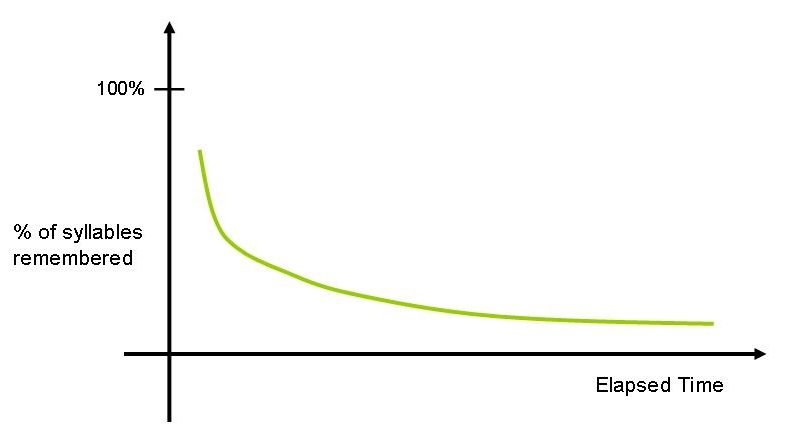 A graph showing memory retention drops sharply without review but stabilizes with spaced repetition. (Image: Nheise at English Wikibooks, CC BY-SA 3.0, via Wikimedia Commons)
D. Elaborative Rehearsal
- Definition: Deeply connecting new info to existing knowledge (vs. rote repetition).
- Example: Linking "photosynthesis" to Daraz’s solar-powered warehouses.
Comparison Table: Memory Techniques
| Technique | How It Works | Best For | Real-World Example |
|---|---|---|---|
| Mnemonics | Associations/cues | Lists, sequences, facts | Memorizing the periodic table. |
| Chunking | Grouping information | Numbers, codes, passwords | Remembering a 16-digit credit card number. |
| Spaced Repetition | Scheduled review | Long-term retention | Using Duolingo for language learning. |
| Elaborative Rehearsal | Deep linking to prior knowledge | Complex concepts | Understanding economics via real-world examples (e.g., inflation at NEPSE). |
5. Special Cases of Memory
A. Eidetic Memory (Photographic Recall)
- Definition: Rare ability to visually recall images with near-perfect accuracy.
- Example: Some children can "see" a page after glancing at it once.
- Skepticism: Most "eidetic" cases are hyperthesia (enhanced attention, not true eidetic memory).
Visual: Eidetic Memory Test
B. False Memories
- Definition: Constructed memories that feel real but are inaccurate (e.g., misremembering a movie plot).
- Cause: Suggestibility (leading questions) or schema-driven filling (filling gaps with expectations).
- Example: The "Lost in the Mall" experiment (Loftus & Pickrell, 1995), where participants "remembered" being lost as children after suggestion.
Visual: False Memory Formation
C. Flashbulb Memories
- Definition: Vivid, detailed memories of emotionally significant events (e.g., 9/11, the 2015 Nepal earthquake).
- Neuroscience: Linked to high amygdala activation (emotion center).
Real-World Example:
- Nepal Earthquake (2015): Many survivors recall exact details of where they were, who they were with, and their reactions—yet may forget mundane daily events.
6. Memory in Everyday Life
In the Real World
eSewa/Khalti Payments
- Idea Used: Procedural memory (automatic recall of PINs) and explicit memory (remembering transaction history).
- Why It Matters: Users rely on chunking (splitting PINs into 4-digit chunks) and mnemonics (linking PINs to birthdays).
Daraz Order Tracking
- Idea Used: Short-term memory (tracking real-time updates) and long-term memory (remembering past orders for repeat purchases).
- Why It Matters: The app uses spaced repetition (sending updates at key intervals) to reduce forgetting.
Pathao Driver Navigation
- Idea Used: Spatial memory (remembering routes) and working memory (processing live traffic updates).
- Why It Matters: Drivers use chunking (grouping stops) and elaborative rehearsal (linking landmarks to routes).
Ncell Data Plans
- Idea Used: Proactive interference (forgetting old plan details after switching).
- Why It Matters: Companies use reminders (SMS alerts) to combat forgetting.
Worked Example: Calculating a Bank Loan Interest Scenario: You take a loan from NMB Bank with a 10% annual interest rate. Your working memory calculates monthly payments, while your long-term memory stores past loan terms to compare offers. Forgetting Risk: If you ignore the amortization schedule, you might repress the total interest paid, leading to financial mistakes.
Exam Tips
Define Memory with Process:
- Always include encoding → storage → retrieval in your answer.
- Example:
"Memory is the process of encoding sensory input into a usable format, storing it in short-term or long-term memory, and retrieving it when needed. For example, reading a textbook (encoding) → reviewing it later (storage) → answering exam questions (retrieval)."
Compare Forgetting Theories:
- Use a table (like the one above) to contrast trace decay, interference, and repression.
- Example:
"Trace decay explains forgetting due to neural weakening (e.g., forgetting a lecture after a week), while interference occurs when new memories compete with old ones (e.g., mixing up two similar passwords). Repression, however, involves unconscious blocking of traumatic memories."
Apply Techniques to Real Life:
- Link mnemonics, chunking, or spaced repetition to examples like eSewa PINs, Daraz orders, or TU exam prep.
- Example:
"To remember a long list of psychology terms, I use the acronym ‘PEMDAS’ (Process, Encoding, Memory, Decay, Amnesia, Storage) to group related concepts, leveraging chunking."
Discuss False Memories Critically:
- Mention Loftus’ experiments and schema theory but also critique Freud’s repression as outdated.
- Example:
"False memories, as shown by Loftus’ ‘lost in the mall’ study, arise from suggestive questioning. While repression was Freud’s idea, modern psychology prefers the term ‘dissociative amnesia’ for extreme cases."
Neuroscience Links:
- Always tie memory to brain structures (e.g., hippocampus for LTM, amygdala for flashbulb memories).
- Example:
"The hippocampus, a seahorse-shaped structure in the brain, is crucial for converting STM to LTM. Damage to it (as in H.M., the famous patient) leads to severe anterograde amnesia."
Final Visual: Memory in Action
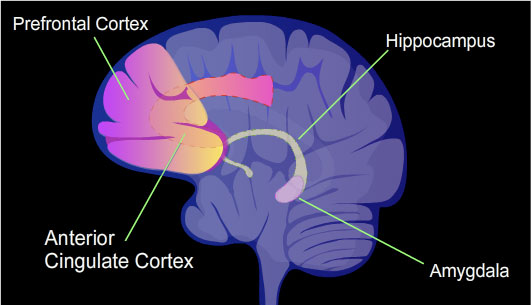 A cross-section of the brain highlighting the hippocampus (LTM), amygdala (emotion), and prefrontal cortex (working memory). (Image: This work has been identified as being free of known restric, Public domain, via Wikimedia Commons)
Summary Flowchart for Quick Revision
Based on the TU BSW syllabus for Introduction To Psychology, unit 5.
Discussion
Loading…