Introduction To Mass CommunicationUnit 59 min read
Specialized Reporting: Disaster, Climate Change & Social Issues
Unit 5 of Introduction To Mass Communication covers specialized reporting techniques for disasters, climate change, and social issues—key challenges in Nepal’s media landscape. Learn ethical frameworks, reporting best practices, and case studies from real-world crises like floods, migration, and labor rights violations
TAKEAWAYS:
- Disaster reporting requires urgency, accuracy, and ethical sensitivity to avoid misinformation during crises (e.g., earthquakes, landslides).
- Climate change journalism must balance scientific data with human impact stories to drive public awareness (e.g., melting glaciers in Nepal).
- Social issue reporting (e.g., migration, labor rights) demands investigative depth and collaboration with NGOs to expose systemic problems.
- Challenges include fake news, live reporting risks, and the influence of social media on traditional media credibility.
- Ethical dilemmas arise in disaster zones (e.g., privacy vs. public safety) and require adherence to journalistic codes.
- Strategies like fact-checking, diverse sourcing, and community engagement improve reporting quality in high-stakes scenarios.
1. Specialized Reporting: Definitions and Scope
Specialized reporting focuses on high-impact, complex issues that require nuanced storytelling. Unlike general news, it demands:
- Depth: Investigative research to uncover root causes (e.g., why a landslide occurred).
- Ethics: Balancing public interest with sensitivity (e.g., interviewing survivors without retraumatizing them).
- Adaptability: Tailoring content for different audiences (e.g., scientific data for policymakers vs. human stories for the public).
Key Areas of Specialization
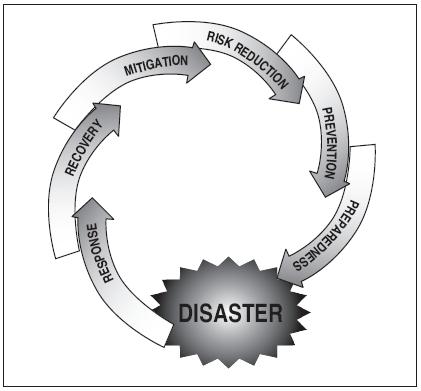 Shows the 4-phase cycle (mitigation, preparedness, response, recovery) critical for disaster reporting. (Image: CC BY 2.5, via Wikimedia Commons)
2. Disaster Reporting: Practices and Challenges
How It Works
Disaster reporting follows a structured approach to ensure safety, accuracy, and public trust:
- Pre-Disaster: Cover preparedness (e.g., NTC’s flood warnings).
- During Disaster: Live updates with verified sources (e.g., Ncell’s emergency alerts).
- Post-Disaster: Investigative stories on recovery efforts (e.g., rebuilding after the 2015 earthquake).
Worked Example: Reporting the 2022 Nepal Floods
- Challenge: Heavy rains caused landslides in Sindhupalchowk. Reporters faced:
- Access issues: Blocked roads delayed coverage.
- Safety risks: Journalists were trapped in rescue operations.
- Solution: Used citizen journalism (WhatsApp groups) to relay real-time updates while mainstream media coordinated with NGOs for safe access.
- Ethical Dilemma: Avoiding sensationalism while highlighting the scale of destruction (e.g., "100+ missing in Dhading").
Challenges in Disaster Reporting
| Challenge | Cause | Solution |
|---|---|---|
| Fake news | Rumors spread via social media | Fact-check with official sources (e.g., NDRRMA) |
| Live reporting risks | Journalists in danger zones | Use remote reporting tools (e.g., drones) |
| Resource limitations | Limited staff/time during crises | Collaborate with international media (e.g., BBC, Reuters) |
3. Climate Change Reporting: Science and Storytelling
Climate change journalism merges scientific data with human narratives. Nepal’s unique challenges:
- Glacial retreat: Melting Himalayan glaciers threaten water supplies (e.g., Koshi River).
- Extreme weather: Increased frequency of floods and droughts.
- Policy gaps: Weak enforcement of environmental laws.
How to Report Climate Issues
- Use data visualizations: Graphs of temperature rises or deforestation rates.
- Interview experts: Scientists (e.g., ICIMOD researchers) and local communities.
- Avoid greenwashing: Critically report corporate sustainability claims (e.g., Daraz’s carbon footprint).
Worked Example: Reporting on Kathmandu’s Air Pollution
- Issue: Winter smog from vehicles and brick kilns exceeds WHO limits.
- Reporting Angle:
- Data: AQI readings from AirVisual.
- Human Impact: Interview a schoolteacher in Lalitpur about health effects.
- Solution: Highlight government failures (e.g., delayed ban on polluting vehicles).
4. Social Issues Reporting: Migration and Labor
Nepal’s labor migration (e.g., Gulf countries) and domestic labor abuses are prime topics. Key practices:
- Investigative journalism: Expose trafficking rings (e.g., The Kathmandu Post’s 2021 series on maid abuses in Malaysia).
- Community engagement: Work with NGOs like INSEC (Institute of Social Justice) for sources.
- Legal context: Report on labor laws (e.g., Nepal’s 2017 Foreign Employment Act).
Challenges
- Source protection: Migrant workers fear retaliation.
- Cultural sensitivity: Avoid stereotyping (e.g., "vulnerable women" → "migrant workers facing systemic barriers").
- Access: Many workers are undocumented.
Worked Example: Reporting on Daraz Delivery Workers
- Issue: Poor wages and unsafe working conditions for gig workers.
- Approach:
- Data: Survey 500 workers (partner with labor unions).
- Stories: Profile a worker from Chitwan who rides in monsoon rains.
- Call to action: Demand Daraz to improve pay and insurance.
5. Ethical Dilemmas and Media Strategies
Common Ethical Issues
- Privacy vs. Public Safety:
- Example: Reporting on a missing child during a landslide.
- Solution: Use initials (e.g., "10-year-old R.K. from Dhading") and avoid graphic details.
- Bias in Disaster Coverage:
- Example: Overemphasizing urban disasters (e.g., Kathmandu floods) vs. rural areas.
- Solution: Diversify sources (e.g., include a reporter from Pokhara).
- Exploitation of Vulnerable Groups:
- Example: Interviewing earthquake survivors without consent.
- Solution: Follow ICRC’s ethical guidelines for conflict zones.
Effective Media Strategies
| Strategy | Example | Benefit |
|---|---|---|
| Fact-checking | Verify flood death tolls with police | Reduces misinformation |
| Multilingual reporting | Coverage in Nepali, Maithili, Tharu | Reaches marginalized communities |
| Collaborative journalism | Partner with The Himalayan Times | Shares resources and expertise |
In the Real World
eSewa and Digital Payments During Lockdowns (2020-2021)
- Idea Used: Live reporting of tech solutions during COVID-19.
- How: Media covered eSewa’s role in delivering rations to elderly citizens, highlighting both its efficiency and digital divide challenges (e.g., rural areas without internet).
Khalti’s Role in Disaster Relief
- Idea Used: Crowdfunding and real-time donations for crises.
- How: After the 2015 earthquake, Khalti facilitated instant donations to NGOs like Red Cross Nepal. Journalists tracked transparency (e.g., "Did funds reach survivors?").
NEPSE’s Stock Market Reporting During Economic Crises
- Idea Used: Financial journalism and climate risks.
- How: Media analyzed how climate-induced disasters (e.g., 2017 floods) affected hydropower stocks (e.g., Butwal Power Company). Reporters interviewed analysts on long-term investment risks.
Pathao’s Worker Strikes (2023)
- Idea Used: Labor rights and gig economy reporting.
- How: Onlinekhabar investigated Pathao’s response to worker demands for better pay, using leaked internal emails and union statements.
Exam Tip
For news writing questions:
- Follow the 5Ws + H structure but prioritize human impact (e.g., "How did the flood affect a single family?").
- Use local data: Cite NDRRMA, ICIMOD, or government reports to add credibility.
- Example headline for a climate story:
"Nepal’s Vanishing Glaciers: How Koshi River’s Flow is Drying Up Farmlands in Bihar"
For challenges/questions:
- Link answers to real-world examples (e.g., "Social media spread fake news about the 2022 landslide deaths").
- Use comparison tables (e.g., traditional media vs. social media in disaster reporting).
For ethical dilemmas:
- Structure answers as:
- Issue (e.g., privacy breach).
- Journalistic code violated (e.g., Press Council of Nepal’s guidelines).
- Solution (e.g., anonymize sources).
- Structure answers as:
Avoid common mistakes:
- ❌ Sensationalism (e.g., "Apocalyptic floods!").
- ✅ Balanced tone (e.g., "While 20 districts are underwater, relief efforts are underway...").
Visual Summary
Based on the TU BSW syllabus for Introduction To Mass Communication, unit 5.
Discussion
Loading…