Tourism and Hospitality AccountingUnit 56 min read
Cash Book & Bank Reconciliation: Records, Errors & Reconciliation
Unit 5 of Tourism and Hospitality Accounting covers the cash book (single and double column), bank reconciliation statement, and common discrepancies between books and bank statements, with real-world examples from Nepali travel agencies and hotels.
What is a Cash Book?
A cash book is a subsidiary book that records all cash transactions (receipts and payments) in chronological order. It is part of the double-entry system and helps track liquidity.
Types of Cash Books
- Single Column Cash Book: Records only cash transactions (no bank columns).
- Double Column Cash Book: Separate columns for cash receipts and cash payments.
- Triple Column Cash Book: Includes bank columns (used when both cash and bank transactions are frequent).
classDiagram
    class CashBook {
        +Records cash receipts and payments
        +Used in double-entry system
        +Types: Single, Double, Triple Column
    }
    class BankReconciliation {
        +Compares cash book vs. bank statement
        +Identifies discrepancies
        +Prevents fraud and errors
    }
    CashBook --> BankReconciliation : "Leads to"
How to Maintain a Cash Book
- Record transactions chronologically (date-wise).
- Debit the receiver (e.g., "Cash A/c" for receipts, "Expenses A/c" for payments).
- Credit the giver (e.g., "Sales A/c" for receipts, "Cash A/c" for payments).
- Balance the cash book at the end of each period.
Example: Cash Book for a Kathmandu Travel Agency (NPR)
Assume Kathmandu Travels records the following transactions in April 2024:
| Date | Particulars | L.F. | Cash A/c (Dr.) | Cash A/c (Cr.) | Balance (Dr.) |
|---|---|---|---|---|---|
| 2024-04-01 | Opening Balance | - | - | - | 50,000 |
| 2024-04-02 | Received from Tour Packages | Sales | 120,000 | - | 170,000 |
| 2024-04-03 | Paid to Suppliers | Purchases | - | 30,000 | 140,000 |
| 2024-04-05 | Paid Salaries | Salaries | - | 40,000 | 100,000 |
| 2024-04-10 | Deposited in Bank | Bank | - | 50,000 | 50,000 |
Closing Balance (Dr.) = 50,000 NPR
Bank Reconciliation Statement (BRS)
A Bank Reconciliation Statement compares the cash book balance with the bank statement balance to identify discrepancies.
Why is BRS Needed?
- Errors in recording (e.g., omissions, wrong amounts).
- Unrecorded transactions (e.g., bank charges, interest).
- Timing differences (e.g., cheques issued but not cleared).
Common Discrepancies
| Cash Book Side | Bank Statement Side |
|---|---|
| Unrecorded deposits | Uncleared cheques |
| Bank charges not recorded | Direct debits/credits |
| Interest earned not recorded | Service charges |
Example: Reconciling Kathmandu Travels’ Bank Account
Assume:
- Cash Book Balance (Dr.) = 50,000 NPR
- Bank Statement Balance = 60,000 NPR
Discrepancies Found:
- Unrecorded deposit: 5,000 NPR (from a tour payment).
- Uncleared cheque: 2,000 NPR (issued but not cleared).
- Bank charges: 3,000 NPR (not recorded in cash book).
Bank Reconciliation Statement (BRS):
| Particulars | Amount (NPR) |
|---|---|
| Cash Book Balance | 50,000 |
| Add: Unrecorded Deposit | +5,000 |
| Less: Uncleared Cheque | -2,000 |
| Less: Bank Charges | -3,000 |
| Bank Statement Balance | 60,000 |
In the Real World
- eSewa (Nepal) – Uses bank reconciliation to match digital payments with merchant records, ensuring no discrepancies in transaction processing.
- Khalti (Nepal) – Maintains cash books for all merchant transactions, reconciling daily to prevent fraud.
- Daraz (Nepal) – Uses triple-column cash books to track cash, bank, and digital wallet transactions for sellers.
Worked Example (Real Situation):
- Pathao Drivers receive cash payments but must reconcile with Pathao’s digital records to ensure no missing transactions.
- If a driver’s cash book shows 15,000 NPR but Pathao’s system shows 18,000 NPR, the discrepancy could be due to unrecorded tips or bank transfers not synced.
How to Prepare a Bank Reconciliation Statement
- Start with the cash book balance.
- Add unrecorded deposits (credits in bank but not in cash book).
- Subtract unrecorded payments (debits in bank but not in cash book).
- Adjust for bank charges/interest (if not recorded).
- Verify with bank statement balance.
Step-by-Step Trace (Kathmandu Travels)
- Cash Book Balance: 50,000 NPR (Dr.)
- Bank Statement Balance: 60,000 NPR
- Adjustments:
- +5,000 (unrecorded deposit)
- -2,000 (uncleared cheque)
- -3,000 (bank charges)
- Final Reconciled Balance: 60,000 NPR (matches bank statement).
Advantages & Disadvantages
| Advantages | Disadvantages |
|---|---|
| Ensures accuracy in financial records | Time-consuming if manual |
| Detects errors and fraud early | Requires constant updating |
| Helps in budgeting and cash flow control | Needs skilled accounting staff |
Exam Tip
- Always start BRS from the cash book balance.
- List adjustments clearly (add/subtract with reasons).
- Match the final reconciled balance with the bank statement.
- Common exam mistakes:
- Forgetting to adjust for uncleared cheques.
- Misclassifying bank charges (should be deducted).
- Not reconciling interest earned/paid.
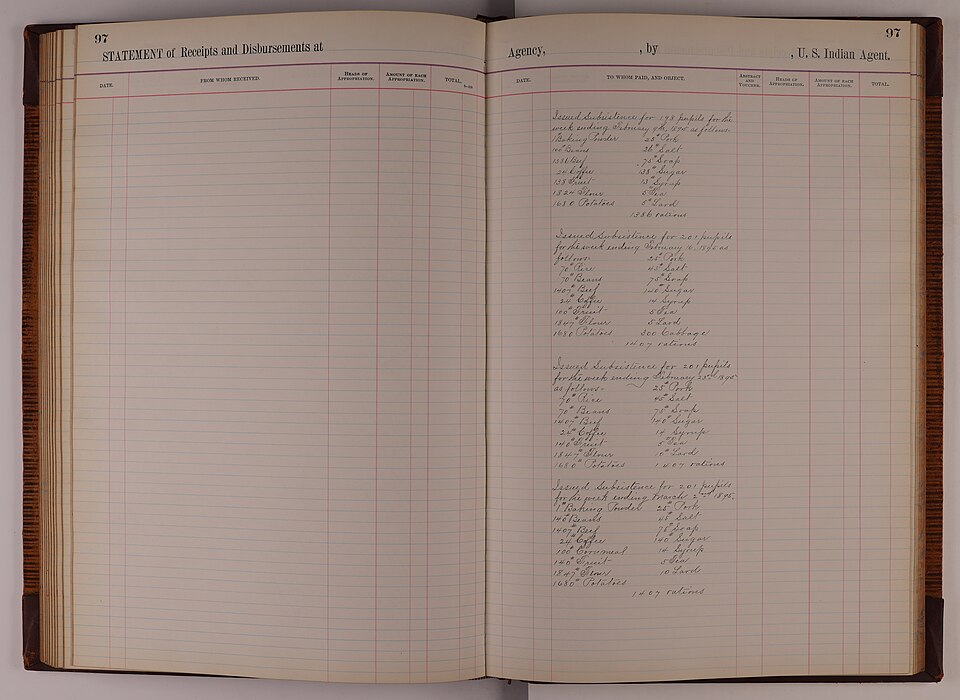 Double-column cash book layout (Image: Department of the Interior. Office of Indian Affairs. Fort S, Public domain, via Wikimedia Commons)
Based on the TU BTTM syllabus for Tourism and Hospitality Accounting, unit 5.
Discussion
Loading…