Tourism and Hospitality AccountingUnit 320 min read
Journal & Ledger: Recording, Posting & Trial Prep
Unit 3 of Tourism and Hospitality Accounting explains how to record transactions in journals, classify them in ledgers, and prepare for trial balances—using real-world examples from Nepali hotels, travel agencies, and eSewa’s payment processing.
TAKEAWAYS
- A journal is the first book of entry where transactions are recorded chronologically in debit-credit format before being posted to ledgers.
- The ledger is the principal book that classifies and summarizes transactions by account (e.g., Cash, Sales, Salaries).
- Posting transfers journal entries to ledger accounts using the double-entry system (every debit has a corresponding credit).
- Trial balance is a summary of ledger balances to check arithmetic accuracy before preparing financial statements.
- Special journals (e.g., Sales Journal, Purchase Journal) speed up recording for repetitive transactions in hospitality.
- Errors detected in journals/ledgers (e.g., omission, commission, reversal) must be corrected via suspense accounts or adjusting entries.
1. Journal: The First Book of Entry
Definition & Purpose
A journal is a chronological record of all financial transactions in a business. It serves as:
- The first point of recording transactions before they are classified in ledgers.
- A source document for verifying entries.
- A tool to detect errors early (e.g., missing entries, incorrect amounts).
In tourism and hospitality, journals record:
- Cash receipts from hotel guests (e.g., advance bookings).
- Payments to suppliers (e.g., Daraz orders for hotel linens).
- Salary payments to staff (e.g., tour guides, housekeeping).
Format of a Journal Entry
Every journal entry follows the double-entry principle:
Debit (Dr.) = Credit (Cr.) Total Dr. entries = Total Cr. entries
| Date       | Particulars (Narration)       | L.F. | Dr. (NPR) | Cr. (NPR) |
|------------|-------------------------------|------|-----------|-----------|
| 2080-03-10 | Cash received from Mr. ABC   |      | 50,000    |           |
|            | for hotel room advance        |      |           | 50,000    |
|            | (Cash A/c Dr., Advance A/c Cr.)|      |           |           |
Key Columns:
- Date: Transaction date (e.g.,
2080-03-10). - Particulars: Description of the transaction (e.g., "Cash received from Mr. ABC for hotel room advance").
- L.F.: Ledger Folio (page number where the entry is posted).
- Dr./Cr.: Amounts in Nepali Rupees (NPR).
Types of Journals
| Journal Type | Purpose | Example in Tourism/Hospitality |
|---|---|---|
| General Journal | Records non-routine transactions (e.g., corrections, adjustments). | Recording depreciation of a hotel’s minibus. |
| Sales Journal | Records credit sales (e.g., tour packages sold on installment). | A travel agency selling a Kathmandu-Pokhara tour for NPR 25,000. |
| Purchase Journal | Records credit purchases (e.g., buying food supplies from a supplier). | Buying NPR 10,000 worth of snacks for a trekking agency. |
| Cash Receipts Journal | Records cash inflows (e.g., guest payments at reception). | A guest pays NPR 15,000 cash for a room at Hotel Himalaya. |
| Cash Payments Journal | Records cash outflows (e.g., paying utility bills). | Paying NPR 8,000 for electricity to NTC. |
Worked Example: Journal Entry for a Nepali Hotel
Scenario: Hotel Everest receives NPR 120,000 from a corporate client for a 10-room booking. The client pays 50% in cash and the rest via bank transfer.
| Date       | Particulars                                      | L.F. | Dr. (NPR) | Cr. (NPR) |
|------------|--------------------------------------------------|------|-----------|-----------|
| 2080-03-15 | Cash received from ABC Corp. for room booking    |      | 60,000    |           |
|            | (Cash A/c Dr., Advance from Clients A/c Cr.)    |      |           | 60,000    |
| 2080-03-15 | Bank transfer received from ABC Corp.            |      |           | 60,000    |
|            | (Bank A/c Dr., Advance from Clients A/c Cr.)    |      | 60,000    |           |
Narration: "Received advance payment for 10 rooms from ABC Corp. (50% cash, 50% bank)."
2. Ledger: The Principal Book of Accounts
Definition & Purpose
A ledger is a book of final entry where transactions from journals are classified and summarized by account. It provides:
- A complete record of each account (e.g., Cash, Sales, Salaries).
- The balance of each account (debit or credit).
- Data for preparing financial statements (e.g., Income Statement, Balance Sheet).
Format of a Ledger Account
Each ledger account has:
- Account Title (e.g., Cash, Sales, Salaries).
- Date, Particulars, Journal Folio (J.F.), Dr./Cr. Amount.
- Balance (calculated as: Total Dr. – Total Cr. or vice versa).
| Date       | Particulars                          | J.F. | Dr. (NPR) | Cr. (NPR) | Balance (NPR) |
|------------|--------------------------------------|------|-----------|-----------|---------------|
| 2080-03-10 | To Cash (Advance received)           | 1    | 50,000    |           | 50,000 Dr.    |
| 2080-03-15 | To ABC Corp. (Room booking advance)  | 2    | 60,000    |           | 110,000 Dr.   |
| 2080-03-20 | By Salaries Paid                     | 3    |           | 20,000    | 90,000 Dr.    |
Key Columns:
- J.F.: Journal Folio (page number in the journal).
- Balance: Shows whether the account is debit or credit balanced.
How to Post from Journal to Ledger
- Identify the accounts involved in the journal entry (e.g., Cash and Advance from Clients).
- Locate the ledger accounts for each.
- Record the date, particulars, and amount in the ledger.
- Reference the journal page (J.F.) in the ledger.
- Calculate the balance after each entry.
Example Trace: From the journal entry above for Hotel Everest, post to the Cash Account:
| Date       | Particulars                          | J.F. | Dr. (NPR) | Cr. (NPR) | Balance (NPR) |
|------------|--------------------------------------|------|-----------|-----------|---------------|
| 2080-03-15 | To ABC Corp. (Advance received)     | 2    | 60,000    |           | 60,000 Dr.    |
3. The Double-Entry System in Action
Why Double-Entry?
- Ensures accuracy (every transaction affects at least two accounts).
- Helps detect errors (if debits ≠ credits, an error exists).
- Provides a complete picture of financial health.
Worked Example: Full Cycle for a Travel Agency
Scenario: Adventure Tours Nepal buys a new van for NPR 3,000,000 (cash payment) and takes a bank loan of NPR 1,500,000 for the remaining amount.
Step 1: Journal Entry
| Date       | Particulars                                      | L.F. | Dr. (NPR) | Cr. (NPR) |
|------------|--------------------------------------------------|------|-----------|-----------|
| 2080-03-20 | Van purchased (Cash paid)                        |      | 1,500,000 |           |
|            | (Van A/c Dr., Cash A/c Cr.)                     |      |           | 1,500,000 |
| 2080-03-20 | Loan from NMB Bank                               |      |           | 1,500,000 |
|            | (Bank Loan A/c Dr., Bank A/c Cr.)               |      | 1,500,000 |           |
Step 2: Post to Ledger Accounts
- Van Account:
| Date | Particulars | J.F. | Dr. (NPR) | Cr. (NPR) | Balance (NPR) | |------------|-----------------------|------|-----------|-----------|---------------| | 2080-03-20 | By Cash & Loan | 1 | 3,000,000 | | 3,000,000 Dr.| - Cash Account:
| Date | Particulars | J.F. | Dr. (NPR) | Cr. (NPR) | Balance (NPR) | |------------|-----------------------|------|-----------|-----------|---------------| | 2080-03-20 | To Van Purchase | 1 | | 1,500,000 | 1,500,000 Cr.| - Bank Loan Account:
| Date | Particulars | J.F. | Dr. (NPR) | Cr. (NPR) | Balance (NPR) | |------------|-----------------------|------|-----------|-----------|---------------| | 2080-03-20 | By Bank | 1 | 1,500,000 | | 1,500,000 Dr.| - Bank Account:
| Date       | Particulars          | J.F. | Dr. (NPR) | Cr. (NPR) | Balance (NPR) |
|------------|-----------------------|------|-----------|-----------|---------------|
| 2080-03-20 | To Loan Received      | 1    | 1,500,000 |           | 1,500,000 Dr.|
4. The Accounting Cycle: Journal → Ledger → Trial Balance
flowchart TD
    A["Transaction Occurs"] --> B["Record in Journal"]
    B --> C["Post to Ledger"]
    C --> D["Prepare Trial Balance"]
    D --> E["Adjusting Entries"]
    E --> F["Final Accounts<br/>(Income Statement & Balance Sheet)"]
    F --> G["Close Books"]
    G --> A
Key Steps Explained
- Transaction Occurs: E.g., Hotel Thamel buys furniture for NPR 800,000 (50% cash, 50% credit).
- Journal Entry: Recorded in the General Journal.
- Post to Ledger: Entries are transferred to:
- Furniture Account (Dr.)
- Cash Account (Cr.)
- Creditor Account (Cr.)
- Trial Balance: Summarizes all ledger balances to check arithmetic accuracy.
- Adjusting Entries: E.g., recording depreciation on the furniture.
- Final Accounts: Prepare Income Statement and Balance Sheet.
- Close Books: Reset temporary accounts (e.g., Revenue, Expenses) for the next period.
5. Common Errors and Corrections
| Error Type | Example | Correction Method |
|---|---|---|
| Omission | Forgetting to record a transaction. | Record the missing entry in the journal. |
| Commission | Recording the wrong account (e.g., Dr. to Salaries instead of Rent). | Reverse the incorrect entry and record the correct one. |
| Reversal | Recording Dr. where Cr. should be (and vice versa). | Reverse the entry (e.g., if Dr. was wrong, make it Cr.). |
| Compensating Error | Two errors cancel each other out (e.g., overstating an asset and understating a liability by the same amount). | Use a Suspense Account to temporarily hold the error until corrected. |
| Partial Omission | Recording only one side of a transaction. | Complete the missing side (e.g., if only Dr. is recorded, add the Cr.). |
Example Correction: Error: Hotel Annapurna recorded a NPR 50,000 payment to a supplier as:
| Date       | Particulars          | Dr. (NPR) | Cr. (NPR) |
|------------|-----------------------|-----------|-----------|
| 2080-03-25 | To Supplier X         | 50,000    |           |
Correction:
- Identify the error: Only the Dr. side is recorded (missing Cr.).
- Correct Entry:
| Date       | Particulars          | Dr. (NPR) | Cr. (NPR) |
|------------|-----------------------|-----------|-----------|
| 2080-03-25 | By Cash Paid to Supplier X |           | 50,000    |
6. Special Journals in Tourism & Hospitality
Why Use Special Journals?
- Saves time: Repetitive transactions (e.g., daily sales) are recorded quickly.
- Reduces errors: Standardized formats minimize mistakes.
- Improves efficiency: Separates routine transactions from irregular ones.
Example: Sales Journal for a Travel Agency
Scenario: Everest Tours sells 3 tour packages in a day:
- Everest Base Camp Trek: NPR 45,000 (credit).
- Pokhara Lakes Tour: NPR 20,000 (cash).
- Chitwan Safari: NPR 30,000 (credit).
Sales Journal:
| Date       | Invoice No. | Customer Name       | Amount (NPR) | Dr. (Sales A/c) | Cr. (A/R A/c) |
|------------|-------------|----------------------|---------------|-----------------|---------------|
| 2080-03-25 | INV-001     | Mr. ABC              | 45,000        | 45,000          | 45,000        |
| 2080-03-25 | INV-002     | Mr. XYZ              | 30,000        | 30,000          | 30,000        |
| 2080-03-25 | Cash        | Mr. PQR              | 20,000        | 20,000          |               |
Posting to Ledger:
- Sales Account (Dr.):
| Date | Particulars | J.F. | Dr. (NPR) | Cr. (NPR) | Balance (NPR) | |------------|-----------------------|------|-----------|-----------|---------------| | 2080-03-25 | To A/R (INV-001) | 1 | 45,000 | | 95,000 Dr. | | 2080-03-25 | To A/R (INV-002) | 1 | 30,000 | | | | 2080-03-25 | To Cash (INV-003) | 1 | 20,000 | | | - Accounts Receivable (A/R) Account (Cr.):
| Date       | Particulars          | J.F. | Dr. (NPR) | Cr. (NPR) | Balance (NPR) |
|------------|-----------------------|------|-----------|-----------|---------------|
| 2080-03-25 | By Sales (INV-001)   | 1    |           | 45,000    | 75,000 Cr.    |
| 2080-03-25 | By Sales (INV-002)   | 1    |           | 30,000    |               |
In the Real World
eSewa & Khalti (Digital Payments)
- Idea Used: Journal Entries for Cash Receipts/Payments
- How: When you book a flight via eSewa or pay a hotel bill via Khalti, the transaction is first recorded in the Cash Receipts Journal of the service provider. For example:
- If Hotel Thamel receives NPR 20,000 via Khalti for a room, their journal entry would be:
| Date | Particulars | Dr. (NPR) | Cr. (NPR) | |------------|-----------------------|-----------|-----------| | 2080-03-30 | To Khalti Payment | 20,000 | | | | (Cash A/c Dr., Sales A/c Cr.) | | 20,000 | - This entry is then posted to the Cash Ledger and Sales Ledger.
- If Hotel Thamel receives NPR 20,000 via Khalti for a room, their journal entry would be:
Daraz (E-Commerce Orders)
- Idea Used: Purchase Journal & Accounts Payable
- How: When Hotel Himalaya orders NPR 50,000 worth of toiletries from Daraz on credit, Daraz’s system records this as:
- Daraz’s Journal (as a supplier):
| Date | Particulars | Dr. (NPR) | Cr. (NPR) | |------------|-----------------------|-----------|-----------| | 2080-03-28 | To Hotel Himalaya | 50,000 | | | | (A/R A/c Dr., Sales A/c Cr.) | | 50,000 | - Hotel’s Journal (as a buyer):
| Date       | Particulars          | Dr. (NPR) | Cr. (NPR) |
|------------|-----------------------|-----------|-----------|
| 2080-03-28 | By Daraz (Purchase)   |           | 50,000    |
|            | (Purchase A/c Dr., A/P A/c Cr.) | 50,000    |           |
- Daraz’s Journal (as a supplier):
Nepal Rastra Bank (NRB) & Bank Reconciliation
- Idea Used: Cash Book vs. Bank Statement Reconciliation
- How: Banks like NMB or Global IME use Cash Books to record deposits/withdrawals. For example:
- If Adventure Tours deposits NPR 100,000 in NMB but the bank statement shows only NPR 95,000 (due to a pending cheque), the bank’s ledger would show:
| Date | Particulars | Dr. (NPR) | Cr. (NPR) | Balance (NPR) | |------------|-----------------------|-----------|-----------|---------------| | 2080-03-29 | To Customer Deposit | 95,000 | | 95,000 Dr. | - The Suspense Account would hold the NPR 5,000 discrepancy until the cheque clears.
- If Adventure Tours deposits NPR 100,000 in NMB but the bank statement shows only NPR 95,000 (due to a pending cheque), the bank’s ledger would show:
Exam Tip
Memorize the Journal Formats:
- Always include Date, Particulars, L.F./J.F., Dr./Cr. Amounts, and Narration.
- Narration is critical in exams—describe why the transaction occurred (e.g., "Received advance for tour packages").
Posting to Ledger is a High-Score Area:
- Examiners check if you:
- Correctly reference the journal folio (J.F.).
- Calculate balances accurately (Dr. or Cr.).
- Trace entries from journal to ledger (e.g., "Post the following journal entry to the Cash Ledger").
- Examiners check if you:
Common Exam Questions:
- Prepare a Journal Entry for: Hotel room bookings, tour package sales, salary payments, utility bill payments.
- Post to Ledger: Given a journal entry, post it to 2–3 ledger accounts.
- Detect Errors: Given a trial balance with discrepancies, identify and correct errors (e.g., "The trial balance does not agree; find and correct the error").
- Special Journals: Prepare a Sales Journal or Purchase Journal from given data.
Real-World Application Questions:
- Expect scenarios like:
- "Hotel Kathmandu received NPR 50,000 cash from a guest and NPR 30,000 via bank transfer for a 5-day package. Journalize and post to ledger."
- "A travel agency bought office equipment for NPR 200,000, paying 40% cash and the rest on credit. Show the journal entry and ledger postings."
- Expect scenarios like:
Avoid These Mistakes:
- Forgetting to balance ledger accounts: Always calculate the balance after each entry.
- Incorrect narration: Narration should explain the economic substance (e.g., not just "Cash received" but "Cash received from Mr. ABC for Everest Base Camp Trek").
- Mismatched Dr./Cr.: Ensure every journal entry has equal debits and credits.
Practice Question (Worked Solution)
Question: Hotel Annapurna recorded the following transactions in March 2080:
- Received NPR 80,000 cash from a corporate client for a 10-room booking.
- Paid NPR 30,000 cash for salaries to housekeeping staff.
- Purchased furniture for NPR 150,000, paying NPR 50,000 cash and the rest on credit to Furniture Mart.
- Received NPR 20,000 via bank transfer from a guest for a room advance.
Tasks: A. Journalize the transactions. B. Post the first transaction to the Cash Ledger and Advance from Clients Ledger. C. Identify one error if the trial balance totals do not match.
Solution:
A. Journal Entries
| Date       | Particulars                                      | L.F. | Dr. (NPR) | Cr. (NPR) |
|------------|--------------------------------------------------|------|-----------|-----------|
| 2080-03-01 | Cash received from XYZ Corp. for room booking    |      | 80,000    |           |
|            | (Cash A/c Dr., Advance from Clients A/c Cr.)    |      |           | 80,000    |
| 2080-03-05 | Salaries paid to housekeeping staff              |      | 30,000    |           |
|            | (Salaries A/c Dr., Cash A/c Cr.)                 |      |           | 30,000    |
| 2080-03-10 | Furniture purchased from Furniture Mart          |      | 150,000   |           |
|            | (Furniture A/c Dr., Cash A/c Cr., Creditors A/c Cr.) |      | 50,000    | 100,000    |
| 2080-03-15 | Bank transfer received from guest for advance    |      |           | 20,000    |
|            | (Bank A/c Dr., Advance from Clients A/c Cr.)    |      | 20,000    |           |
B. Post to Ledger Accounts
Cash Ledger:
| Date       | Particulars                          | J.F. | Dr. (NPR) | Cr. (NPR) | Balance (NPR) |
|------------|--------------------------------------|------|-----------|-----------|---------------|
| 2080-03-01 | To XYZ Corp. (Advance received)      | 1    | 80,000    |           | 80,000 Dr.    |
| 2080-03-05 | By Salaries Paid                     | 2    |           | 30,000    | 50,000 Dr.    |
| 2080-03-10 | By Furniture Purchase                | 3    |           | 50,000    | 0 Dr.         |
Advance from Clients Ledger:
| Date       | Particulars                          | J.F. | Dr. (NPR) | Cr. (NPR) | Balance (NPR) |
|------------|--------------------------------------|------|-----------|-----------|---------------|
| 2080-03-01 | By Cash (XYZ Corp.)                  | 1    |           | 80,000    | 80,000 Cr.    |
| 2080-03-15 | By Bank (Guest Advance)              | 4    |           | 20,000    | 100,000 Cr.   |
C. Error Detection
If the trial balance does not match:
- Possible Error: In the furniture transaction, the total Dr. (150,000) ≠ total Cr. (50,000 + 100,000).
- Correction: The Creditors Account should be credited with NPR 100,000 (not NPR 100,000 Cr. is correct here, but if the journal had only credited NPR 50,000, the error would be:
- Missing Cr. of NPR 50,000 to Creditors.
- Solution: Add the missing entry:
| Date | Particulars | Dr. (NPR) | Cr. (NPR) | |------------|-----------------------|-----------|-----------| | 2080-03-10 | By Furniture Mart | | 50,000 | | | (Creditors A/c Dr., Cash A/c Cr.) | 50,000 | | - Note: In this case, the journal entry was correct, but if the Creditors Account was not posted, the trial balance would still not match. Always verify postings to ledgers.
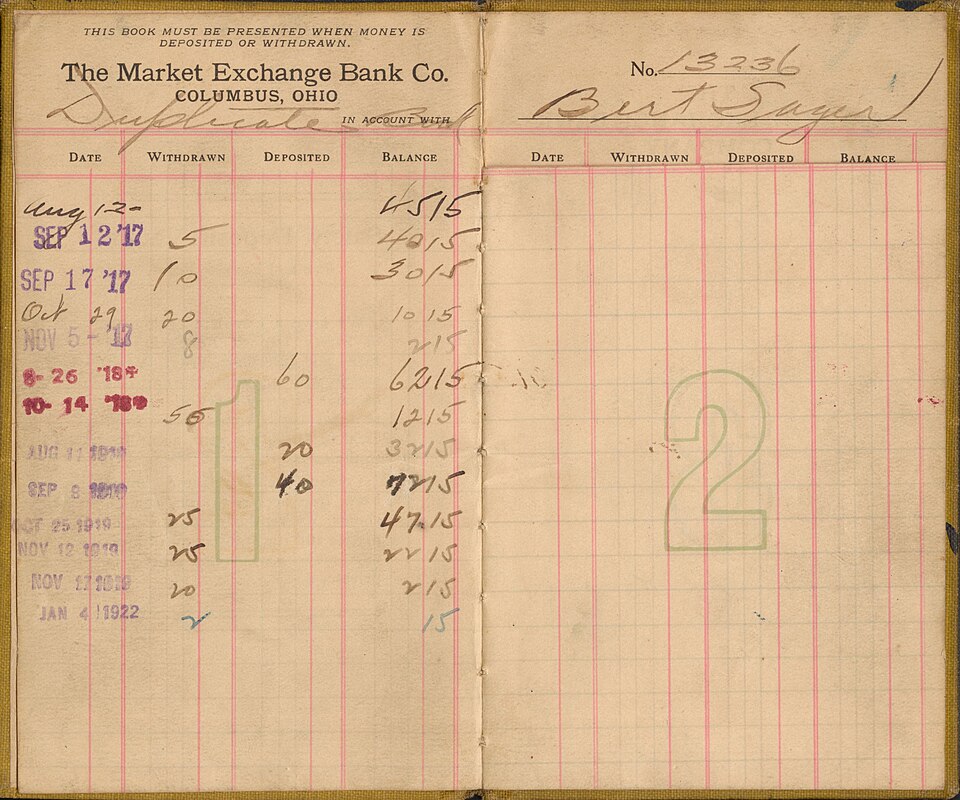 A ledger account showing Dr./Cr. sides, particulars, and balance calculation. (Image: Market Exchange Bank Company, Public domain, via Wikimedia Commons)
Based on the TU BTTM syllabus for Tourism and Hospitality Accounting, unit 3.
Discussion
Loading…