Air Travel OperationsUnit 111 min read
Aviation Basics: History, Aircraft, Airlines & Global Impact
Unit 1 of Air Travel Operations covers the origins of aviation, types of aircraft, airline business models, and the role of air travel in global connectivity, with a focus on Nepal’s aviation sector and key industry terms.
1. The Birth of Aviation: From Dreams to Reality
1.1 Early Pioneers and Milestones
Aviation began with human curiosity about flight. Key milestones include:
- 1783: First manned hot-air balloon flight by the Montgolfier brothers (France).
- 1903: Wright brothers (USA) achieved the first powered, controlled, and sustained heavier-than-air manned flight.
- 1919: First transatlantic flight by Alcock and Brown (UK).
- 1927: Charles Lindbergh’s solo nonstop flight across the Atlantic.
1.2 Why Aviation Matters
Aviation revolutionized global travel, trade, and communication. Before airplanes, long-distance travel took weeks or months. Today, a flight from Kathmandu to Dubai takes just 3 hours, compared to 30+ days by ship in the 19th century.
2. Types of Aircraft: From Small Planes to Jumbo Jets
Aircraft are classified based on size, purpose, and technology. The two main categories are:
| Category | Description | Examples | Used By |
|---|---|---|---|
| General Aviation | Small planes for private, training, or short-distance travel. | Cessna 172, Piper Cherokee | Flying clubs, pilots-in-training |
| Commercial Aviation | Large aircraft for passenger and cargo transport. | Boeing 737, Airbus A320, Boeing 787 | Nepal Airlines, Buddha Air |
| Military Aviation | Designed for defense, reconnaissance, or combat. | F-16, MiG-29, C-130 Hercules | Nepal Army, RAF |
| Helicopters | Vertical takeoff/landing (VTOL) for short hops or emergency services. | Airbus H145, Bell 407 | Nepal Army, Helicopter Services |
2.1 How Airplanes Fly: The Four Forces
An airplane stays in the air due to a balance of four forces:
- Lift (upward force from wings).
- Thrust (forward force from engines).
- Drag (air resistance).
- Weight (gravity pulling down).
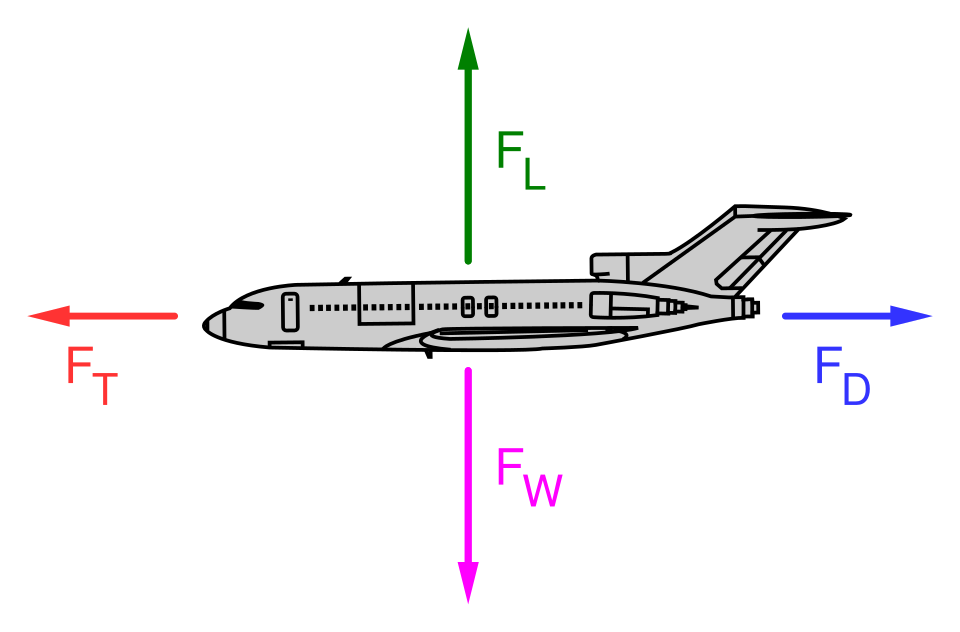 The four forces acting on an Airbus A320 during flight. (Image: MikeRun, CC BY-SA 4.0, via Wikimedia Commons)
2.2 Parts of an Airplane (External View)
3. The Airline Business: How Airlines Make Money
Airlines operate like transportation companies but with unique challenges:
- High fixed costs (aircraft, fuel, airport fees).
- Perishable inventory (empty seats = lost revenue).
- Regulation-heavy (safety, environmental, and government rules).
3.1 Revenue Streams for Airlines
| Source | Description | Example in Nepal |
|---|---|---|
| Passenger Fares | Ticket sales (economy, business, first class). | Nepal Airlines, Buddha Air |
| Cargo Services | Shipping goods (perishables, electronics, mail). | Yeti Airlines (cargo flights) |
| Ancillary Revenue | Extra fees (baggage, seat selection, food). | "Pay for priority boarding" on Yeti Airlines |
| Government Contracts | Military or VIP transport. | Nepal Army charters |
| Leasing Aircraft | Renting planes from other airlines or lessors. | Nepal Airlines leasing Airbus A320s |
3.2 Cost Structure of an Airline
A typical airline’s costs break down as:
- Fuel: ~30% of total costs (most volatile).
- Labor: ~20% (pilots, cabin crew, ground staff).
- Aircraft Maintenance: ~15%.
- Airport Fees: ~10% (landing, parking, security).
- Marketing & Administration: ~10%.
- Insurance & Taxes: ~15%.
4. Aviation in Nepal: Challenges and Opportunities
Nepal’s aviation sector is small but growing, with key players:
- Nepal Airlines (flag carrier, operates international routes).
- Buddha Air (budget-friendly, connects major cities).
- Yeti Airlines (cargo + passenger, expanding routes).
- Simrik Airlines (regional flights to Pokhara, Bharatpur).
4.1 Key Challenges
| Challenge | Impact | Example |
|---|---|---|
| Mountainous Terrain | Short runways, weather delays, high-altitude operations. | Tribhuvan International Airport (KTM) at 1,398m |
| Limited Infrastructure | Few modern airports, poor ground handling. | Bharatpur Airport lacks advanced radar. |
| Fuel Costs | High due to import dependency. | Nepal Airlines spends ~$50M/year on fuel. |
| Safety Concerns | Past accidents (e.g., 2018 Yeti Airlines crash). | Stricter CAAN regulations now in place. |
| Competition from India | Cheaper flights from Indian carriers (IndiGo, SpiceJet). | Kathmandu-Delhi fares drop when IndiGo enters. |
4.2 Opportunities
- Tourism Growth: More international flights to Pokhara, Chitwan, and Lukla.
- Cargo Expansion: Demand for medical and perishable goods.
- Low-Cost Carriers (LCCs): Potential for budget airlines like Pathao Air (if launched).
- Helicopter Services: Rescue missions, sightseeing (e.g., Annapurna Base Camp).
## In the Real World
eSewa & Air Ticket Bookings
- How it uses aviation concepts: eSewa partners with airlines (Nepal Airlines, Buddha Air) to sell tickets online. When you book a flight via eSewa, you’re directly interacting with IATA’s airline codes (e.g., RNA for Nepal Airlines) and freedoms of the air (Unit 3), which allow airlines to operate between Nepal and other countries.
- Real example: Booking a Kathmandu-Doha flight via eSewa involves selecting an airline (Qatar Airways, QTR), paying via mobile banking, and receiving an e-ticket—all governed by IATA’s BSP (Billing and Settlement Plan).
Pathao’s Future in Air Travel
- How it uses aviation concepts: Pathao, known for ride-hailing, is exploring helicopter services for urban transport in Kathmandu. This would use VTOL (Vertical Takeoff and Landing) technology, similar to AirAsia’s planned "flying taxi" service in Singapore.
- Real example: If Pathao launches drone or helicopter services, it would need CAAN (Civil Aviation Authority of Nepal) approval, just like Nepal Helicopter Services does today.
Nepal Airlines’ Cargo Operations
- How it uses aviation concepts: Nepal Airlines transports medical supplies, relief goods, and perishables (e.g., fruits to India). During the COVID-19 pandemic, they flew oxygen cylinders and vaccines under IATA’s Pharma Cargo guidelines.
- Real example: In 2021, Nepal Airlines chartered a flight to bring 100,000 COVID-19 vaccine doses from India to Kathmandu, using specialized cargo aircraft like the Boeing 747F.
## Worked Example: Calculating Flight Time with Wind
Scenario: A flight from Kathmandu (KTM) to Delhi (DEL) is 1,500 km without wind. The airplane’s airspeed (speed in still air) is 800 km/h. However, there’s a headwind of 50 km/h (wind blowing against the plane). Question: How long will the flight take?
Solution:
- Effective speed = Airspeed – Headwind = 800 km/h – 50 km/h = 750 km/h.
- Time = Distance / Speed = 1,500 km / 750 km/h = 2 hours.
Real-world tie-in: This is how Nepal Airlines adjusts flight times when flying from Kathmandu to Varanasi during the monsoon, when winds can slow planes down.
## Exam Tip
Memorize Key Definitions:
- Aviation: The design, development, and operation of aircraft.
- Airline: A company providing scheduled flights for passengers/cargo.
- General Aviation vs. Commercial Aviation: Know the difference (see table above).
Understand the Four Forces:
- Lift > Weight = Plane flies.
- Thrust > Drag = Plane moves forward.
- Exam trick: If asked why a plane stalls, say "Lift drops below weight" due to low speed or angle.
Nepal-Specific Questions:
- Expect questions on Nepal Airlines, CAAN, and major airports (KTM, PKR, LUA).
- Know one challenge and one opportunity for Nepal’s aviation sector.
Diagrams Are Your Friends:
- Draw the four forces on an airplane.
- Label an airplane’s external parts (fuselage, wings, engines).
- Sketch a timeline of aviation milestones (Wright brothers, Lindbergh, etc.).
Real-World Applications:
- Relate eSewa bookings to IATA codes.
- Link Pathao’s potential helicopter service to VTOL technology.
- Connect Nepal Airlines’ cargo to global supply chains.
## Quick Revision Checklist
Before the exam, ensure you can: ✅ Define aviation and list 3 milestones. ✅ Differentiate between general, commercial, and military aviation. ✅ Explain the four forces acting on an airplane. ✅ Name 2 Nepalese airlines and 1 challenge they face. ✅ Calculate flight time with wind (like the worked example). ✅ Describe how eSewa or Pathao uses aviation concepts.
Based on the TU BTTM syllabus for Air Travel Operations, unit 1.
Discussion
Loading…