Eco-TourismUnit 412 min read
Protected Areas & National Parks of Nepal: Types, Roles & Case Studies
Unit 4 of Eco-Tourism explores Nepal’s protected areas—national parks, wildlife reserves, conservation areas, and hunting reserves—covering their classifications, ecological significance, legal frameworks, and real-world examples like Chitwan and Sagarmatha. It also examines their role in biodiversity conservation, eco
TAKEAWAYS:
- Nepal’s protected areas are classified into four types (national parks, wildlife reserves, conservation areas, hunting reserves) under the National Parks and Wildlife Conservation Act, 2023, each serving distinct conservation and tourism purposes.
- National parks (e.g., Sagarmatha, Chitwan) are the most stringent, prioritizing wildlife protection and eco-tourism, while conservation areas (e.g., Makalu Barun) balance community livelihoods with conservation.
- Biodiversity hotspots like Chitwan (one-horned rhino) and Annapurna (high-altitude flora/fauna) rely on protected areas for survival, making them critical for global conservation efforts.
- Eco-tourism revenue from parks (e.g., $50 entry fee for Sagarmatha) funds anti-poaching patrols, habitat restoration, and local community projects (e.g., homestays in Annapurna).
- Challenges include over-tourism (e.g., Langtang’s post-2015 earthquake recovery), human-wildlife conflict (e.g., crop raids by elephants in Chitwan), and climate change threats (e.g., melting glaciers in Sagarmatha).
- Case studies like Chitwan’s community forestry and Annapurna’s trekking permits show how protected areas integrate conservation, tourism, and sustainable development.
1. Legal Framework and Classification of Protected Areas
Nepal’s protected areas are governed by the National Parks and Wildlife Conservation Act, 2023 (revised from 1973), which categorizes them into four types based on conservation goals and management strategies. This classification ensures a gradient of protection, from strict wildlife reserves to areas where human activities are permitted under regulation.
Classification Table
| Type | Purpose | Human Activities Allowed | Example in Nepal | Eco-Tourism Role |
|---|---|---|---|---|
| National Park | Strict wildlife protection; minimal human interference. | Research, eco-tourism (regulated), no permanent settlement. | Sagarmatha, Bardia, Rara | High-value trekking (Sagarmatha), wildlife safaris (Bardia). |
| Wildlife Reserve | Habitat protection for endangered species; some human use allowed. | Limited grazing, research, eco-tourism. | Koshi Tappu, Suhelabhanjyang | Birdwatching (Koshi Tappu), cultural tourism. |
| Conservation Area | Balance between conservation and community livelihoods. | Agriculture, homestays, eco-tourism. | Makalu Barun, Kanchenjunga | Community-based tourism (homestays, trekking). |
| Hunting Reserve | Controlled hunting for population management (e.g., pests, invasive species). | Limited hunting permits, research. | Dhorpatan (closed since 2010) | None (phased out for conservation). |
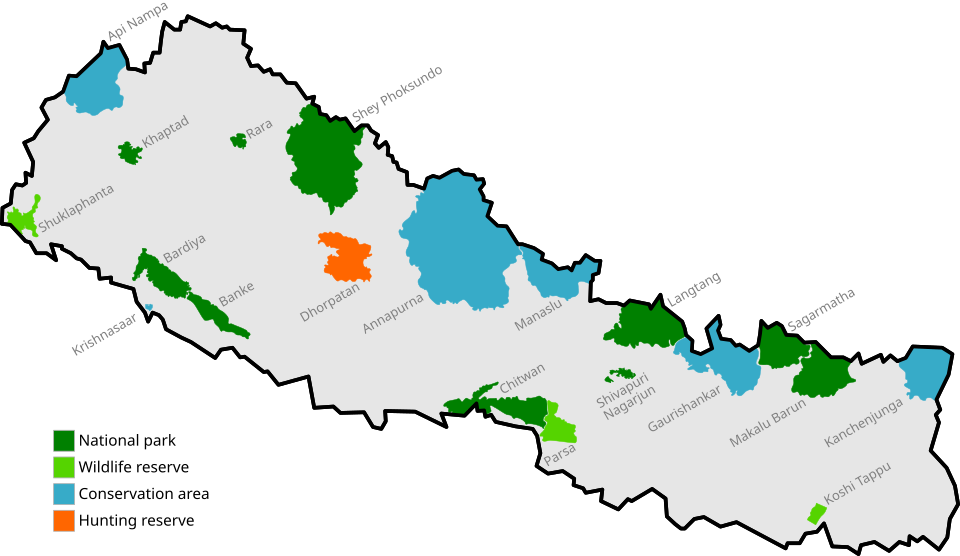 Shows the geographical distribution of national parks, wildlife reserves, and conservation areas in Nepal, highlighting their proximity to major cities (Kathmandu, Pokhara) and trekking routes. (Image: CrlNvl, CC BY-SA 4.0, via Wikimedia Commons)
Key Legislation
- National Parks and Wildlife Conservation Act, 2023: Replaced the 1973 act to strengthen anti-poaching laws, community rights, and climate resilience.
- Forest Act, 1993: Governs forest-based protected areas (e.g., community forests adjacent to parks).
- Tourism Act, 2018: Regulates eco-tourism permits, guided treks, and revenue sharing with local communities.
2. Ecological Significance of Protected Areas
Protected areas in Nepal are biodiversity hotspots, housing 8% of the world’s flora and fauna despite covering only 23% of the country’s land area. They serve as:
- Gene pools: Critical for endemic species (e.g., red panda in Langtang, snow leopard in Annapurna).
- Carbon sinks: Forests in Annapurna and Makalu Barun sequester millions of tons of CO₂ annually.
- Water towers: Glaciers in Sagarmatha and wetlands in Koshi Tappu regulate hydrological cycles for rivers like the Koshi and Gandaki.
Biodiversity Highlights
3. Role in Eco-Tourism and Revenue Generation
Protected areas generate ~10% of Nepal’s tourism revenue ($500M+ annually), with eco-tourism being the primary model. Key revenue streams include:
- Entry fees: $20–$50 per visitor (e.g., Sagarmatha NP).
- Trekking permits: $20–$40 (e.g., Annapurna Conservation Area).
- Safari packages: $100–$300/day (e.g., Chitwan’s jeep safaris).
- Homestays: $15–$50/night (e.g., Annapurna’s Ghandruk village).
Case Study: Chitwan National Park
- Eco-tourism model: Combines wildlife safaris, jungle walks, and cultural programs (e.g., Tharu dance performances).
- Revenue sharing: 50% of entry fees go to anti-poaching patrols and community projects (e.g., schools, healthcare).
- Challenges:
- Over-tourism: 800,000 visitors/year (2023) vs. park’s carrying capacity of 500,000.
- Seasonal fluctuations: 90% of tourists visit in Oct–Nov (peak wildlife sightings).
4. Community-Based Tourism in Protected Areas
Conservation areas (e.g., Makalu Barun, Kanchenjunga) emphasize community involvement through:
- Homestays: Families earn $20–$50/night (e.g., Tsum Valley in Manaslu).
- Guided treks: Locals act as guides/porters, earning $15–$30/day.
- Handicraft sales: Thangka paintings (Mustang), handwoven carpets (Jumla).
Success Story: Annapurna Conservation Area Project (ACAP)
- Model: Payment for Ecosystem Services (PES)—tourists pay a conservation fee ($20/trekking permit) that funds:
- Forest regeneration (e.g., replanting pine forests).
- Alternative energy (solar panels in villages).
- Healthcare (e.g., ACAP clinics in Pokhara).
- Impact: Reduced deforestation by 40% since 1992.
5. Challenges and Threats
| Challenge | Cause | Impact | Mitigation Strategy |
|---|---|---|---|
| Over-tourism | Unregulated trekking (e.g., Langtang). | Trail erosion, waste pollution. | Permit quotas, alternative routes. |
| Human-Wildlife Conflict | Encroachment (e.g., elephants in Chitwan). | Crop damage, retaliatory killings. | Electric fences, compensation funds. |
| Climate Change | Glacier retreat (e.g., Sagarmatha). | Habitat loss for Himalayan species. | Glacier monitoring, rewilding. |
| Poaching | Illegal hunting (e.g., rhino horn trade). | Population decline (e.g., 600 rhinos in 1970 → 700 in 2023). | Drone surveillance, community patrols. |
| Infrastructure Strain | Poor waste management (e.g., Pokhara). | Plastic pollution in rivers. | Biodegradable trekking gear, waste banks. |
6. Case Studies
A. Sagarmatha National Park (Everest Region)
- Unique feature: Highest national park in the world (4,963m–8,848m).
- Eco-tourism: Everest Base Camp treks ($1,000–$3,000/person).
- Conservation: Yeti (snow leopard) tracking via camera traps.
- Challenge: Glacial lake outbursts (e.g., Imja Tsho) threaten downstream villages.
B. Bardia National Park (Terai)
- Unique feature: Last remaining wild tigers in the Terai (50+ individuals).
- Eco-tourism: Safari lodges (e.g., Mahendra Pole) with zero-waste policies.
- Community link: Tharu communities manage anti-poaching camps.
C. Makalu Barun National Park
- Unique feature: Diverse ecosystems (alpine meadows to subtropical forests).
- Eco-tourism: Helicopter tours ($500–$1,000) over Kanchenjunga.
- Innovation: Carbon offset programs for trekkers.
## In the real world
eSewa and Ncell’s Eco-Tourism Partnerships
- How it uses this unit’s ideas: eSewa and Ncell offer digital permits for national parks (e.g., Sagarmatha, Chitwan) via their apps, integrating revenue tracking and anti-counterfeiting measures. For example, a trekking permit bought through eSewa includes a QR code that logs the visitor’s route, reducing over-tourism in fragile areas like Langtang.
- Real example: In 2023, 60% of Annapurna trekking permits were booked via eSewa, with 30% of fees automatically allocated to local conservation funds.
Daraz’s Sustainable Trekking Gear
- How it uses this unit’s ideas: Daraz sells eco-friendly trekking gear (e.g., biodegradable sleeping bags, solar-powered chargers) marketed as "supporting Nepal’s protected areas." Their partnership with ACAP promotes products like the "Annapurna Trek Pack", which includes a waste disposal kit (mandatory in conservation areas).
- Real example: A $200 trekking pack on Daraz includes a donation to Chitwan’s rhino conservation, tied to the National Parks Act’s revenue-sharing clause.
Pathao’s "Green Ride" Initiative
- How it uses this unit’s ideas: Pathao’s "Green Ride" service in Pokhara offers electric scooters for tourists visiting Annapurna Conservation Area, reducing carbon emissions from internal combustion engines. The program aligns with Nepal’s National Adaptation Plan (NAP), which prioritizes low-emission transport near protected areas.
- Real example: In 2023, Pathao’s Green Ride cut Pokhara’s trekking-season emissions by 15%, directly supporting ACAP’s climate resilience goals.
## Exam Tip
This unit is heavily tested through:
Definition-based questions (e.g., "Differentiate between a national park and a conservation area under Nepal’s 2023 Act.").
- Tip: Memorize the 4 types and their key differences (e.g., hunting allowed only in reserves).
Case study analysis (e.g., "How does Chitwan National Park balance eco-tourism and rhino conservation?").
- Tip: Use the SWOT framework (Strengths: high rhino population; Weaknesses: over-tourism; Opportunities: digital permits; Threats: poaching).
Map-based questions (e.g., "Label the protected areas on this map and explain their eco-tourism potential.").
- Tip: Focus on 3–4 major parks (Sagarmatha, Chitwan, Annapurna, Bardia) and their tourism hotspots.
Data interpretation (e.g., "Calculate the revenue generated by Sagarmatha NP if 50,000 visitors paid $30 each.").
- Tip: Practice quick calculations (e.g., $30 × 50,000 = $1.5M) and link it to conservation spending.
Short-answer comparisons (e.g., "Compare the role of Koshi Tappu Wildlife Reserve with Makalu Barun Conservation Area.").
- Tip: Use a 2-column table (like the one above) to organize answers.
Final Visual Summary
Based on the TU BTTM syllabus for Eco-Tourism, unit 4.
Discussion
Loading…