French Language IUnit 39 min read
Numbers, Days & Months in French – Essential Vocabulary & Usage
Unit 3 of French Language I covers cardinal and ordinal numbers (0–100+), days of the week, months, and their correct pronunciation and usage in travel/tourism contexts (e.g., dates, times, prices, and itineraries).
Key Vocabulary: Numbers
French numbers differ from English in pronunciation, spelling, and usage (e.g., 1–20 are irregular, 21–69 follow a pattern, and 70–99 use compound forms). Mastering them is critical for prices, dates, times, and phone numbers in tourism.
1. Cardinal Numbers (0–100+)
French numbers are pronounced differently from their English equivalents. Below is a comparison table with audio cues (listen to Forvo for accuracy):
| English | French (Pronunciation) | Example Usage |
|---|---|---|
| 0 | zéro (zeh-roh) | Le prix est zéro rupees. |
| 1 | un (uhn) / une (uun) | J’ai une chambre. (feminine) |
| 2 | deux (duh) | Deux billets, s’il vous plaît. |
| 3 | trois (twa) | Trois jours à Katmandou. |
| 4 | quatre (katr) | Quatre personnes dans le groupe. |
| 5 | cinq (sank) | Cinq étoiles pour cet hôtel. |
| 6 | six (sees) | Six heures du matin. |
| 7 | sept (set) | Sept nuits en Europe. |
| 8 | huit (weet) | Huit cent mètres de la gare. |
| 9 | neuf (nœf) | Neuf cent cinquante. |
| 10 | dix (dees) | Dix minutes d’attente. |
| 11 | onze (ohnz) | Onze heures trente. |
| 12 | douze (dooz) | Douze passagers. |
| 13 | treize (trez) | Treize euros. |
| 14–16 | quatorze (kat-orz), | Quatorze chambres disponibles. |
| quinze (kanz), seize (setz) | ||
| 17–19 | dix-sept (dee-set), | Dix-neuf clients. |
| dix-huit (dee-weet), | ||
| dix-neuf (dee-nœf) | ||
| 20 | vingt (vahn) | Vingt euros. |
| 21–69 | vingt-et-un (vahn-tuh-uhn) to soixante-neuf (swah-zant-nœf) | Vingt-cinq pour cent. |
| 70 | soixante-dix (swah-zant-dees) | Soixante-dix ans. |
| 80 | quatre-vingts (katr-vahn) | Quatre-vingts mètres. |
| 90 | quatre-vingt-dix (katr-vahn-dees) | Quatre-vingt-dix-neuf. |
| 100 | cent (sahn) | Cent pour cent satisfait. |
| 101+ | cent un (sahn-uhn) | Cent un voyageurs. |
Worked Example: Pricing in a Kathmandu Hotel
Scenario: You’re checking into Hotel Everest in Thamel. The receptionist says: “La chambre coûte deux mille cinq cents rupees.”
- Breakdown:
- deux mille = 2,000
- cinq cents = 500
- Total = 2,500 rupees.
- Pronunciation tip: Mille (thousand) is always plural (deux mille, trois mille), even for 1,000.
2. Ordinal Numbers (1st–31st)
Used for dates, rankings, and sequences (e.g., 1er janvier = January 1st). Key ordinals:
- 1st: premier/première (pruh-myeh/pruh-myer)
- 2nd: deuxième (duh-zjem)
- 3rd: troisième (twa-zjem)
- 20th: vingtième (vahn-tjem)
- 21st: vingt-et-unième (vahn-tuh-uh-nyem)
Worked Example: Flight Board at Tribhuvan International Airport
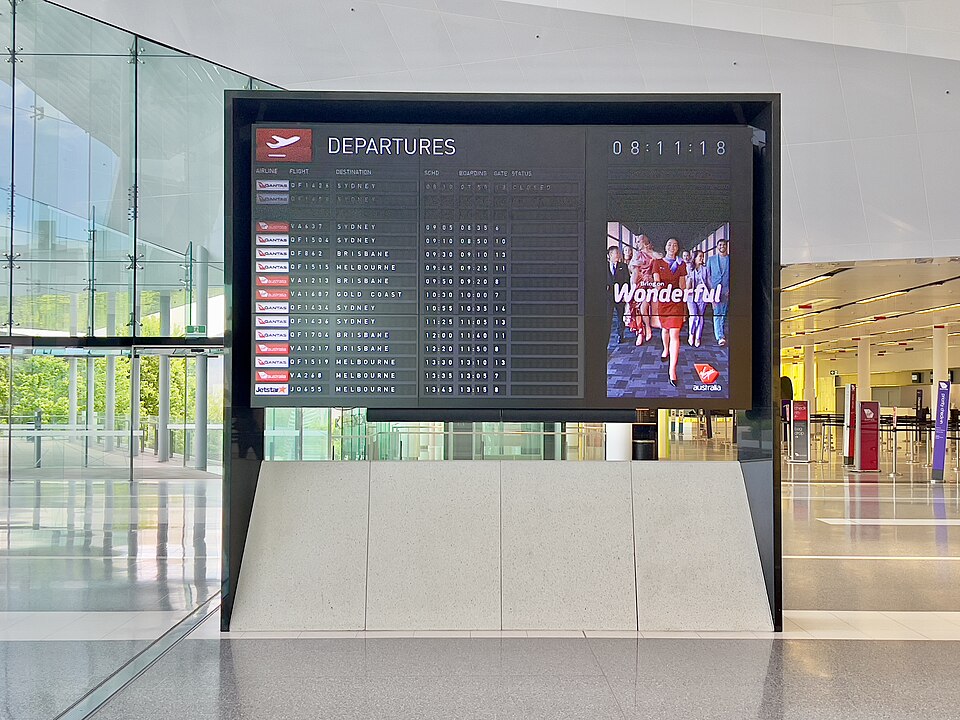 A real TIA departure screen showing flight numbers and times. (Image: Kgbo, CC BY-SA 4.0, via Wikimedia Commons)
Scenario: Your flight is Air India 123, departing at 8:45 AM.
- French announcement:
“Le vol Air India cent vingt-trois décollera à huit heures quarante-cinq.”
- cent vingt-trois = 123
- quatre-vingt is used for 80 (not soixante-dix).
3. Decimals and Large Numbers
- Decimals: Use virgule (comma) where English uses a period.
- 3.14 → trois virgule quatorze
- Large numbers: Group by spaces (not commas).
- 1,000 → un mille
- 1,000,000 → un million
- 1,000,000,000 → un milliard
Real-World Application: NEPSE Stock Prices
Scenario: The Nepal Bank Limited (NBL) share price is ₹1,250.75.
- French translation:
“Le cours de l’action NBL est mille deux cent cinquante virgule soixante-quinze rupees.”
- soixante-quinze = 75 (from soixante + quinze).
Days of the Week and Months
1. Days of the Week
French days are not capitalized unless at the start of a sentence. Memorize the order (Monday–Sunday) for itineraries:
```mermaid
mindmap
  root((Days of the Week))
    lundi["Lundi (Monday)"]
    mardi["Mardi (Tuesday)"]
    mercredi["Mercredi (Wednesday)"]
    jeudi["Jeudi (Thursday)"]
    vendredi["Vendredi (Friday)"]
    samedi["Samedi (Saturday)"]
    dimanche["Dimanche (Sunday)"]
Key Phrases:
- Aujourd’hui, c’est lundi. (Today is Monday.)
- Demain, nous visitons le palais. (Tomorrow, we visit the palace.)
- Hier, il a plu. (Yesterday, it rained.)
2. Months of the Year
Months are capitalized and follow a logical pattern (Roman numerals for 1–12):
| English | French (Pronunciation) | Key Notes |
|---|---|---|
| January | janvier (zhan-vyehr) | Le premier janvier = Jan 1st |
| February | février (fe-vryehr) | Février a 28 jours. |
| March | mars (mahr) | Mars est le 3ème mois. |
| April | avril (ah-vreel) | Avril ou mai? (April or May?) |
| May | mai (mahy) | Mai est le mois des fleurs. |
| June | juin (zhewen) | Juillet suit juin. |
| July | juillet (zhew-yeh) | Juillet est chaud. |
| August | août (oht) | Août a 31 jours. |
| September | septembre (set-ahmbr) | Septembre = 7ème mois. |
| October | octobre (ok-tohrbr) | Octobre est automnal. |
| November | novembre (no-vahmbr) | Novembre = 11ème mois. |
| December | décembre (deh-sahmbr) | Noël est en décembre. |
Worked Example: Booking a Tour with Pathao Travels
Scenario: You’re planning a 5-day Pokhara tour starting Monday, April 15th.
- French confirmation:
“Votre voyage commence le lundi quinze avril.”
- quinze avril = April 15th (no "th" in French dates).
- Never say “le 15ème avril” unless specifying the ordinal (e.g., le premier avril = April Fool’s Day).
In the Real World
eSewa & Khalti Payments
- When paying for a hotel booking or train ticket via eSewa/Khalti, the system may display prices in French (e.g., for international partners).
- Example: A €50 hotel deposit is announced as: “Le dépôt est cinquante euros.”
- Why it matters: Many Nepali tourism operators (e.g., Seven Hills Trekking) use French for client communications.
NTC Train Timetables
- The Nepal Railway (e.g., Janakpur–Bhairahawa route) sometimes lists departure times in French for international tourists.
- Example: “Le train pour Bhairahawa part à seize heures.” (Train leaves at 4 PM.)
YouTube Travel Videos
- Channels like “Nepal Travel Guide” or “French in Nepal” use French numbers/dates in subtitles.
- Example: A video titled “5 jours à Katmandou” uses cinq jours (5 days) for the itinerary.
Common Mistakes to Avoid
| Mistake | Correction | Example |
|---|---|---|
| Saying vingt-et-un as vingt-un | Add the -et- for 21–99. | Vingt-et-un (not vingt-un). |
| Using et before 70+ | Soixante-dix (not soixante-et-dix). | Soixante-dix ans. |
| Capitalizing days/months | Only capitalize if at sentence start. | lundi (not Lundi). |
| Saying un mille for 1,000 | Always mille (no un). | Mille rupees. |
| Mixing virgule and point | French decimals use commas. | 3,14 → trois virgule quatorze. |
Exam Tip
Pronunciation is Key
- Examiners test spoken accuracy. Practice with:
- Forvo (pronunciation guide).
- Shadowing YouTube videos (e.g., “French Numbers for Beginners”).
- Examiners test spoken accuracy. Practice with:
Dates and Times
- Always use the 24-hour format in French (e.g., quatorze heures = 2 PM).
- Never say “le 15th avril” → Use le quinze avril.
Contextual Usage
- Numbers 1–69 are often tested in pricing, dates, and counts.
- Days/months appear in itinerary questions (e.g., “When does the tour start?”).
Common Exam Questions
- Translate: “The flight departs at 6:30 PM.” → “Le vol décolle à dix-huit heures trente.”
- Fill in the blank: “J’ai réservé pour _______ personnes.” → cinq (if booking for 5).
Final Checklist Before the Exam: ✅ Can you count from 0–100 without hesitation? ✅ Do you know the order of days/months? ✅ Can you write a date in French (e.g., le 25 décembre)? ✅ Have you practiced pronouncing decimals (e.g., vingt virgule cinquante)?
Based on the TU BTTM syllabus for French Language I, unit 3.
Discussion
Loading…