Culture And Social Psychology For TourismUnit 210 min read
Tourist Behaviour: Theories & Real-World Patterns
Unit 2 of Culture And Social Psychology For Tourism: explores how tourists think, act, and make decisions—from motivation to cultural clashes—using theories like Maslow’s hierarchy, the Travel Career Model, and the Theory of Planned Behavior, with real-world examples from Nepal’s tourism industry.
TAKEAWAYS:
- Tourist behaviour is shaped by psychological needs (safety, belonging, self-esteem) and social influences (peer groups, media, past experiences).
- Theories like Maslow’s hierarchy and the Travel Career Model explain why tourists choose destinations and activities.
- Cross-cultural differences (e.g., individualism vs. collectivism) affect how tourists interact with locals and destinations.
- Post-purchase behaviour (e.g., sharing reviews on Daraz or Pathao) influences future travel decisions.
- Tourist typologies (e.g., adventure seekers, cultural explorers) help marketers tailor products (e.g., Daraz’s seasonal promotions).
- Social psychology principles (e.g., conformity, persuasion) explain why tourists follow trends (e.g., Instagram-worthy spots in Kathmandu).
1. Defining Tourist Behaviour
Tourist behaviour refers to the thoughts, feelings, and actions of individuals or groups when they travel, influenced by psychological, social, and cultural factors. Unlike locals, tourists often seek novelty, relaxation, or cultural immersion, but their decisions are shaped by:
- Personal factors (age, income, past experiences).
- Social factors (family, friends, online reviews).
- Cultural factors (values, traditions, stereotypes).
Worked Example: A Nepali tourist visiting Pokhara might choose Tibet House for its Instagram-worthy views (social influence) but also avoid crowded spots due to past negative experiences (personal factor). Their behaviour is a mix of emotional needs (relaxation) and logistical choices (safety).
2. Key Theories Explaining Tourist Behaviour
A. Maslow’s Hierarchy of Needs (Applied to Tourism)
Maslow’s pyramid shows how tourists prioritise needs, from basic survival to self-actualisation. In tourism:
- Physiological needs → Food, shelter (e.g., booking a hotel via Daraz).
- Safety needs → Security (e.g., avoiding unsafe areas in Kathmandu).
- Social needs → Belonging (e.g., joining a group tour with Pathao).
- Esteem needs → Recognition (e.g., posting on social media).
- Self-actualisation → Personal growth (e.g., trekking Everest Base Camp).
Mermaid Diagram: Maslow’s Hierarchy in Tourism
B. The Travel Career Model (TCM)
Developed by Butler (1980), this model explains how tourists evolve in their travel habits over time:
- Discovery → First-time visitors (e.g., a Nepali tourist visiting Pokhara for the first time).
- Development → Repeat visits, deeper exploration (e.g., trekking Annapurna Circuit).
- Consolidation → Routine trips (e.g., annual family visits to Chitwan).
- Stagnation → Lack of innovation (e.g., always staying in the same hotel).
- Decline → Reduced interest (e.g., avoiding crowded tourist spots).
Real-World Tie:
- Daraz’s seasonal promotions target tourists in the Development stage (e.g., "Book your second trek with 20% off").
- Pathao’s group tour packages attract tourists in the Discovery stage.
C. Theory of Planned Behavior (TPB)
TPB (Ajzen, 1991) predicts tourist decisions based on:
- Attitudes (e.g., "I love trekking").
- Subjective norms (e.g., "My friends recommend Pokhara").
- Perceived behavioural control (e.g., "I can afford a 7-day trip").
Worked Example: A student considering a study tour to Kathmandu might:
- Have a positive attitude (enjoying history).
- Follow subjective norms (friends who studied there).
- Assess control (budget, time off).
3. Cross-Cultural Perspectives in Tourist Behaviour
Cultures shape how tourists perceive destinations. Key dimensions (Hofstede’s framework):
| Dimension | Western Tourists | Asian Tourists (e.g., Nepali) |
|---|---|---|
| Individualism | Prefer solo travel, self-expression | Prefer group tours, family-based travel |
| Power Distance | Expect equal service (e.g., demanding hotels) | Respect hierarchy (e.g., deferring to guides) |
| Uncertainty Avoidance | Seek structured itineraries (e.g., Pathao packages) | Tolerate flexibility (e.g., last-minute changes) |
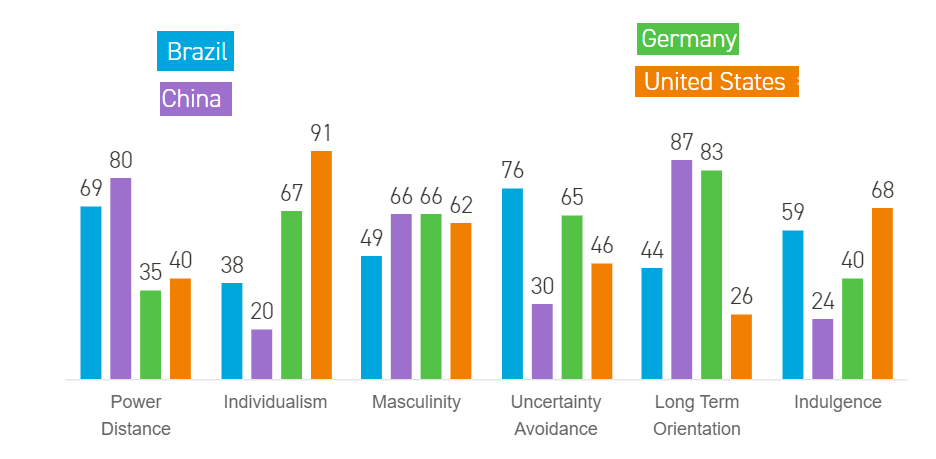 Hofstede’s framework showing individualism vs. collectivism. (Image: Piotrus, CC BY-SA 4.0, via Wikimedia Commons)
Tourists from high-context cultures (e.g., Japan) rely on implicit cues (e.g., local gestures), while low-context cultures (e.g., USA) prefer explicit instructions.
Hofstede’s framework showing individualism vs. collectivism. (Image: Piotrus, CC BY-SA 4.0, via Wikimedia Commons)
Tourists from high-context cultures (e.g., Japan) rely on implicit cues (e.g., local gestures), while low-context cultures (e.g., USA) prefer explicit instructions.
Real-World Example:
- Google Maps’ offline mode helps tourists in high-uncertainty-avoidance cultures (e.g., Germans) feel secure.
- Pathao’s multilingual support caters to Nepali tourists’ low power-distance expectations.
4. Post-Purchase Behaviour
After a trip, tourists engage in:
- Satisfaction/dissatisfaction (e.g., leaving a 5-star review on Daraz or complaining on social media).
- Word-of-mouth (e.g., "Don’t go to this hotel—bad service!").
- Repeat patronage (e.g., returning to the same trekking agency).
Mermaid Diagram: Post-Purchase Cycle
flowchart TD
    A["Purchase Decision"] --> B["Experience"]
    B --> C["Satisfaction"]
    C -->|"Positive"| D["Repeat Visit"]
    C -->|"Negative"| E["Negative Review"]
    D --> F["Loyalty"]
    E --> G["Avoid Future Trips"]
Worked Example: A tourist who had a bad experience at a Kathmandu hotel might:
- Post a negative review on TripAdvisor.
- Avoid booking similar hotels in the future.
- Share the experience on Facebook, influencing others.
5. Tourist Typologies and Segmentation
Tourists can be grouped based on:
- Motivation (e.g., adventure seekers, cultural explorers).
- Behaviour (e.g., planners vs. spontaneists).
- Demographics (e.g., students, families, retirees).
Mermaid Diagram: Tourist Segmentation
Real-World Application:
- Daraz’s "Adventure Packs" target adventure seekers.
- Pathao’s family tour packages cater to family tourists.
6. Interpersonal and Social Influences
Tourists are influenced by:
- Reference groups (e.g., friends who trekked Annapurna).
- Opinion leaders (e.g., travel bloggers on YouTube).
- Family expectations (e.g., parents planning a child’s first trip).
Worked Example: A Nepali student might choose Pokhara over Kathmandu because:
- Their friends (reference group) recommend it.
- A travel influencer (opinion leader) posted about it on Instagram.
7. Persuasion in Tourist Behaviour
Persuasion techniques used in tourism marketing:
- Scarcity ("Only 3 rooms left in this heritage hotel!").
- Social proof ("10,000+ tourists loved this trek!").
- Reciprocity (Free guidebook with hotel booking).
Mermaid Diagram: Persuasion Techniques
Real-World Example:
- Ncell’s "Book now, pay later" offer uses reciprocity (free SIM with booking).
- Khalti’s "Only 2 seats left!" uses scarcity.
In the Real World
- Pathao’s Group Tours
- Uses: Social influence (group dynamics) and Travel Career Model (targeting discovery-stage tourists).
- How: Offers shared vehicles and guides, making it easier for first-time travellers to explore Pokhara.
Daraz’s Seasonal Promotions
- Uses: Post-purchase behaviour (encouraging repeat visits) and Maslow’s hierarchy (fulfilling safety and social needs).
- How: Discounts on trekking gear appeal to adventure seekers (self-actualisation).
Nepal Tourism Board’s "Visit Nepal 2020" Campaign
- Uses: Persuasion techniques (social proof: "1 million tourists expected") and cultural dimensions (highlighting Nepal’s diversity).
- How: Targeted Western tourists (individualistic) with adventure-focused ads and Asian tourists (collectivistic) with family-friendly packages.
Exam Tip
- For descriptive questions (e.g., "Analyze tourist behaviour in Nepal"), use theories + real examples:
- Start with Maslow’s hierarchy (e.g., "Tourists seek self-actualisation through trekking").
- Add cross-cultural factors (e.g., "Nepali tourists prefer group tours due to collectivism").
- Include post-purchase behaviour (e.g., "They share experiences on Facebook").
- For short notes, focus on key theories (TCM, TPB) and typologies (adventure vs. cultural tourists).
- For case studies, pick a real Nepali tourism scenario (e.g., Pokhara vs. Kathmandu choices) and apply 2-3 theories.
- Avoid vague answers—always tie theories to real products/services (Pathao, Daraz, Ncell).
Based on the TU BTTM syllabus for Culture And Social Psychology For Tourism (TTM343), unit 2.
Discussion
Loading…