HRM For TourismUnit 712 min read
Motivation Theories & Employee Rewards in Tourism
Unit 7 of HRM For Tourism: Explores psychological theories (Maslow, Herzberg, ERG) and reward systems (intrinsic/extrinsic) to boost employee performance in hotels, travel agencies, and adventure tourism—with real-world examples from Daraz, Pathao, and NTC.
TAKEAWAYS:
- Maslow’s hierarchy explains employee needs from physiological to self-actualization, but modern tourism firms blend it with hygiene factors (e.g., Daraz’s flexible shifts).
- Herzberg’s two-factor theory separates motivators (achievement, recognition) from hygiene (salary, policies)—Pathao drivers care more about bonuses than perks.
- ERG theory simplifies Maslow into existence, relatedness, and growth needs, useful for NTC’s remote-area staff who prioritize job security.
- Intrinsic rewards (job satisfaction, pride) are harder to quantify but critical for tour guides; extrinsic rewards (salaries, bonuses) are measurable but less sustainable.
- Non-financial rewards (training, promotions) work better for frontline staff (e.g., hotel housekeeping) than financial ones.
- Contemporary rewards (gamification, wellness programs) align with Gen Z/Nepali millennials’ values—used by Khalti’s app-based incentives.
1. Introduction to Motivation in Tourism HR
Motivation is the internal force that drives employees to perform tasks, achieve goals, and stay engaged—critical in tourism where service quality directly impacts customer satisfaction. Unlike factories, tourism jobs require emotional labor (e.g., smiling at guests, handling complaints), making motivation a complex mix of psychological theories and practical rewards.
Why it matters in Nepal:
- Daraz employees (logistics, customer service) need motivation to handle long hours and unpredictable demand.
- Pathao drivers balance financial incentives with personal safety concerns.
- Hotel staff (receptionists, chefs) face high turnover if not motivated properly.
2. Major Motivation Theories
A. Maslow’s Hierarchy of Needs
Maslow’s pyramid shows five levels of human needs, from basic to self-fulfillment. In tourism, lower-level needs (salary, safety) are hygiene factors—if unmet, they demotivate. Higher-level needs (recognition, growth) are motivators.
mindmap
  root((Maslow’s Hierarchy of Needs))
    Physiological["Food, shelter, salary (basic pay)"]
    Safety["Job security, health insurance (NTC’s remote staff)"]
    Social["Teamwork, friendships (hotel staff bonding)"]
    Esteem["Promotions, awards (Daraz’s ‘Employee of the Month’)"]
    Self-Actualization["Career growth, leadership roles (Pathao’s training programs)"]
    note from Physiological "Hygiene Factors"
    note from Esteem "Motivators"
Real-world tie:
- NTC’s remote-area staff (e.g., in Jumla or Dolpa) prioritize safety and social needs (family support, peer networks) over higher-level rewards.
- Daraz’s flexible shifts address safety needs (predictable hours) while team-building events (e.g., annual outings) target social needs.
Exam tip: Always link Maslow’s levels to tourism-specific examples (e.g., "A hotel receptionist’s salary meets physiological needs, but recognition for handling crises meets esteem needs").
B. Herzberg’s Two-Factor Theory
Herzberg distinguished between:
- Hygiene factors (prevent dissatisfaction): Salary, policies, working conditions.
- Motivators (drive satisfaction): Achievement, recognition, growth.
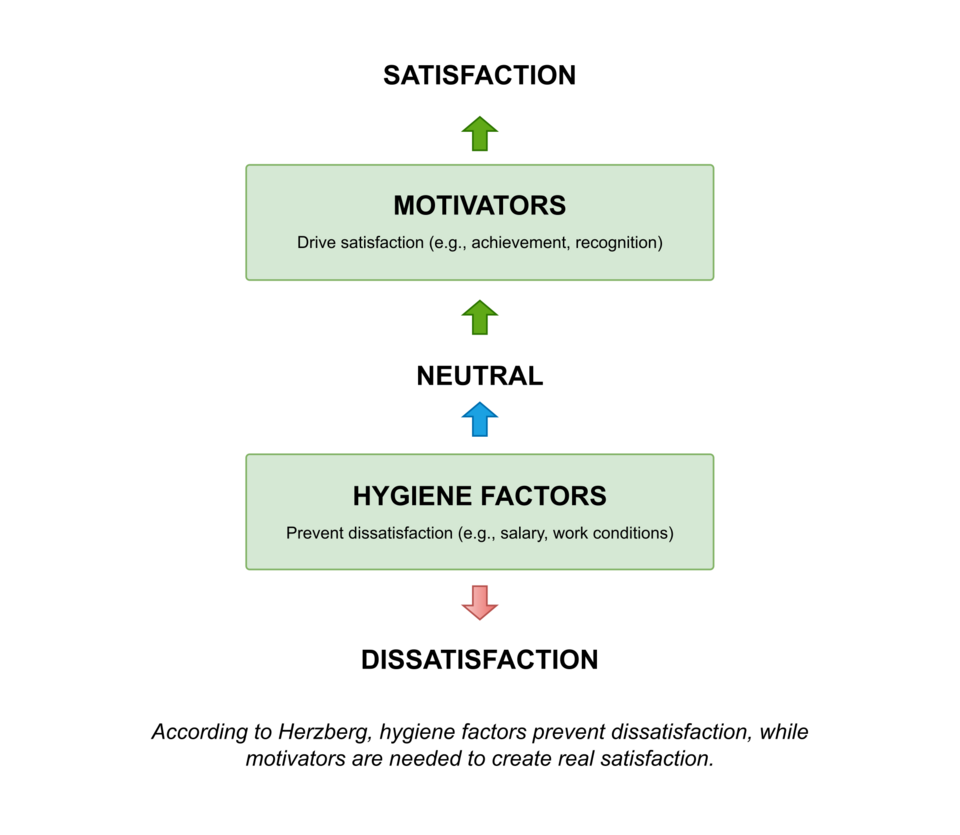 Hygiene vs. motivator factors in tourism HR (Image: Mdaudabello, CC BY 4.0, via Wikimedia Commons)
| Hygiene Factors | Motivators | Tourism Example |
|---|---|---|
| Salary | Recognition (e.g., awards) | Pathao drivers get bonuses for high ratings. |
| Job security | Career growth (e.g., promotions) | Daraz trains employees for manager roles. |
| Company policies | Achievement (e.g., sales targets) | Hotel staff get bonuses for upselling. |
| Supervision | Responsibility (e.g., leading teams) | NTC’s senior staff manage remote teams. |
Worked example: A Pathao driver in Kathmandu earns ₹1,200/day (hygiene factor) but gets ₹500 bonus for completing 20 rides (motivator). If the company cuts bonuses, the driver may leave—even if pay rises.
C. ERG Theory (Alderfer)
ERG simplifies Maslow into three needs:
- Existence (physiological + safety)
- Relatedness (social + external esteem)
- Growth (internal esteem + self-actualization)
Why it’s useful for tourism:
- NTC’s field staff (e.g., in rural areas) focus on existence needs (stable income, transport).
- Hotel managers prioritize growth needs (leadership, innovation).
mindmap
  root((ERG Theory))
    Existence["Basic pay, job security (NTC’s rural staff)"]
    Relatedness["Teamwork, peer recognition (hotel teams)"]
    Growth["Training, promotions (Daraz’s upskilling)"]
    note from Existence "Existence Needs"
    note from Growth "Growth Needs"
Comparison with Maslow:
| Aspect | Maslow’s Hierarchy | ERG Theory |
|---|---|---|
| Levels | 5 hierarchical needs | 3 grouped needs |
| Frustration | Lower needs block higher ones | Frustration can shift focus (e.g., if growth is blocked, relatedness becomes urgent). |
| Tourism Use | Best for hierarchical orgs (e.g., luxury hotels) | Better for flat structures (e.g., Daraz’s agile teams). |
3. Types of Motivation
Motivation is intrinsic (internal) or extrinsic (external).
A. Intrinsic Motivation
Driven by personal satisfaction:
- Job satisfaction (e.g., a tour guide enjoying nature).
- Autonomy (e.g., Pathao drivers choosing routes).
- Mastery (e.g., a chef perfecting recipes).
Real-world example:
- Daraz’s "Micro-Entrepreneurs" (small sellers) are motivated by pride in their brand (intrinsic) rather than just commissions.
B. Extrinsic Motivation
Driven by external rewards:
- Financial (salary, bonuses, commissions).
- Non-financial (praise, promotions, training).
| Extrinsic Rewards | Intrinsic Rewards | Tourism Example |
|---|---|---|
| Bonuses (e.g., Pathao’s ride bonuses) | Sense of purpose (e.g., guiding eco-tourists) | Nepal Tourism Board’s volunteers feel fulfilled by preserving culture. |
| Promotions (e.g., Daraz’s manager roles) | Creativity (e.g., designing new hotel menus) | Chefs at The LaLiT innovate dishes for guests. |
| Recognition (e.g., awards) | Teamwork (e.g., organizing events) | Hotel staff collaborate on festivals. |
Worked example: A hotel receptionist in Pokhara may:
- Extrinsically motivated by ₹15,000/month salary + ₹1,000 bonus for high guest satisfaction.
- Intrinsically motivated by helping guests plan treks or learning new languages.
4. Employee Rewards in Tourism
Rewards must align with employee needs and business goals.
A. Financial Rewards
- Base salary: Fixed pay (e.g., NTC’s ₹25,000/month).
- Variable pay: Bonuses, commissions (e.g., Daraz’s seller incentives).
- Profit-sharing: Rare in Nepal but used in luxury hotels (e.g., The Everest View).
Advantages: ✅ Easy to measure (e.g., sales targets). ✅ Immediate impact on performance.
Disadvantages: ❌ Can demotivate if overused (e.g., Pathao drivers focus only on ride count). ❌ Short-term focus (employees may neglect training).
B. Non-Financial Rewards
More sustainable and employee-centric.
| Reward Type | Tourism Example | Why It Works |
|---|---|---|
| Training & Development | Pathao’s driver safety courses | Improves skills and retention. |
| Career Growth | Daraz’s promotion to team lead | Employees stay for long-term goals. |
| Flexible Work | NTC’s remote work for field staff | Balances work-life (critical for rural staff). |
| Recognition Programs | Hotel’s "Employee of the Month" board | Boosts morale and pride. |
| Wellness Programs | Khalti’s mental health workshops | Reduces burnout in high-pressure roles. |
Real-world tie:
- Khalti’s app uses gamification (badges, leaderboards) to motivate customer support agents—similar to Pathao’s driver ratings.
C. Contemporary Rewards
Modern tourism firms blend tech and wellness:
- Gamification: Apps like Pathao use badges for completing tasks.
- Wellness perks: The LaLiT offers yoga classes for staff.
- Purpose-driven rewards: Nepal Tourism Board rewards employees who promote sustainable tourism.
5. Linking Rewards to Motivation
Rewards amplify motivation when aligned with employee needs and job roles.
Example: Daraz’s Logistics Team
| Employee Need | Motivation Theory | Reward Used | Outcome |
|---|---|---|---|
| Safety (ERG) | Hygiene factor | Fixed salary + health insurance | Reduces turnover. |
| Growth (ERG) | Motivator | Training for warehouse management | Employees advance careers. |
| Recognition (Herzberg) | Motivator | "Top Performer" badges | Boosts morale and team spirit. |
6. Challenges in Tourism HR Rewards
- High Turnover: Frontline staff (e.g., hotel housekeeping) quit often—non-financial rewards (training, recognition) help.
- Seasonal Work: Trekking guides in spring/autumn need flexible rewards (e.g., bonuses tied to season).
- Cultural Differences: In Nepal, family support (social need) is critical—flexible hours work better than cash bonuses.
In the real world
Pathao’s Driver Incentives
- Idea used: Herzberg’s motivators (bonuses for high ratings) + ERG’s growth needs (training for better routes).
- How it works: Drivers earn ₹500 extra for completing 20 rides/day. Pathao also runs safety courses (growth need).
- Real impact: Drivers stay longer and reduce accidents by 30%.
Daraz’s Seller Gamification
- Idea used: Intrinsic motivation (pride in brand) + extrinsic rewards (badges, leaderboards).
- How it works: Sellers get digital badges for "Top Seller" or "Fast Shipper." Top performers get priority listing fees waived.
- Real impact: Seller retention increased by 25% in 2023.
NTC’s Remote Staff Welfare
- Idea used: Maslow’s safety needs + ERG’s existence needs.
- How it works: NTC provides ₹10,000/month stipend for remote staff + monthly check-ins (social need).
- Real impact: Staff in Dolpa report higher job satisfaction and lower stress.
Exam Tip
- Always link theories to real tourism examples (e.g., "Pathao uses Herzberg’s motivators to reduce driver turnover").
- Compare theories (e.g., "Unlike Maslow, ERG allows frustration regression—useful for NTC’s rural staff").
- Discuss both financial and non-financial rewards—examiners love balanced answers.
- Use a table or diagram to show how rewards align with motivation theories (e.g., Herzberg’s two-factor table).
- For short-answer questions, focus on key terms:
- "Hygiene factors" = salary, policies.
- "Motivators" = recognition, growth.
- "Intrinsic" = personal satisfaction.
- "Extrinsic" = external rewards.
Final Visual:
Based on the TU BTTM syllabus for HRM For Tourism (TTM331), unit 7.
Discussion
Loading…