EnglishUnit 411 min read
Ecology & Environment: Ecosystems, Pollution, Conservation
Unit 4 of English explores the interconnected world of ecology and environmental issues, teaching students about ecosystems, biodiversity, pollution types, conservation efforts, and sustainable practices through clear explanations, real-world examples, and exam-focused writing tasks.
TAKEAWAYS:
- Understand ecosystems (biotic + abiotic components) and how energy flows through food chains/webs.
- Learn types of pollution (air, water, soil, noise, light) and their causes/effects on humans and nature.
- Know conservation strategies (afforestation, recycling, wildlife protection) and their importance.
- Differentiate between renewable and non-renewable resources and their sustainable use.
- Practice writing skills (essays, notices, reports) on environmental topics with proper structure.
- Recognize NEB exam patterns—short answers, summaries, and creative writing on ecology themes.
1. Introduction to Ecology and Environment
Definition:
- Ecology is the study of how living things (plants, animals, humans) interact with each other and their surroundings.
- Environment includes everything around us—air, water, soil, and living organisms.
Key Terms:
| Term | Meaning |
|---|---|
| Ecosystem | A community of living things (biotic) + their physical surroundings (abiotic). |
| Biodiversity | The variety of life in an ecosystem (plants, animals, microbes). |
| Habitat | The natural home of a plant or animal. |
| Niche | The role an organism plays in its ecosystem (e.g., a bee pollinates flowers). |
How Ecosystems Work:
- Producers (plants) → Consumers (herbivores, carnivores) → Decomposers (fungi, bacteria).
- Energy flows from the sun → producers → consumers.
- Food Chain Example: Grass (producer) → Grasshopper (primary consumer) → Frog (secondary consumer) → Snake (tertiary consumer).
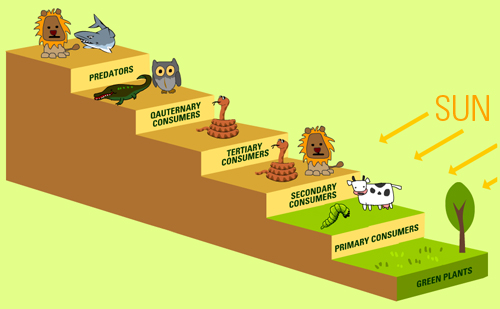 A simple linear food chain with arrows showing energy flow. (Image: Suwachanee Maneeratanachot, CC BY-SA 4.0, via Wikimedia Commons)
2. Types of Ecosystems
Ecosystems can be terrestrial (land) or aquatic (water).
| Terrestrial Ecosystems | Aquatic Ecosystems |
|---|---|
| Forest (Tropical, Temperate) | Freshwater (Lakes, Rivers) |
| Grassland (Savanna, Prairie) | Marine (Oceans, Coral Reefs) |
| Desert | Wetland (Swamps, Marshes) |
| Tundra |
Example:
- Tropical Rainforest: High biodiversity, warm climate, heavy rainfall.
- Desert: Low rainfall, extreme temperatures, adapted plants (cacti) and animals (camels).
3. Environmental Pollution
Pollution harms ecosystems and human health. There are five main types:
| Type of Pollution | Causes | Effects | Solutions |
|---|---|---|---|
| Air Pollution | Vehicle emissions, factories, burning fossil fuels | Respiratory diseases, global warming | Use public transport, plant trees |
| Water Pollution | Industrial waste, plastic, sewage | Waterborne diseases, death of aquatic life | Treat wastewater, ban plastic bags |
| Soil Pollution | Pesticides, industrial waste, plastic | Reduced crop yield, soil infertility | Use organic farming, composting |
| Noise Pollution | Loud vehicles, construction, factories | Hearing loss, stress, sleep disorders | Noise barriers, quiet zones |
| Light Pollution | Excessive streetlights, billboards | Disrupts wildlife, eye strain in humans | Use LED lights, reduce unnecessary lighting |
Real-Life Example:
- Plastic Pollution in Rivers:
- Cause: Factories and households dump plastic waste into rivers.
- Effect: Fish and birds ingest plastic, leading to death. Rivers become unfit for drinking.
- Solution: Ban single-use plastics, promote recycling.
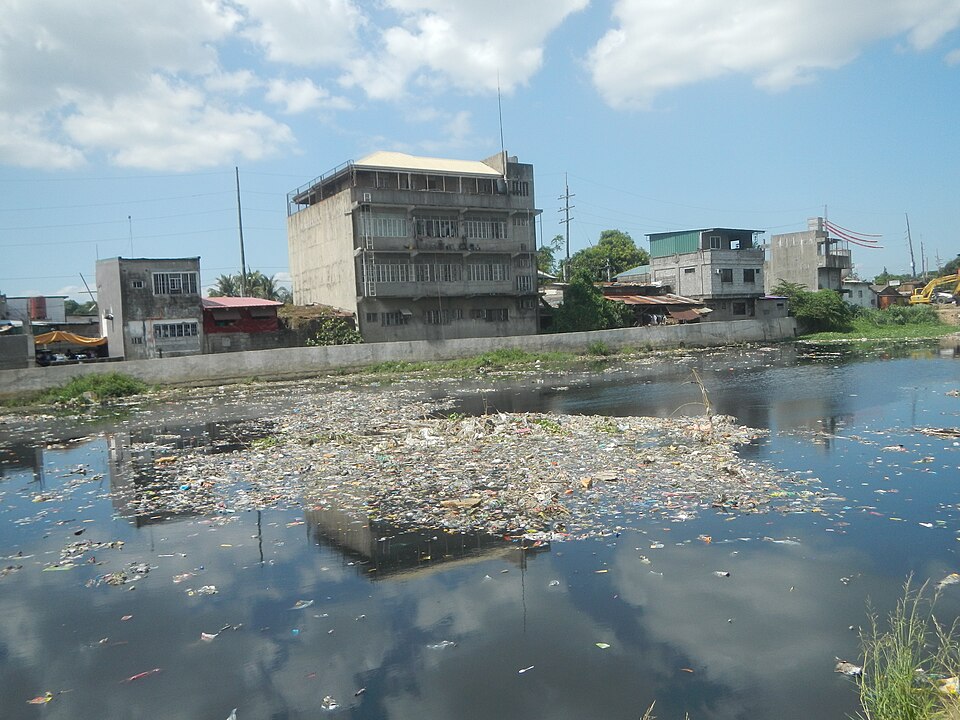 A river with floating plastic bottles and bags. (Image: JFVelasquez Floro, CC0, via Wikimedia Commons)
4. Conservation of Environment
Conservation means protecting natural resources for future generations.
Methods of Conservation:
Afforestation & Reforestation
- Planting new trees (afforestation) or regrowing cut forests (reforestation).
- Benefit: Increases oxygen, reduces soil erosion, provides habitats for wildlife.
Recycling & Reducing Waste
- Reuse materials (paper, plastic, metal) instead of throwing them away.
- Example: Recycling one ton of paper saves 17 trees.
Wildlife Protection
- National Parks & Sanctuaries: Areas where animals are protected (e.g., Chitwan National Park in Nepal).
- Endangered Species: Animals like the Red Panda and One-Horned Rhino need special protection.
Use of Renewable Energy
- Solar, wind, hydroelectric power instead of coal/oil.
- Benefit: Reduces air pollution and climate change.
5. Renewable vs. Non-Renewable Resources
| Renewable Resources | Non-Renewable Resources |
|---|---|
| Solar energy | Coal |
| Wind energy | Petroleum (oil) |
| Hydropower | Natural gas |
| Biomass (wood, dung) | Minerals (iron, gold) |
| Advantage: Never runs out | Disadvantage: Finite, causes pollution |
classDiagram
    class Resource {
        +name: String
        +type: String
        +renewable: Boolean
    }
    class Renewable {
        +source: String
        +advantage: "Never runs out"
    }
    class NonRenewable {
        +source: String
        +disadvantage: "Finite, causes pollution"
    }
    Resource <|-- Renewable
    Resource <|-- NonRenewable
    Renewable : +solar
    Renewable : +wind
    Renewable : +hydropower
    NonRenewable : +coal
    NonRenewable : +petroleum
    NonRenewable : +natural gas
Classification of resources into renewable and non-renewable types with their key attributes.Example:
- Non-renewable: Burning coal → Air pollution (smog, acid rain).
- Renewable: Using solar panels → Clean energy, no pollution.
6. Writing Skills for NEB Exams
This unit tests essay writing, notices, and reports on environmental topics.
A. Essay Writing (300-400 words)
Structure:
- Introduction – Define the topic (e.g., "Pollution is a major threat to our environment.").
- Body – Discuss causes, effects, and solutions (use 3 main points).
- Conclusion – Summarize and give a hopeful message.
Example Essay Topic: "How can we reduce air pollution in cities?"
**Reducing Air Pollution in Cities**

Air pollution is a serious problem in many cities, causing health issues like asthma and heart diseases. The main causes are vehicle emissions, industrial smoke, and burning garbage. To reduce air pollution, we can take several steps.

First, people should use **public transport** or **bicycles** instead of private cars. Governments can also **ban old vehicles** that produce more smoke. Second, factories should use **clean energy** like solar power and follow pollution control rules. Finally, people should **avoid burning plastic and dry leaves**, which release toxic gases.

If we follow these steps, our cities will have **cleaner air**, and future generations will live healthier lives. It’s our responsibility to protect our environment for a better tomorrow.
B. Notice Writing (Formal & Informal)
Format:
- Header: Name of school/institution, date.
- Notice for: (e.g., "All Students")
- Subject: (e.g., "Tree Plantation Campaign")
- Body: Purpose, date, time, venue.
- Signature: Name and designation.
Example 1 (Formal Notice):
**Notices**
**ABC Secondary School, Kathmandu**
**Date: 2024/03/15**

**Notice for: All Students**

**Subject: Cleanliness Drive – 2024**

Dear Students,
To keep our school clean and green, we are organizing a **Cleanliness Drive** on **March 20, 2024**, from **9 AM to 11 AM**. All students must participate by cleaning classrooms, gardens, and playgrounds.

Let’s make our school a **pollution-free zone**!

**Principal**
ABC Secondary School
Example 2 (Informal Notice – Poster): SAVE OUR EARTH! 🌍 Stop Plastic Pollution 🌍
- Use cloth bags instead of plastic.
- Recycle paper, glass, and metal.
- Plant a tree every month!
Organized by: Green Club, XYZ College
C. Report Writing (Formal)
Structure:
- Heading: Title of the report.
- Introduction: Brief background.
- Body: Details (who, what, when, where, why).
- Conclusion: Suggestions/findings.
Example Report Topic: "Water Pollution in River X"
**Report on Water Pollution in River X**

**Introduction:**
River X, a major water source for our district, is severely polluted due to industrial waste and plastic dumping.

**Findings:**
- **Cause:** Factories near the river release **chemical waste** without treatment.
- **Effect:** Fish are dying, and villagers suffer from **skin diseases**.
- **Solution:** The government should **fine polluting factories** and set up **wastewater treatment plants**.

**Conclusion:**
If immediate action is not taken, River X will become **unfit for drinking and fishing**. We urge the local administration to **clean the river** and **penalize polluters**.

**Submitted by:**
[Your Name]
Environment Club, XYZ School
7. NEB Exam Tips for Unit 4
✅ Short Answer Questions (SAQs):
- Example Question: "What are the three main causes of air pollution?"
Answer:
- Vehicle emissions
- Industrial smoke
- Burning of fossil fuels
✅ Essay Writing:
- Do:
- Write in simple, clear English.
- Use examples (e.g., "Like in Kathmandu, traffic jams increase air pollution").
- Follow 3 paragraphs (intro, body, conclusion).
- Don’t:
- Write too long or too short.
- Copy from textbooks—use your own words.
✅ Notice/Report Writing:
- Check format (date, subject, body, signature).
- Use polite language (e.g., "We request all students to...").
- Be specific (give dates, times, places).
✅ Multiple Choice Questions (MCQs):
- Example: "Which of the following is a renewable resource?" a) Coal b) Petroleum c) Solar energy ✅ d) Natural gas
✅ Creative Writing (Story/Poem):
- If asked to write a short story on "Deforestation," include:
- A problem (trees being cut).
- A solution (planting trees).
- Moral (e.g., "Nature gives us life; we must protect it").
8. Practice Questions (NEB Style)
A. Short Answer (5 marks)
- Define biodiversity. Give two examples of biodiversity loss.
- What are the three R’s of waste management? Explain one.
- How does deforestation affect the environment?
B. Essay (10 marks) "The role of individuals in protecting the environment."
C. Notice Writing (5 marks) Write a notice for your school asking students to participate in a tree-planting campaign.
D. Report Writing (10 marks) Prepare a report on "Plastic Waste Management in Your Area" based on a survey.
Final Advice:
- Revise key terms (ecosystem, pollution types, conservation methods).
- Practice writing notices, reports, and essays.
- Read newspapers for real-world environmental issues.
Good luck for your NEB exams! 🌱📚
Based on the NEB +2 Humanities syllabus for English (Eng), unit 4.
Discussion
Loading…