HistoryUnit 613 min read
Ancient Civilizations: Mesopotamia, Egypt, Indus, China & Greece
Unit 6 of History explores the world’s first great civilizations—Mesopotamia, Egypt, Indus Valley, China, and Greece—covering their geography, achievements, social structures, and legacies that shaped modern life.
TAKEAWAYS:
- Ancient civilizations emerged near rivers (Nile, Tigris-Euphrates, Indus, Huang He) due to fertile land and water for farming.
- Each civilization had unique writing systems (cuneiform, hieroglyphs, Brahmi), governments (pharaohs, kings, councils), and religious beliefs (polytheism, ancestor worship).
- Advances like wheel, calendar, mathematics, and architecture (pyramids, ziggurats) were shared or adapted across civilizations.
- Social hierarchies (pharaohs/emperors at top, slaves at bottom) and trade networks connected distant regions.
- Their legacies include laws (Hammurabi’s Code), literature (Epic of Gilgamesh), and scientific knowledge still studied today.
What is a Civilization?
A civilization is a complex society with:
- Advanced cities (e.g., Ur, Thebes, Mohenjo-Daro).
- Organized government (kings, priests, or councils).
- Social classes (rulers, warriors, farmers, slaves).
- Writing system (to record laws, trade, stories).
- Art, architecture, and religion (temples, statues, gods).
- Technology (plows, wheels, metal tools).
Why did civilizations start near rivers? Rivers provided:
- Water for drinking and farming.
- Fertile soil (silt from floods) for crops.
- Transportation for trade and travel.
- Protection from invaders (natural barriers).
1. Mesopotamia: The Land Between Two Rivers
Location: Between the Tigris and Euphrates rivers (modern Iraq). Time Period: ~3500 BCE – 500 BCE.
Key Features
- First civilization with cities, writing, and laws.
- Invented the wheel (~3500 BCE) and plow.
- Cuneiform script (wedge-shaped writing on clay tablets).
- Polytheistic religion (gods like Enlil, Inanna).
- Ziggurats (temple towers) as religious centers.
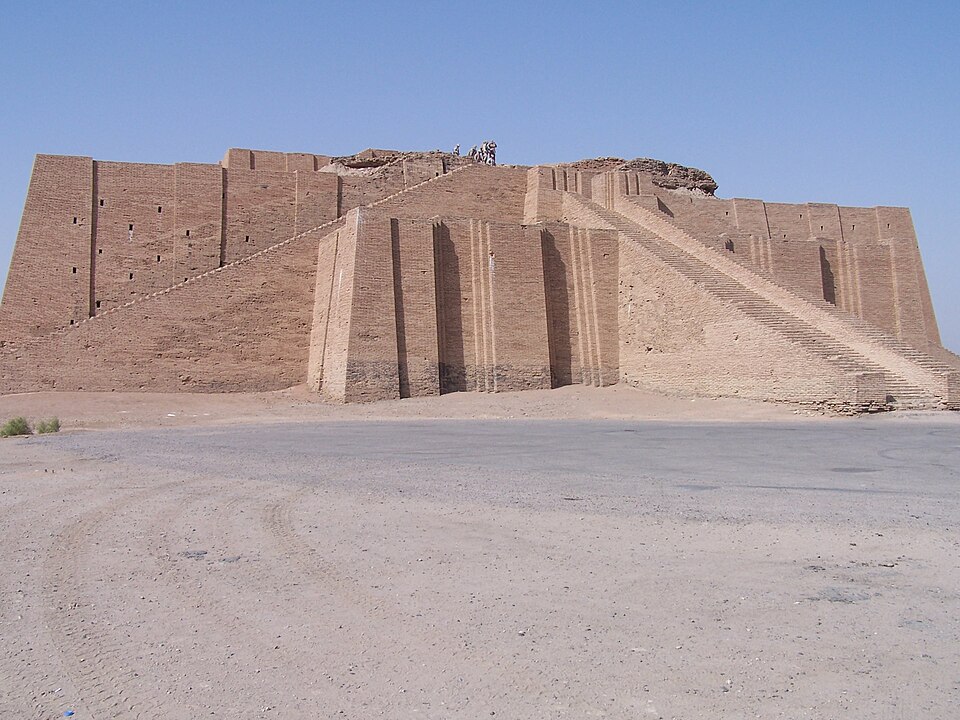 A ziggurat in Ur, Mesopotamia, showing its stepped design and religious importance. (Image: en:User:Hardnfast, CC BY 3.0, via Wikimedia Commons)
Government and Society
- City-states (e.g., Ur, Babylon) ruled by kings or priests.
- Social classes:
- Kings/Priests
- Warriors/Nobles
- Merchants/Artisans
- Farmers
- Slaves
Achievements
| Field | Achievement | Example |
|---|---|---|
| Writing | Cuneiform (first writing system) | Clay tablets with laws/stories |
| Math | Base-60 system (60 seconds, 60 minutes) | Used in time and angles |
| Law | Hammurabi’s Code (eye for an eye) | 282 laws carved in stone |
| Architecture | Ziggurats (temple towers) | Great Ziggurat of Ur |
Solved Example: Why was cuneiform important? Answer: Cuneiform was the first writing system, used to record:
- Trade (inventory, prices).
- Laws (Hammurabi’s Code).
- Stories (Epic of Gilgamesh).
- Taxes (government records). Without it, history would have no written proof of early Mesopotamia!
2. Ancient Egypt: The Gift of the Nile
Location: Along the Nile River (modern Egypt). Time Period: ~3100 BCE – 30 BCE.
Key Features
- Unified under King Narmer (~3100 BCE).
- Hieroglyphs (picture writing) and papyrus (paper).
- Mummification (preserving bodies for the afterlife).
- Pyramids (tombs for pharaohs).
- Polytheistic religion (gods like Ra, Osiris, Anubis).
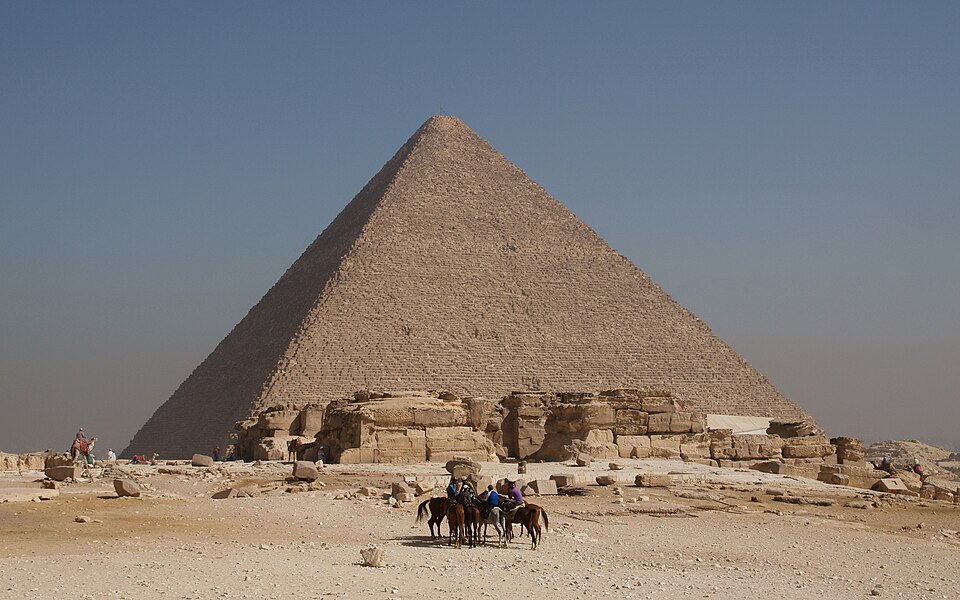 The Great Pyramid of Giza, built as a tomb for Pharaoh Khufu. (Image: kallerna, CC BY-SA 3.0, via Wikimedia Commons)
Government and Society
- Pharaoh (god-king) ruled with visiers (advisors).
- Social classes:
- Pharaoh
- Priests/Nobles
- Scribes (government workers)
- Soldiers/Farmers
- Slaves
Achievements
| Field | Achievement | Example |
|---|---|---|
| Writing | Hieroglyphs (picture symbols) | Rosetta Stone (deciphered in 1822) |
| Medicine | First medical papyri (Ebers Papyrus) | Treatments for diseases |
| Architecture | Pyramids (Great Pyramid of Giza) | Built with 2.3 million stone blocks |
| Calendar | 365-day solar calendar | Basis for modern calendars |
Comparison: Mesopotamia vs. Egypt
| Feature | Mesopotamia | Egypt |
|---|---|---|
| Rivers | Tigris & Euphrates (unpredictable floods) | Nile (predictable floods) |
| Writing | Cuneiform (wedges) | Hieroglyphs (pictures) |
| Religion | Many gods (Enlil, Inanna) | Many gods (Ra, Osiris) + afterlife |
| Architecture | Ziggurats (stepped towers) | Pyramids (tombs) |
| Government | City-states (kings/priests) | Unified under pharaohs |
3. Indus Valley Civilization: The Harappans
Location: Along the Indus River (modern Pakistan/India). Time Period: ~2600 BCE – 1900 BCE.
Key Features
- Advanced city planning (grid layout, drainage systems).
- Undeciphered script (no one knows how to read it yet!).
- Trade with Mesopotamia (seals with animals).
- No evidence of warfare (no weapons found).
Government and Society
- Possible centralized government (similar cities suggest one ruler).
- Social classes (unknown, but likely merchants, priests, farmers).
- No kings or warriors found in artifacts.
Achievements
| Field | Achievement | Example |
|---|---|---|
| Cities | Planned streets, brick houses | Mohenjo-Daro, Harappa |
| Sanitation | Advanced drainage systems | Public baths, toilets |
| Trade | Seals with animals (traded with Mesopotamia) | |
| Weights | Standardized weights for trade | Found in excavations |
Why did the Indus Valley decline? Possible reasons:
- River changes (Indus shifted course).
- Earthquakes (damaged cities).
- Trade decline (Mesopotamia’s rise).
- Climate change (droughts).
4. Ancient China: The Yellow River Civilization
Location: Along the Huang He (Yellow River). Time Period: ~1700 BCE – 221 BCE (Xia, Shang, Zhou dynasties).
Key Features
- First Chinese dynasty: Xia (legendary, little proof).
- Shang Dynasty (~1700 BCE) – first with writing (oracle bones).
- Bronze technology (weapons, tools, art).
- Ancestor worship (believed in communicating with dead ancestors).
 Example of Shang Dynasty writing on turtle shells. (Image: Oracle_bone_graphs_rotated_90_degrees.gif: Dragonbones deriv, Public domain, via Wikimedia Commons)
Government and Society
- Emperor ruled with mandate of heaven (gods’ approval).
- Social classes:
- Emperor
- Nobles
- Farmers
- Artisans
- Merchants (lowest, as they didn’t farm)
Achievements
| Field | Achievement | Example |
|---|---|---|
| Writing | Oracle bone script (earliest Chinese writing) | Used for divination |
| Metalwork | Bronze weapons & art | Shang Dynasty daggers |
| Agriculture | Irrigation systems | Controlled Yellow River floods |
| Philosophy | Confucianism (respect for family) | Later developed by Confucius |
How did oracle bones work?
- Priests wrote questions on turtle shells or animal bones.
- Heated the bones until they cracked.
- Interpreted cracks as answers from gods/ancestors.
- Recorded answers in Shang script (earliest Chinese writing).
5. Ancient Greece: The Birth of Democracy
Location: Greek city-states (Athens, Sparta, etc.). Time Period: ~800 BCE – 146 BCE.
Key Features
- City-states (polis) like Athens and Sparta.
- Democracy (Athens: first democracy in 508 BCE).
- Philosophy (Socrates, Plato, Aristotle).
- Olympic Games (started in 776 BCE).
- Mythology (gods like Zeus, Athena, Apollo).
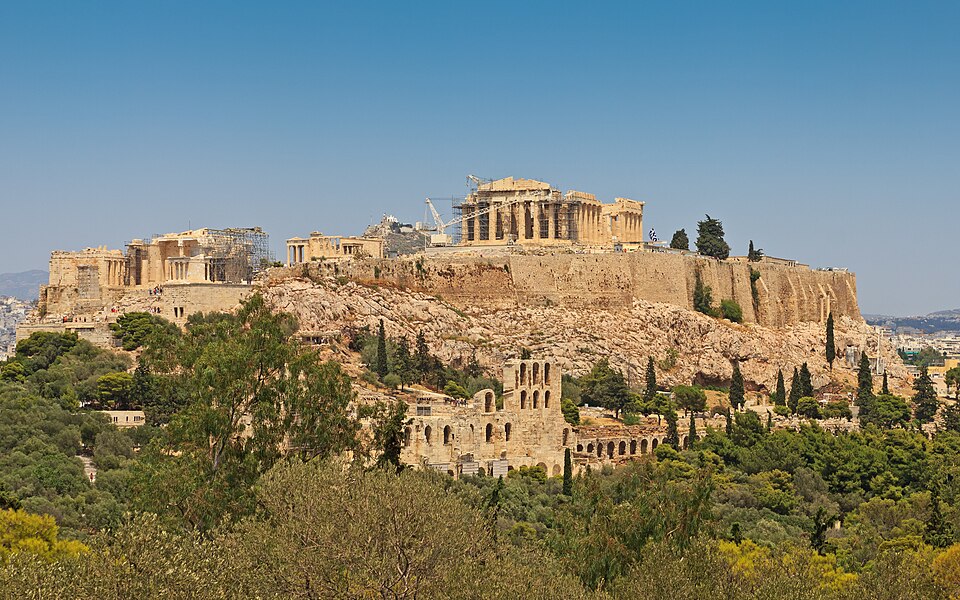 The Acropolis in Athens, home to the Parthenon temple. (Image: A.Savin, CC BY-SA 3.0, via Wikimedia Commons)
Government and Society
| City-State | Government | Focus |
|---|---|---|
| Athens | Democracy (citizen assembly) | Arts, philosophy, trade |
| Sparta | Military oligarchy | War, discipline, strength |
Achievements
| Field | Achievement | Example |
|---|---|---|
| Government | Democracy (Athens) | Citizens voted on laws |
| Philosophy | Socrates, Plato, Aristotle | Questions about justice, truth |
| Architecture | Columns (Doric, Ionic, Corinthian) | Parthenon in Athens |
| Science | Pythagoras (math), Hippocrates (medicine) |
Solved Example: How was Athenian democracy different from today’s? Answer:
| Feature | Ancient Athens | Modern Democracy |
|---|---|---|
| Who voted? | Free male citizens (no women, slaves) | All adults (men and women) |
| How voted? | Hand-raising in assembly | Secret ballots, elections |
| Leaders | Elected for 1 year (no career politicians) | Long-term representatives |
| Laws | Debated and passed in assembly | Made by elected legislatures |
How Did These Civilizations Connect?
Trade and ideas spread through:
- Silk Road (China to Mediterranean).
- Indian Ocean trade (Indus to Mesopotamia).
- Cultural exchange (writing, math, religion).
Example: The Wheel
- Invented in Mesopotamia (~3500 BCE).
- Spread to Egypt, Indus Valley, China.
- Used for pottery, chariots, and later carts.
Exam Tip: How to Score Full Marks
- Define key terms (e.g., "What is a civilization?").
- Compare civilizations (use tables for differences).
- Explain causes and effects (e.g., "Why did Egypt rely on the Nile?").
- Use examples (e.g., "Hammurabi’s Code shows Mesopotamia’s laws").
- Link to modern life (e.g., "Democracy started in Athens").
- NEB-style questions to practice:
- "Describe the achievements of the Indus Valley Civilization." (List 3+ with examples).
- "How was the government of Mesopotamia different from Egypt?" (Compare kings vs. pharaohs).
- "Why is the Nile called ‘Egypt’s lifeline’?" (Explain farming, transport, floods).
- "What were the main features of Athenian democracy?" (Citizens, assembly, voting).
- "Compare the writing systems of Mesopotamia and Egypt." (Cuneiform vs. hieroglyphs).
Common Mistakes to Avoid:
- Mixing up civilizations (e.g., calling pyramids "ziggurats").
- Ignoring geography (always mention rivers when describing a civilization).
- Not explaining "why" (e.g., "Why did they build pyramids?" → For pharaohs’ afterlife).
- Forgetting trade/connection (e.g., Indus Valley traded with Mesopotamia).
Final Tip: Draw timelines or maps in exams to show connections between civilizations. For example:
This shows chronological order and helps examiners see your understanding!
Based on the NEB +2 Humanities syllabus for History (His), unit 6.
Discussion
Loading…