HistoryUnit 314 min read
Medieval Nepal: Malla Kings, Art & Kathmandu Valley’s Golden Age
Unit 3 of History explores the Malla period (12th–18th centuries), when Nepal’s Kathmandu Valley became a center of art, culture, and Hindu-Buddhist harmony under three royal dynasties: Kathmandu, Patan, and Bhaktapur. Learn about their kingdoms, architecture, and conflicts that shaped Nepal’s medieval identity.
The Rise of the Mallas: Three Kingdoms, One Valley
The Malla period (c. 12th–18th century) saw the Kathmandu Valley divided into three independent kingdoms, each ruled by a Malla dynasty. These kingdoms—Kathmandu, Patan (Lalitpur), and Bhaktapur—were not just political units but cultural powerhouses. Their rivalry and cooperation shaped Nepal’s medieval art, religion, and urban planning.
How Did the Mallas Come to Power?
- The Kirat and Lichchhavi empires had weakened by the 12th century.
- Local chieftains (thakuris) and warrior clans (like the Mallas) gained power.
- The **first Malla king, Arideva, established the Kathmandu dynasty in 1194 AD.
- The Patan Mallas (founded by Ananta Malla) and Bhaktapur Mallas (founded by Anandadeva) soon followed.
mindmap
root((Malla Period: 12th–18th Century))
Kathmandu Mallas
Founder: Arideva (1194 AD)
Capital: Kathmandu Durbar Square
Famous Kings: Jayasthiti Malla, Pratap Malla
Patan Mallas
Founder: Ananta Malla (14th century)
Capital: Lalitpur Durbar Square
Famous Kings: Siddhi Narasimha, Tej Narasimha
Bhaktapur Mallas
Founder: Anandadeva (14th century)
Capital: Bhaktapur Durbar Square
Famous Kings: Bhupatindra Malla, Ranajit Malla
Key Features
Hindu-Buddhist Harmony
Temple Architecture (Newari Style)
Trade & Urban Planning
Conflicts Between Kingdoms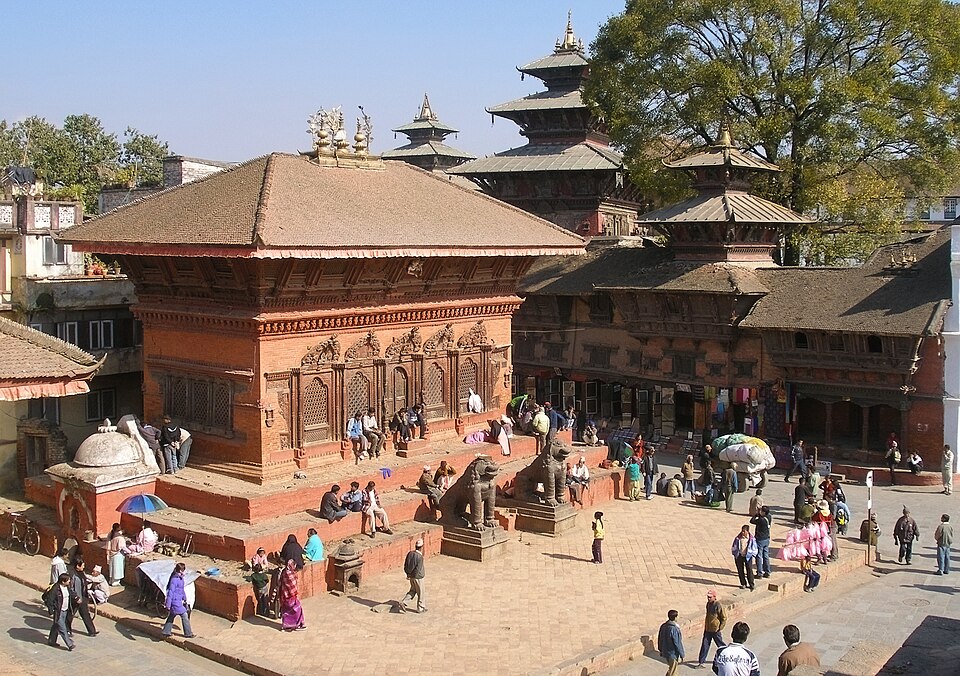 Aerial view of the square with Kasthamandap, Kumari Ghar, and Basantapur Palace. (Image: Original: Vyacheslav Argenberg Derivative work: Unpetitprole, CC BY 4.0, via Wikimedia Commons)
The Three Malla Kingdoms: A Comparison
Each Malla kingdom had its own capital, religion, and architectural style, but they shared a common culture.
| Feature | Kathmandu Mallas | Patan Mallas | Bhaktapur Mallas |
|---|---|---|---|
| Capital | Kathmandu Durbar Square | Lalitpur Durbar Square | Bhaktapur Durbar Square |
| Religion | Hindu (Shakti worship) | Buddhist (Vajrayana) | Hindu-Buddhist blend |
| Famous Temple | Kasthamandap (wooden temple) | Patan Durbar Square (golden temples) | Nyatapola Temple (5-tiered) |
| Architecture | Red brick, wooden carvings | Intricate stonework, gold gilding | Pottery, terracotta, pagoda style |
| Notable King | Pratap Malla (unified valley) | Siddhi Narasimha (patron of art) | Ranajit Malla (last great king) |
Why Does This Matter? The Mallas preserved Nepal’s cultural identity despite political divisions. Their temples, art, and urban planning are still admired today.
Malla Architecture: The Newari Style
The Mallas built some of Nepal’s most iconic temples and palaces, blending Hindu and Buddhist elements. Their style is called Newari architecture, known for:
- Red brick and stone (durable and earthquake-resistant).
- Wooden windows and carvings (intricate designs).
- Pagoda-style roofs (multi-tiered, symbolizing Mount Meru).
- Courtyards and open spaces (for festivals and gatherings).
Key Temples & Structures
Kasthamandap (Kathmandu)
- Built in 1596 AD by King Laxmi Narsingh Malla.
- Made entirely of wood (no nails used!).
- Symbolizes Hindu-Buddhist unity (dedicated to both gods and goddesses).
Patan Durbar Square (Lalitpur)
- Golden temples like Krishna Temple (covered in gold leaf).
- Stone carvings depicting Hindu epics (Ramayana, Mahabharata).
Nyatapola Temple (Bhaktapur)
- Five-tiered pagoda (symbolizing the five elements).
- Built in 1702 AD by King Bhupatindra Malla.
Religion & Society: Hindu-Buddhist Harmony
The Mallas promoted both Hinduism and Buddhism, making the Kathmandu Valley a religious melting pot.
Hindu Practices
- Worship of Shakti (goddesses) like Taleju (Kathmandu) and Bhadrakali (Bhaktapur).
- Festivals:
- Indra Jatra (Kathmandu) – Celebrates Lord Indra with a living goddess (Kumari).
- Dashain & Tihar – Major Hindu festivals still celebrated today.
Buddhist Practices
- Vajrayana Buddhism (Tibetan influence).
- Stupas and chaityas (e.g., Boudhanath Stupa – though built later, influenced by Malla patronage).
- Monasteries like Swayambhunath (Monkey Temple).
Why Did This Harmony Exist?
- The Mallas believed in syncretism (blending religions).
- Kings acted as patrons of both traditions to strengthen their rule.
Economy & Trade: The Valley’s Wealth
The Mallas controlled trade routes between Tibet, India, and the Himalayas, making the valley prosperous.
Key Economic Activities
| Source of Income | Details |
|---|---|
| Agriculture | Rice, wheat, and barley grown in the valley’s fertile land. |
| Trade | Silk, wool, and spices traded with Tibet and India. |
| Craftsmanship | Pottery (Bhaktapur), wood carving, and metalwork (Patan’s bronze statues). |
| Taxes & Tributes | Peasants paid taxes in kind (grain, animals), while traders paid customs. |
Problem: Frequent wars between Malla kingdoms disrupted trade.
Conflicts & the Decline of the Mallas
Despite their cultural achievements, the Mallas fought constantly over land and power.
Major Conflicts
Kathmandu vs. Patan (1482 AD)
- King Rayamalla of Kathmandu defeated King Ananta Malla of Patan.
- Patan became a vassal state (had to pay tribute).
Bhaktapur’s Rise (16th–17th Century)
- King Bhupatindra Malla expanded Bhaktapur’s territory.
- Pratap Malla of Kathmandu later unified the valley (1674 AD) but briefly.
Gurkha Threat (Late 18th Century)
- The Gurkha king Prithvi Narayan Shah saw the Mallas as weak.
- This led to the unification of Nepal in 1768 AD, ending Malla rule.
Why Did the Mallas Fall?
- Internal wars weakened them.
- No strong central authority (each kingdom was independent).
- Gurkha expansionism was too powerful.
timeline
  title: Malla Period Conflicts & Key Events
  1194: Arideva founds Kathmandu Malla dynasty
  1482: Kathmandu defeats Patan (Rayamalla vs. Ananta Malla)
  1674: Pratap Malla briefly unifies the valley
  1768: Prithvi Narayan Shah conquers Kathmandu (end of Malla rule)
Legacy of the Mallas
Even though the Mallas lost power, their cultural and architectural legacy lives on: ✅ UNESCO World Heritage Sites – Kathmandu, Patan, and Bhaktapur Durbar Squares. ✅ Newari culture – Language, festivals, and cuisine (e.g., sel roti, juju dhau). ✅ Hindu-Buddhist syncretism – Still seen in Nepal’s religious practices.
Exam Tip: How to Score Full Marks
The NEB exam tests facts, comparisons, and analysis. Here’s how to excel:
1. Remember Key Dates & Kings
- Arideva (1194 AD) – First Malla king.
- Pratap Malla (1674 AD) – Briefly unified the valley.
- Bhupatindra Malla – Built Nyatapola Temple.
2. Compare the Three Kingdoms
Use a table (like above) to show differences in:
- Capital cities
- Religious focus
- Architectural styles
3. Explain Causes & Effects
- Why did the Mallas fight? → Weak central authority, rival dynasties.
- Why did they decline? → Internal wars + Gurkha invasion.
4. Describe Architecture in Detail
- Mention materials (red brick, wood), styles (pagoda roofs), and symbolism (Mount Meru).
- Example answer:
"The Nyatapola Temple in Bhaktapur has five tiers representing the five elements (earth, water, fire, air, sky). Its square base and pagoda roof reflect Newari architectural influence, blending Hindu and Buddhist elements."
5. Link to Modern Nepal
- UNESCO sites (Kathmandu Valley).
- Festivals (Indra Jatra, Dashain).
- Cultural identity (Newari language, cuisine).
NEB Board-Style Questions & Answers
Short Answer (5 marks)
Q: Describe the contributions of the Malla kings to Nepal’s medieval culture. A: The Malla kings (12th–18th century) made three major contributions:
- Architecture – Built Kasthamandap (wooden temple), Patan’s golden temples, and Nyatapola Temple, showcasing Newari style with pagoda roofs and intricate carvings.
- Religion – Promoted Hindu-Buddhist harmony; kings like Pratap Malla worshipped both Shakti goddesses and Buddhist deities.
- Urban Planning – Developed Kathmandu, Patan, and Bhaktapur Durbar Squares with open courtyards, temples, and trade centers, making them UNESCO World Heritage Sites today.
Long Answer (10 marks)
Q: Why did the Malla period see frequent conflicts between the three kingdoms? Explain with examples. A: The Malla period (12th–18th century) was marked by frequent conflicts due to:
Lack of a Strong Central Authority
- The three kingdoms (Kathmandu, Patan, Bhaktapur) were independent, each with its own king and army.
- No single ruler could control all three, leading to constant power struggles.
Territorial Disputes
- Example 1 (1482 AD): King Rayamalla of Kathmandu invaded Patan, defeating Ananta Malla. Patan became a vassal state, but resentment remained.
- Example 2 (16th–17th Century): Bhaktapur expanded under Bhupatindra Malla, leading to wars with Kathmandu.
Economic Rivalry
- Control over trade routes (especially with Tibet) was crucial.
- Kathmandu and Patan competed for silk and spice trade, leading to raids.
Dynastic Succession Conflicts
- Weak kings were overthrown by rivals (e.g., Pratap Malla’s brief unification failed due to internal opposition).
External Threats
- The Gurkha king Prithvi Narayan Shah saw the Mallas as divided and weak, leading to the final conquest in 1768 AD.
Conclusion: The absence of unity, territorial greed, and weak leadership made the Malla kingdoms vulnerable to collapse, paving the way for Nepal’s unification under the Shah dynasty.
Multiple Choice (1 mark each)
Which Malla king briefly unified the Kathmandu Valley in 1674 AD? a) Jayasthiti Malla b) Pratap Malla c) Ananta Malla d) Bhupatindra Malla Answer: b) Pratap Malla
What is the significance of Kasthamandap in Kathmandu? a) It is a Buddhist monastery b) It is made entirely of wood without nails c) It was built by Prithvi Narayan Shah d) It is the tallest temple in Nepal Answer: b) It is made entirely of wood without nails
Which festival is unique to Kathmandu and involves the worship of the Kumari goddess? a) Dashain b) Tihar c) Indra Jatra d) Buddha Jayanti Answer: c) Indra Jatra
Map Work (3 marks)
Q: On an outline map of Nepal, mark and label:
- Kathmandu Durbar Square
- Patan (Lalitpur) Durbar Square
- Bhaktapur Durbar Square Also, show the approximate boundaries of the three Malla kingdoms.
Answer: (Draw a simple map with:
- Three circles representing the three Durbar Squares in the Kathmandu Valley.
- Dotted lines separating the three kingdoms (Kathmandu in the east, Patan in the center, Bhaktapur in the west).
- Label each with the kingdom name and capital.)
Source-Based Question (5 marks)
Q: Read the following excerpt and answer: "The Malla kings were great patrons of art and architecture. Their temples, with their pagoda roofs and intricate carvings, stand as a testament to their cultural achievements. However, their frequent wars weakened the kingdom, making it easy for the Gurkhas to conquer Nepal."
a) What does the text say about Malla achievements? b) Why were the Mallas vulnerable to Gurkha conquest?
A: a) The text states that the Mallas were great patrons of art and architecture, known for:
- Temples with pagoda roofs (symbolizing Mount Meru).
- Intricate carvings (wooden and stone).
- Cultural achievements (still seen in Kathmandu Valley today).
b) The Mallas were vulnerable to Gurkha conquest because:
- Frequent wars between the three kingdoms weakened them.
- No strong central government made them easy targets for Prithvi Narayan Shah.
Critical Thinking (7 marks)
Q: "The Malla period was a golden age of culture but a failure in politics." Do you agree? Justify your answer with examples.
A: Agreement: Yes, the Malla period was culturally brilliant but politically unstable.
Supporting Points: ✔ Cultural Successes:
- Architecture: Built Kasthamandap, Patan’s golden temples, and Nyatapola Temple (still UNESCO sites).
- Religion: Promoted Hindu-Buddhist harmony (e.g., Kumari worship in Kathmandu).
- Urban Planning: Developed well-organized cities with temples, markets, and open spaces.
✖ Political Failures:
- No unity: The three kingdoms fought constantly (e.g., 1482 AD Kathmandu vs. Patan war).
- Weak leadership: Kings like Pratap Malla briefly unified the valley but failed to maintain peace.
- External threat: The Gurkhas exploited divisions to conquer Nepal in 1768 AD.
Conclusion: While the Mallas left a rich cultural legacy, their political divisions led to downfall, proving that cultural greatness does not always ensure political stability.
Final Tip for NEB Exam
- Use diagrams (e.g., temple structure, kingdom boundaries).
- Link answers to modern Nepal (e.g., UNESCO sites, festivals).
- Practice writing short notes (e.g., "Contributions of Malla kings" in 5 marks).
Good luck! 🚀
Based on the NEB +2 Humanities syllabus for History (His), unit 3.
Discussion
Loading…