HistoryUnit 913 min read
Causes, Events & Impact of American & French Revolutions
Unit 9 of History explores why and how the American Revolution (1775–1783) and French Revolution (1789–1799) happened, their key events, and their lasting effects on modern democracy, nationalism, and global politics—with visual timelines, cause-effect diagrams, and comparison tables.
TAKEAWAYS:
- The American Revolution was a colonial rebellion against British taxes and tyranny, leading to the world’s first modern democracy (1776 Constitution).
- The French Revolution was a social upheaval caused by inequality, debt, and Enlightenment ideas, ending monarchy and spreading "Liberty, Equality, Fraternity."
- Both revolutions were fueled by Enlightenment thinkers (Locke, Rousseau, Voltaire) but had different outcomes: America’s was gradual; France’s was violent and radical.
- The revolutions inspired nationalist movements worldwide and reshaped global power structures.
- NEB exams test causes, key events, and impacts—always link them to modern democracy or Nepal’s history.
Why Revolutions Happened: Causes
Revolutions don’t start suddenly. They grow from long-term problems and immediate triggers. Let’s break down the causes of both revolutions using a cause-effect diagram (below).
1. The American Revolution (1775–1783): Causes
Key Causes:
British Taxes Without Representation: After the Seven Years’ War (1756–1763), Britain was in debt. To pay for it, they taxed the American colonies (e.g., Stamp Act 1765, Townshend Acts 1767). Colonists shouted:
"No taxation without representation!" They had no say in British Parliament but were forced to pay taxes.
Trade Restrictions: Britain passed laws like the Navigation Acts to control colonial trade. This hurt American businesses.
Enlightenment Ideas: Thinkers like John Locke (natural rights: life, liberty, property) and Jean-Jacques Rousseau (social contract) inspired Americans to question British rule.
Immediate Trigger: The Boston Massacre (1770) and Boston Tea Party (1773)
- Boston Massacre: British soldiers killed 5 colonists. Propaganda turned this into a symbol of tyranny.
- Boston Tea Party: Colonists dumped 342 chests of British tea into Boston Harbor to protest tea taxes.
2. The French Revolution (1789–1799): Causes
Key Causes:
Social Inequality: The Three Estates France was divided into three rigid classes:
Estate Group Taxes? Power? 1st Clergy (Church) No Huge land & wealth 2nd Nobility No Political control 3rd Commoners (98% of people) Yes No political power The 3rd Estate (peasants, bourgeoisie) paid all taxes but had no voice.
Economic Crisis
- King Louis XVI’s Debt: France helped America in its revolution (cost: 1.3 billion livres) and spent heavily on wars.
- Poor Harvests (1788–89): Bread prices rose, causing famines. The poor starved while the rich ate lavishly.
Enlightenment Ideas French philosophers like Voltaire (criticized the Church) and Rousseau (argued for democracy) spread ideas of freedom and equality.
Immediate Trigger: The Estates-General (1789) The king called a meeting of all estates to solve the crisis. The 3rd Estate demanded equal representation but was outvoted. They broke away and formed the National Assembly, vowing to write a constitution.
Key Events of the Revolutions
Both revolutions had landmark moments that changed history. Let’s trace them step-by-step.
1. American Revolution: Timeline of Events
timeline
    title American Revolution Key Events
    1774 : First Continental Congress - Colonies unite to protest British laws
    1775 : Battles of Lexington & Concord - "Shot heard 'round the world" (first battles)
    1776 : Declaration of Independence - Written by Thomas Jefferson, signed July 4
    1777 : Battle of Saratoga - Turning point; France joins America
    1781 : Battle of Yorktown - British surrender; revolution wins
    1783 : Treaty of Paris - Britain recognizes U.S. independence
    1787 : U.S. Constitution written - First modern democracy
Important Events:
Declaration of Independence (July 4, 1776) Written by Thomas Jefferson, it stated:
"All men are created equal... with certain unalienable Rights: Life, Liberty, and the pursuit of Happiness." This was influenced by John Locke’s ideas.
Battle of Saratoga (1777) America’s victory convinced France to join the war against Britain.
Battle of Yorktown (1781) The final battle where General Washington trapped British General Cornwallis, forcing Britain to surrender.
2. French Revolution: Phases and Key Events
The French Revolution had three main phases, each with radical changes.
Key Events:
Storming of the Bastille (July 14, 1789) The people of Paris attacked the Bastille prison (a symbol of royal tyranny) to get weapons. This is now France’s national holiday (Bastille Day).
Women’s March on Versailles (October 1789) Thousands of women marched to Versailles Palace, demanding bread. They forced the king and queen to move to Paris.
Execution of Louis XVI (January 21, 1793) After the king tried to escape France (1791), radicals like Robespierre had him executed by guillotine.
Reign of Terror (1793–1794) 40,000 people (including nobles, priests, and even revolutionaries) were executed for "treason." The guillotine became a symbol of the revolution.
Comparing the Two Revolutions
How were these revolutions similar and different? Fill in the table below:
| Aspect | American Revolution | French Revolution |
|---|---|---|
| Main Cause | Taxation without representation | Social inequality & economic crisis |
| Leaders | George Washington, Thomas Jefferson | Robespierre, Danton, Napoleon |
| Key Document | Declaration of Independence (1776) | Declaration of Rights of Man (1789) |
| Violence Level | Moderate (mostly battles) | Extreme (Reign of Terror, executions) |
| Outcome | Created first modern democracy (U.S.) | Ended monarchy, spread radical ideas |
| Global Impact | Inspired other revolutions (e.g., Latin America) | Spread nationalism & secularism worldwide |
Why the Difference?
- America had a clear enemy (Britain) and a shared goal (independence).
- France was divided internally (rich vs. poor, radicals vs. moderates), leading to chaos.
Impacts of the Revolutions
Both revolutions changed the world. Here’s how:
1. Political Impacts
Democracy Spread:
- America became the first modern republic with a written constitution (1787).
- France abolished monarchy and created a republic (1792).
Nationalism Rose:
- People began to identify with their nation (e.g., "French," "American") rather than just their king or region.
- This later inspired unification movements (e.g., Italy, Germany).
2. Social Impacts
End of Feudalism (France): The revolution abolished feudal privileges (e.g., nobles no longer had special rights).
Slavery Debates:
- The American Revolution inspired abolitionists, but slavery continued in the U.S. until 1865.
- The French Revolution briefly abolished slavery (1794) but later reinstated it under Napoleon.
3. Economic Impacts
Capitalism Grew (America): The U.S. became a free-market economy with no royal restrictions.
Inflation & Chaos (France): The revolution caused hyperinflation (money became worthless), leading to economic collapse.
4. Cultural Impacts
- Enlightenment Ideas Spread:
- Liberty, Equality, Fraternity became global slogans.
- Artists like Jacques-Louis David painted revolutionary themes.
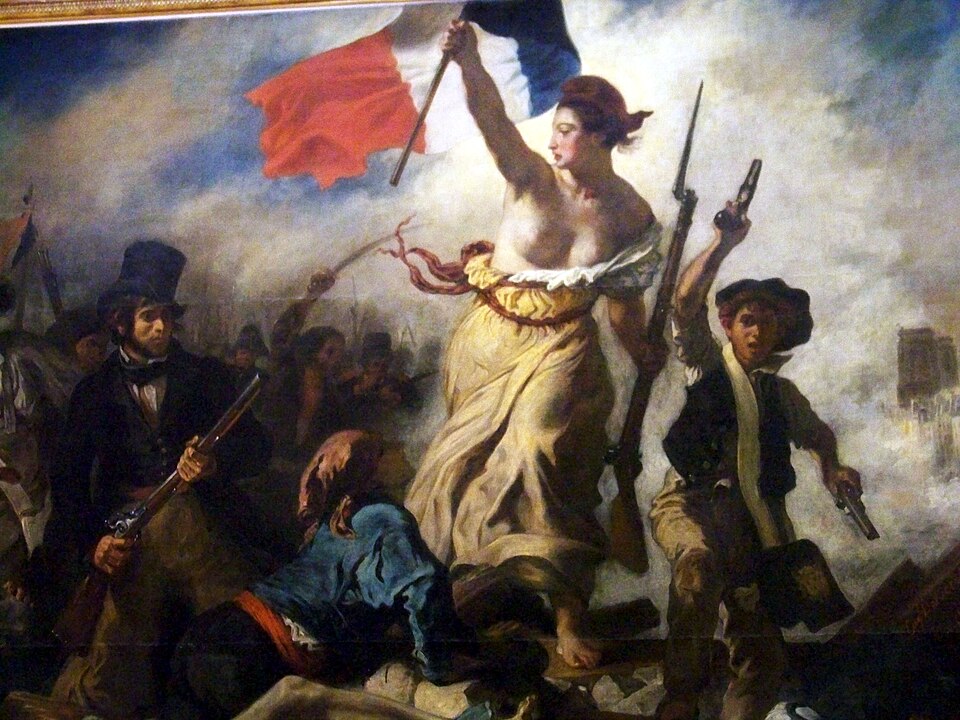 Eugène Delacroix’s famous painting of the French Revolution (Image: Eugène Delacroix, CC BY 2.0, via Wikimedia Commons)
How These Revolutions Connect to Nepal
Nepal’s history also has revolutions and struggles for freedom:
- 1951 Democratic Revolution: Ended the Rana autocracy and brought democracy.
- 1990 People’s Movement: Overthrew the king’s absolute monarchy and established a democracy.
- Maoist Insurgency (1996–2006): A people’s war against the monarchy (though controversial).
Comparison Table: Nepal’s Revolutions vs. American/French
| Aspect | American/French Revolutions | Nepal’s Revolutions |
|---|---|---|
| Main Cause | Tyranny, inequality | Monarchy’s autocracy, lack of democracy |
| Key Leaders | Washington, Robespierre | King Mahendra, Gyanendra, Maoists, Jana Andolan leaders |
| Key Event | Storming of Bastille, Declaration of Independence | 1951 Revolution, 1990 Jana Andolan |
| Outcome | Democracy, nationalism | Democratic constitution, republic (2008) |
| Violence Level | High (especially France) | Mixed (1951 peaceful, Maoist war violent) |
Exam Tips for NEB Class 11 History
NEB exams test causes, events, and impacts. Here’s how to score full marks:
For Short Answer Questions (SAQs):
- Example Question: "What were the main causes of the American Revolution?"
- How to Answer:
The American Revolution was caused by British taxation without representation (e.g., Stamp Act, Townshend Acts), trade restrictions (Navigation Acts), and Enlightenment ideas (Locke’s natural rights). The Boston Tea Party (1773) and Boston Massacre (1770) were immediate triggers that united the colonies.
For Long Answer Questions (LAQs):
- Example Question: "Compare the causes and impacts of the American and French Revolutions."
- How to Answer: Use a comparison table (like above) and explain 3 causes and 3 impacts for each. Mention similarities (Enlightenment influence, nationalism) and differences (violence level, outcomes).
For Map-Based Questions:
- If asked to locate key places (e.g., Boston, Versailles, Yorktown), draw a simple map with labels.
For Source-Based Questions:
- If given a quote or document, identify:
- Who wrote it?
- What was the main idea?
- How does it relate to the revolution?
- If given a quote or document, identify:
Common Mistakes to Avoid:
- ❌ Mixing up dates (e.g., saying the French Revolution started in 1776).
- ❌ Ignoring causes—always explain why something happened.
- ❌ Overlooking impacts—NEB loves questions like "How did this revolution change the world?"
Practice Question (NEB Style): "The French Revolution was more radical than the American Revolution. Do you agree? Justify with examples." Model Answer:
Yes, the French Revolution was more radical. While both were influenced by Enlightenment ideas, the French Revolution abolished monarchy, executed the king (Louis XVI), and had the Reign of Terror (40,000 executions). In contrast, the American Revolution was a war for independence but kept slavery and had no mass executions. The French Revolution also spread secularism (separation of Church and state), whereas America remained religiously diverse but not secular.
Final Note: Revolutions are not just about wars—they’re about ideas. The American and French Revolutions showed that people could overthrow unjust rulers and demand freedom and equality. Their legacies still shape democracies, human rights, and nationalism today.
Revise with:
- Timelines of key events.
- Comparison tables (causes, impacts).
- Maps of battle sites and revolutions.
- Quotes from Enlightenment thinkers and revolutionaries.
Good luck! 🚀
Based on the NEB +2 Humanities syllabus for History (His), unit 9.
Discussion
Loading…