Political ScienceUnit 119 min read
Political Ideologies: Definitions, Types & Real-World Examples
Unit 11 of Political Science explores the core ideas behind political ideologies—what they are, how they shape governments, and their key differences (liberalism, socialism, fascism, etc.)—with clear definitions, comparisons, and NEB-style questions.
TAKEAWAYS:
- Political ideologies are sets of beliefs about power, freedom, and society that guide governments.
- Major ideologies include liberalism (freedom), socialism (equality), and fascism (authority).
- Ideologies shape laws, economies, and political systems (e.g., democracy vs. dictatorship).
- Nepal’s constitution reflects a mix of ideologies (e.g., federalism + socialist principles).
- NEB exams test definitions, comparisons, and real-world examples (e.g., "How does liberalism differ from socialism?").
What Are Political Ideologies?
Political ideologies are sets of ideas about how a society should be organized. They answer questions like:
- Who should hold power?
- How should wealth be distributed?
- What rights should people have?
Example: If a country believes in equality, its government might provide free healthcare (like in Sweden). If it believes in freedom, it might allow private businesses to operate without strict rules (like in the U.S.).
 A horizontal line showing left (socialism) to right (fascism) with liberalism in the center. (Image: Mielas, CC BY-SA 4.0, via Wikimedia Commons)
Key Political Ideologies
Here are the five major ideologies you must know for NEB:
1. Liberalism
Definition: Liberalism supports individual freedom, private property, and limited government. It believes people should have rights like speech, religion, and voting.
Key Features:
- Economic Freedom: People can own businesses and trade freely.
- Democracy: Power comes from the people (elections).
- Rule of Law: Laws apply equally to everyone.
Example: The U.S. Constitution is based on liberal ideas (freedom of speech, private property).
Advantages: ✅ Encourages innovation and personal choice. ✅ Protects minority rights.
Disadvantages: ❌ Can lead to wealth inequality (rich get richer). ❌ May ignore social welfare (poor may suffer).
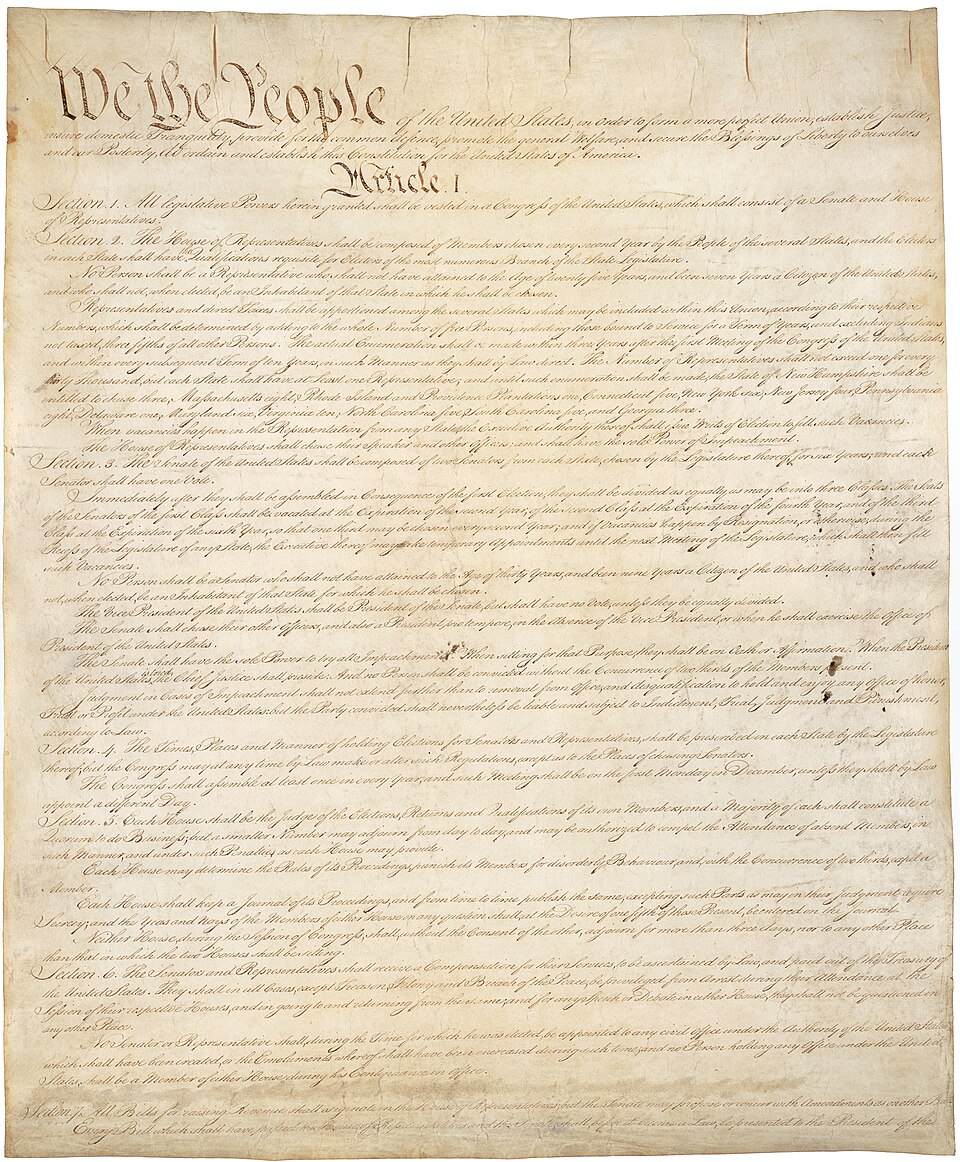 A photo of the original Constitution showing the Bill of Rights. (Image: Constitutional Convention, Public domain, via Wikimedia Commons)
2. Socialism
Definition: Socialism believes in collective ownership (government or workers control resources) to reduce inequality.
Key Features:
- Public Services: Healthcare, education, and housing are free or subsidized.
- Wealth Redistribution: Taxes fund social programs (e.g., pensions).
- Worker Rights: Unions and fair wages are protected.
Example: Sweden has socialist policies (free university, strong welfare).
Advantages: ✅ Reduces poverty and provides safety nets. ✅ Focuses on public good (e.g., clean water, schools).
Disadvantages: ❌ High taxes can discourage business growth. ❌ Government control may limit personal freedom.
3. Fascism
Definition: Fascism is authoritarian (one leader has absolute power) and nationalist (prioritizes the nation over individuals).
Key Features:
- Strong Leader: A dictator controls the government.
- Militarism: Glorifies war and military strength.
- Suppression of Opposition: No free press or protests.
Example: Nazi Germany (Hitler) and Fascist Italy (Mussolini) were fascist regimes.
Advantages: ✅ Can bring quick economic growth (e.g., infrastructure projects). ✅ Strong national unity (in times of crisis).
Disadvantages: ❌ Violates human rights (censorship, persecution). ❌ Leads to wars and oppression.
4. Communism
Definition: Communism is an extreme form of socialism where the government owns all property and there is no private ownership.
Key Features:
- Classless Society: No rich or poor—everyone shares equally.
- State Control: Government runs factories, farms, and businesses.
- No Political Parties: Only one party (usually communist) is allowed.
Example: Cuba and North Korea have communist governments.
Advantages: ✅ Eliminates extreme poverty (theoretically). ✅ Focuses on collective good over individual greed.
Disadvantages: ❌ Lack of competition leads to inefficiency (e.g., shortages). ❌ No freedom of speech or dissent.
5. Anarchism
Definition: Anarchism rejects all government and believes in self-governance by communities.
Key Features:
- No Police or Army: People solve conflicts peacefully.
- Voluntary Cooperation: People work together without force.
- Direct Democracy: Everyone votes on decisions.
Example: Rojava (Syrian Kurdistan) has anarchist-inspired self-governance.
Advantages: ✅ Encourages equality and grassroots democracy. ✅ Reduces corruption (no government officials).
Disadvantages: ❌ Hard to enforce laws (chaos if conflicts arise). ❌ Difficult to provide public services (e.g., roads, hospitals).
Comparison Table: Liberalism vs. Socialism vs. Fascism
| Feature | Liberalism | Socialism | Fascism |
|---|---|---|---|
| Government Role | Limited (hands-off) | Strong (welfare state) | Total control (dictator) |
| Economy | Free market | Mixed (public + private) | State-controlled |
| Freedom | High (individual rights) | Moderate (collective good) | None (suppressed) |
| Example Country | USA, UK | Sweden, Cuba | Nazi Germany |
Political Ideologies in Nepal
Nepal’s 2015 Constitution reflects a mix of ideologies:
- Federalism (like liberalism—power to provinces).
- Socialist Principles (Article 4: "Nepal is a socialist republic").
- Secularism (like liberalism—no state religion).
Why? Nepal balances freedom (democracy) with equality (welfare programs).
How Ideologies Shape Governments
Ideologies influence:
- Laws (e.g., liberalism → free speech laws; fascism → censorship).
- Economy (e.g., socialism → public healthcare; liberalism → private hospitals).
- Political System (e.g., democracy → elections; dictatorship → no elections).
Example:
- Liberal Democracy (USA): Free elections, private businesses.
- Socialist Democracy (Sweden): Free healthcare, high taxes.
- Fascist Dictatorship (North Korea): One-party rule, no freedoms.
flowchart TD
    A["Political Ideology"] --> B["Liberalism"]
    A --> C["Socialism"]
    A --> D["Fascism"]
    A --> E["Communism"]
    A --> F["Anarchism"]
    B --> G["Free Market<br/>Democracy"]
    C --> H["Public Ownership<br/>Welfare"]
    D --> I["Dictatorship<br/>Militarism"]
    E --> J["Classless Society<br/>State Control"]
    F --> K["No Government<br/>Self-Rule"]
NEB-Style Questions & Answers
Short Answer (5 marks)
Q: Differentiate between liberalism and socialism. A:
| Liberalism | Socialism |
|---|---|
| Supports private property. | Supports public ownership. |
| Believes in free market. | Believes in government control of key industries. |
| Example: USA (capitalist). | Example: Sweden (welfare state). |
| Focus: Individual freedom. | Focus: Collective equality. |
Long Answer (10 marks)
Q: Explain the features of fascism and its impact on society. A: Fascism is an authoritarian ideology where a dictator holds absolute power. Its key features are:
- Strong Leader: One person (e.g., Hitler, Mussolini) controls the government.
- Militarism: The military is glorified, and wars are common.
- Suppression of Opposition: No free press, protests, or political parties.
- Nationalism: The country is prioritized over individuals.
Impact on Society: ✅ Short-term: Can bring economic growth (e.g., infrastructure projects). ✅ National Unity: People may rally behind a common cause (e.g., war). ❌ Human Rights Violations: Censorship, persecution of minorities. ❌ Wars: Fascist regimes often lead to conflicts (e.g., WWII).
Example: Nazi Germany under Hitler used fascist policies, leading to WWII and the Holocaust.
Exam Tip
- Memorize Definitions: Know the core beliefs of each ideology (e.g., "Liberalism = freedom; Socialism = equality").
- Compare & Contrast: NEB loves questions like "How is fascism different from democracy?"
- Use Real Examples: Mention countries (USA for liberalism, Sweden for socialism).
- Link to Nepal: Show how Nepal’s constitution mixes ideologies (e.g., federalism + socialism).
- Avoid Confusion:
- Socialism ≠ Communism (Socialism allows some private ownership; communism abolishes it).
- Fascism ≠ Democracy (Fascism has no elections; democracy does).
Final Thought: Political ideologies are like recipes for running a country. Some focus on freedom (liberalism), others on equality (socialism), and some on control (fascism). Nepal’s constitution is like a mix of recipes—taking the best from different ideologies!
Based on the NEB +2 Humanities syllabus for Political Science (Pol), unit 11.
Discussion
Loading…