Political ScienceUnit 1013 min read
Nepal’s Constitution: From Rana Rule to Federalism
Unit 10 of Political Science explores Nepal’s constitutional journey—from the 1948 democracy movement to the 2015 federal constitution, analyzing key documents, struggles, and transitions that shaped modern Nepal.
TAKEAWAYS:
- Nepal’s constitutional history spans 1948–2015, marked by democratic movements, monarchical control, and federalism.
- The 1990 constitution ended the Panchayat system but failed due to the Maoist insurgency.
- The 2006 Interim Constitution abolished monarchy and established a republic.
- The 2015 constitution created a federal democratic republic with 7 provinces.
- Key challenges included monarchy vs. democracy, ethnic federalism, and peace processes.
- Exam focus: Compare constitutions, explain transitions, and link to Nepal’s current political system.
Nepal’s Constitutional Timeline: A Visual Journey
gantt
    title Nepal’s Constitutional Development (1948–2015)
    dateFormat  YYYY
    section Monarchical Rule
    Rana Rule (1846–1951) :1846, 5y
    section Democratic Struggles
    1948 Democracy Movement :1948, 0m
    1951 Interim Constitution :1951, 0m
    1959 Constitution (Parliamentary Monarchy) :1959, 0m
    section Panchayat Era
    1962 Panchayat System :1962, 28y
    section Democratic Transition
    1990 Constitution (End of Panchayat) :1990, 0m
    1999 Civil War Begins :1999, 0m
    section Interim Period
    2006 Interim Constitution (Republic) :2006, 0m
    2008 Constituent Assembly (CA) :2008, 0m
    section Federal Republic
    2015 Federal Democratic Constitution :2015, 0m
1. Pre-1948: The Rana Rule (1846–1951)
What was it?
- Nepal was ruled by the Rana Prime Ministers (e.g., Jung Bahadur Rana) under the Gorkha king (like a puppet).
- The Ranas controlled the army, government, and economy—no democracy.
- Key fact: The king was a symbol, but real power was with the Ranas.
Why did it end?
- 1948 Democracy Movement: Led by B.P. Koirala and Ganesh Man Singh, students and citizens demanded:
- End of Rana rule.
- A written constitution.
- Universal suffrage (right to vote for all adults).
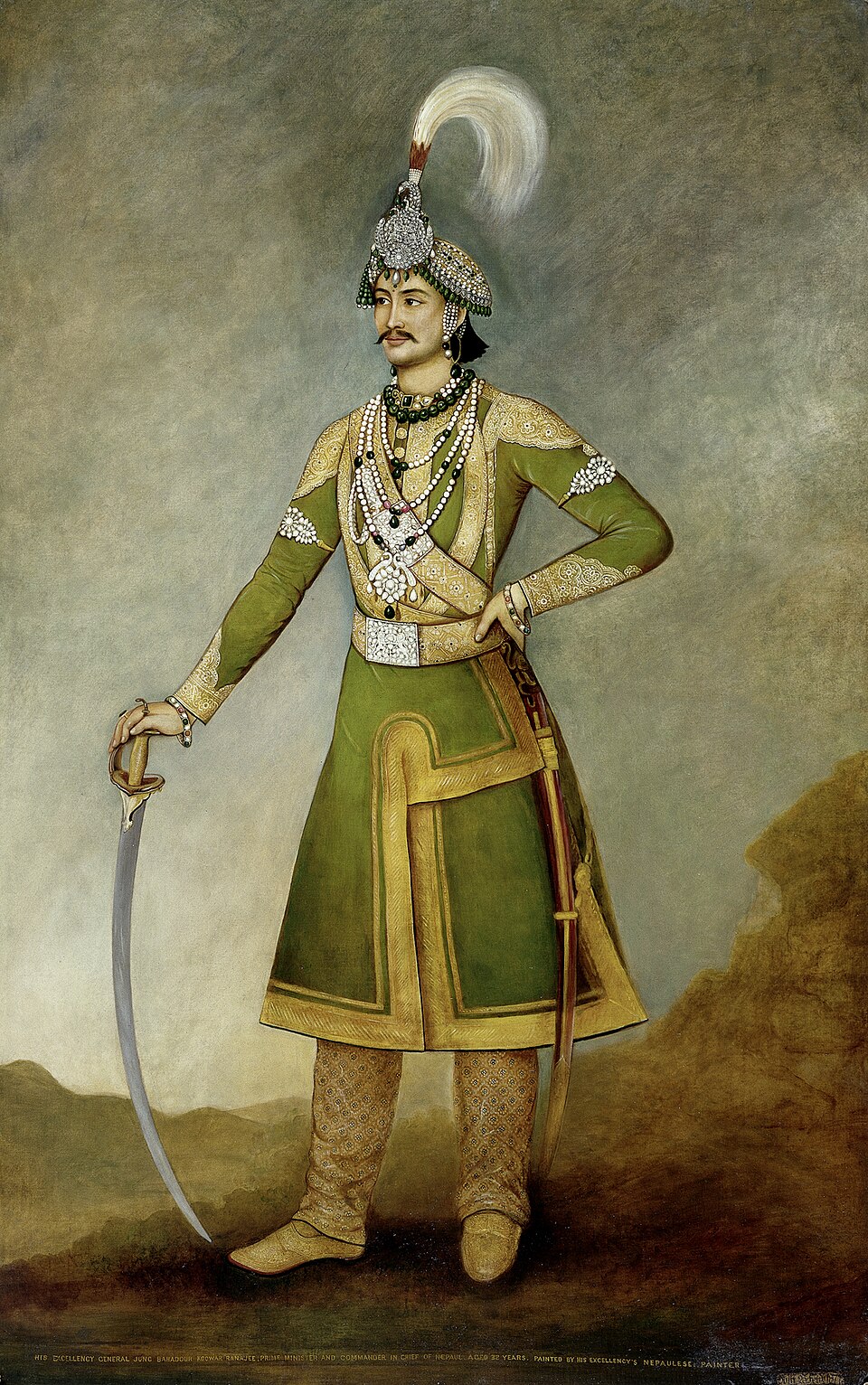 First Rana Prime Minister of Nepal (1846–1877) (Image: Bhaujaman Citrakar (active 1849), Public domain, via Wikimedia Commons)
2. 1951 Interim Constitution: First Democratic Step
What did it do?
- Ended Rana rule and restored king’s power.
- Created a bicameral legislature (House of Representatives + National Panchayat).
- Limitation: The king still had absolute power (not a full democracy).
Key Provisions:
| Feature | Details |
|---|---|
| Government | King + Council of Ministers (appointed by the king). |
| Legislature | National Panchayat (elected) + House of Representatives (appointed). |
| Fundamental Rights | Limited (no strong protections). |
| Electoral System | Restricted franchise (only property owners could vote). |
Why did it fail?
- The king dissolved the legislature in 1959 and introduced the Panchayat system.
3. 1962 Panchayat System: "Guided Democracy"
What was it?
- King Mahendra introduced a one-party system (Nepal Congress banned).
- Local governance through Panchayats (village councils).
- No political parties, only the Rastriya Panchayat Party (government party).
Structure of Panchayat System:
Why was it unpopular?
- No democracy: People had no say in government.
- Suppression: Opposition leaders (like B.P. Koirala) were jailed.
- Economic struggles: Poverty and corruption worsened.
4. 1990 Constitution: End of Panchayat, Birth of Democracy
How did it happen?
- People’s Movement (Jana Andolan I, 1990): Mass protests forced King Birendra to restore democracy.
- New constitution was written in 9 months (record speed!).
Key Features of 1990 Constitution:
| Feature | Details |
|---|---|
| Government | Multi-party democracy. |
| Legislature | Bicameral: House of Representatives (directly elected) + National Panchayat (indirectly elected). |
| Fundamental Rights | Strong protections: Freedom of speech, press, assembly. |
| Judiciary | Independent Supreme Court. |
| Electoral System | Universal adult suffrage (all adults could vote). |
Why did it fail?
- Maoist insurgency (1996–2006): The Maoists rebelled against the government.
- Weak implementation: Corruption and ethnic discrimination continued.
- King’s role: The monarchy still had influence over politics.
5. 2006 Interim Constitution: Nepal Becomes a Republic
What triggered it?
- Second People’s Movement (Jana Andolan II, 2006): After a 10-year civil war, people demanded:
- End of monarchy.
- New constitution.
- Peace and reconciliation.
Key Changes in 2006 Interim Constitution:
- Abolished monarchy: Nepal became a federal democratic republic.
- New government: Council of Ministers (led by a Prime Minister).
- Truth and Reconciliation Commission: To address human rights abuses from the civil war.
- Federalism: Prepared the way for provinces (later in 2015).
Timeline of 2006 Transition:
gantt
    title 2006: Nepal’s Democratic Transition
    dateFormat  YYYY-MM
    section Events
    Jana Andolan II Begins :2006-04, 0m
    King Gyanendra Abdicates :2006-05, 0m
    Interim Constitution Approved :2006-05, 0m
    Constituent Assembly Elected :2008-04, 0m
6. 2015 Federal Democratic Constitution: Nepal Today
Why was it needed?
- The 2008 Constituent Assembly (CA) failed to draft a constitution by the deadline.
- Ethnic conflicts: Marginalized groups (like Madhesis, Tharus, Janajatis) demanded federalism.
- Peace process: The Maoist insurgency needed to be resolved.
Key Features of 2015 Constitution:
| Feature | Details |
|---|---|
| Government | Federal democratic republic. |
| Federal Structure | 7 provinces (instead of earlier plans for 14). |
| Executive | President (ceremonial) + Prime Minister (head of government). |
| Legislature | Bicameral: House of Representatives (directly elected) + National Assembly (indirectly elected). |
| Judiciary | Independent Supreme Court + provincial high courts. |
| Fundamental Rights | Strong protections, including right to self-rule for provinces. |
| Electoral System | Proportional representation + first-past-the-post. |
Provinces of Nepal (2015):
mindmap
  root((Nepal))
    Province 1
    Province 2
    Province 3
    Province 4
    Province 5
    Province 6
    Province 7
Challenges After 2015:
- Madhesi protests: Disputes over border demarcation and citizenship.
- Economic struggles: High unemployment, corruption.
- Political instability: Frequent government changes.
7. Comparing Nepal’s Constitutions
| Year | Type of Government | Key Features | Major Challenges |
|---|---|---|---|
| 1951 | Parliamentary Monarchy | King + bicameral legislature | Limited democracy, king’s power |
| 1962 | Panchayat System | One-party rule, no elections | Suppression, no political freedom |
| 1990 | Multi-party Democracy | Fundamental rights, independent judiciary | Maoist insurgency, weak governance |
| 2006 | Interim Republic | Abolished monarchy, truth commissions | Transition struggles, ethnic issues |
| 2015 | Federal Democratic Republic | 7 provinces, strong rights | Madhesi protests, economic issues |
8. Why Did Nepal Struggle with Constitutions?
flowchart TD
    A["Weak Governance"] --> B["Corruption"]
    B --> C["Ethnic Discrimination"]
    C --> D["Maoist Insurgency"]
    D --> E["King's Influence"]
    E --> F["Failed Implementations"]
    F --> A
Key Reasons:
- Monarchy’s role: Kings often interfered in politics.
- Ethnic federalism: Hard to satisfy all groups (e.g., Madhesis vs. Hill people).
- Civil war: The Maoist conflict (1996–2006) delayed stability.
- Political parties: Selfish interests over national unity.
Exam Tip: How to Score Full Marks
- Memorize key dates:
- 1948 (Democracy Movement), 1951 (Interim Constitution), 1962 (Panchayat), 1990 (End of Panchayat), 2006 (Republic), 2015 (Federal Constitution).
- Compare constitutions in tables (like above).
- Explain causes and effects:
- Why did Panchayat fail? → No democracy, suppression.
- Why 2015 constitution? → Ethnic demands, peace process.
- Link to current Nepal:
- "Nepal is now a federal republic because of the 2015 constitution, which replaced the 2006 interim setup."
- Use real examples:
- "The Madhesi protests (2015–16) showed how ethnic federalism was not fully addressed."
- Avoid vague answers:
- ❌ "The 1990 constitution was good."
- ✅ "The **1990 constitution ended Panchayat but failed due to the Maoist insurgency, leading to the 2006 interim constitution."
NEB Board-Style Questions (Practice!)
Short Answer (5 marks each)
"Explain the main features of the 1990 constitution of Nepal."
- Answer:
- Ended Panchayat system.
- Established multi-party democracy.
- Bicameral legislature (House of Representatives + National Panchayat).
- Fundamental rights (freedom of speech, press).
- Independent judiciary.
- Answer:
"Why did the 2006 interim constitution abolish the monarchy?"
- Answer:
- People’s Movement (Jana Andolan II) demanded an end to royal interference.
- The civil war (1996–2006) weakened the monarchy’s legitimacy.
- The king (Gyanendra) had tried to seize power in 2005, losing public trust.
- The Constituent Assembly (2008) voted to abolish monarchy.
- Answer:
Long Answer (10 marks)
- "Trace the constitutional development of Nepal from 1948 to 2015. How did each constitution address the political challenges of its time?"
- Answer Structure:
- 1948–1951: Democracy movement → 1951 Interim Constitution (ended Rana rule but kept king’s power).
- 1959 Constitution: Parliamentary monarchy but weak democracy.
- 1962 Panchayat: One-party rule → suppression of democracy.
- 1990 Constitution: End of Panchayat → multi-party democracy but Maoist insurgency.
- 2006 Interim Constitution: Abolished monarchy, truth commissions, prepared for federalism.
- 2015 Constitution: Federal democratic republic, 7 provinces, but Madhesi protests.
- Answer Structure:
Critical Thinking (8 marks)
- "Do you think Nepal’s 2015 constitution has successfully addressed all the challenges of the past? Justify your answer with examples."
- Answer:
- Successes:
- Federalism: Gave autonomy to provinces (e.g., Province 2 for Madhesis).
- Republic: Ended monarchy’s political role.
- Rights: Stronger fundamental rights for all citizens.
- Challenges Remaining:
- Madhesi protests (2015–16): Citizenship issue (who is a Nepali?) still unresolved.
- Economic struggles: Unemployment, corruption persist.
- Political instability: Frequent government changes (e.g., 2018–2021).
- Conclusion: The 2015 constitution was a major step, but full stability requires more reforms.
- Successes:
- Answer:
Final Summary: Nepal’s Constitutional Journey
Key Takeaway: Nepal’s constitution evolved from monarchy → democracy → republic → federalism, but challenges like ethnic federalism and stability remain.
Now you’re ready for the NEB exam!
- Revise the timeline.
- Practice comparing constitutions.
- Link each constitution to Nepal’s political struggles.
Based on the NEB +2 Humanities syllabus for Political Science (Pol), unit 10.
Discussion
Loading…