Political ScienceUnit 912 min read
Political Parties & Pressure Groups: Types, Roles & Differences
Unit 9 of Political Science explains how political parties and pressure groups function as key players in democracy, their types, roles, and how they differ—essential for NEB exams with real-world examples and comparison tables.
TAKEAWAYS:
- Political parties are organized groups that contest elections to form governments, while pressure groups influence policies without seeking power.
- Parties are classified by ideology (left, right, centrist) and structure (single-party vs. multi-party systems).
- Pressure groups use lobbying, protests, and media campaigns to shape public opinion and policy.
- Both parties and groups strengthen democracy but can also cause instability if unchecked.
- Nepal’s political landscape includes major parties like Nepali Congress and CPN-UML, and groups like FEDINE and INSEC.
- NEB exams test definitions, roles, and comparisons—always link theory to Nepal’s context.
What Are Political Parties?
Political parties are organized groups of people who share similar political ideas and work together to:
- Contest elections.
- Form governments.
- Influence policies.
Why Do We Need Political Parties?
Without parties, elections would be chaotic—imagine thousands of independent candidates with no shared goals! Parties help by:
- Simplifying choices: Voters pick a party’s platform instead of individual candidates.
- Stability: Governments can function smoothly with clear leadership.
- Representation: Different parties represent diverse interests (e.g., farmers, workers, youth).
Types of Political Parties
Parties can be classified in two main ways:
1. By Ideology (Political Spectrum)
graph LR
    A["Left-Wing (Socialist/Communist)"]
    B["Centre (Moderate/Reformist)"]
    C["Right-Wing (Conservative/Liberal)"]
    A -->|"Supports equality, state control"| D["Examples: CPN-UML (Nepal), Labour Party (UK)"]
    B -->|"Balanced policies"| E["Examples: Nepali Congress, Democratic Party (US)"]
    C -->|"Supports free markets, tradition"| F["Examples: Rastriya Prajatantra Party (Nepal), Republicans (US)"]
2. By System of Government
| Type | Definition | Example in Nepal | Pros | Cons |
|---|---|---|---|---|
| Single-Party System | Only one party is allowed to rule. | (Historical: Panchayat System, 1960–1990) | Strong leadership, no conflicts | No democracy, suppresses dissent |
| Two-Party System | Two major parties dominate (e.g., US, UK). | (Not common in Nepal) | Stable governments, clear choices | Ignores smaller groups |
| Multi-Party System | Many parties compete (common in Nepal). | Nepali Congress, CPN-UML, Maoist Centre | Represents diverse views | Coalition governments can be unstable |
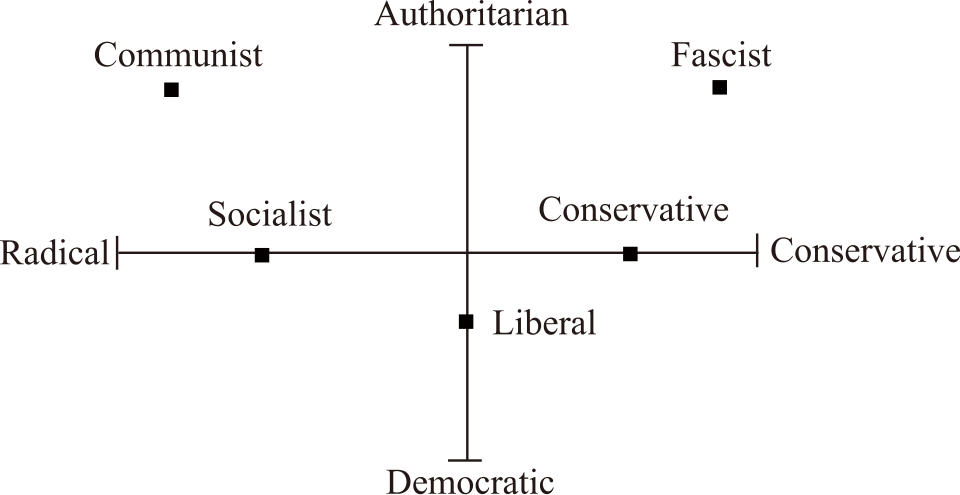 A horizontal line showing Left (Socialism) to Right (Conservatism) with Nepal’s major parties placed. (Image: Original: Uwe Backes Vector: Ib, Public domain, via Wikimedia Commons)
How Do Political Parties Work?
Functions of Political Parties
- Forming Governments
- Win elections → form cabinets (e.g., KP Oli’s government in 2021).
- Opposition Role
- Criticize the government (e.g., Nepali Congress opposing CPN-UML policies).
- Education & Awareness
- Teach voters about issues (e.g., campaigns on federalism).
- Policy Making
- Draft manifestos (e.g., promises on education, healthcare).
How Parties Win Elections
- Campaigning: Rallies, posters, social media.
- Manifestos: Promises they’ll keep if elected.
- Alliances: Parties join coalitions (e.g., 2017 election alliance between Nepali Congress and Maoist Centre).
SOLVED EXAMPLE: Identify the Type of Party Question: The Rastriya Prajatantra Party (RPP) in Nepal supports monarchy, free markets, and traditional values. Is it left-wing, right-wing, or centrist? Answer:
- Right-wing because it supports tradition (monarchy) and free markets (capitalism).
- Why not left-wing? Left parties support equality and state control (e.g., CPN-UML’s socialist policies).
What Are Pressure Groups?
Pressure groups (or interest groups) are organizations that try to influence government policies but do not seek power directly. Examples:
- FEDINE (Federation of Disabled) – Advocates for disabled rights.
- INSEC (Investment Board) – Promotes business-friendly policies.
- Trade Unions (e.g., NTUC) – Fight for workers’ rights.
How Do Pressure Groups Work?
They use non-violent methods to shape policy:
- Lobbying: Meeting politicians to discuss issues (e.g., doctors’ associations lobbying for better hospitals).
- Protests & Strikes: Demonstrations, strikes (e.g., teachers’ protests for salary hikes).
- Media Campaigns: Ads, social media (e.g., #SaveLakes for environmental protection).
- Petitions: Collecting signatures (e.g., against corruption).
Key Differences: Political Parties vs. Pressure Groups
| Feature | Political Parties | Pressure Groups |
|---|---|---|
| Goal | Win elections, form government | Influence policy without seeking power |
| Membership | Open to all (voters) | Limited (e.g., only doctors, farmers) |
| Methods | Elections, manifestos, coalitions | Lobbying, protests, media campaigns |
| Example in Nepal | Nepali Congress, CPN-UML | FEDINE, INSEC, NTUC |
| Power Source | Majority votes | Public support, expertise |
Advantages and Disadvantages
Political Parties
✅ Pros:
- Provide stable governments.
- Give voters clear choices.
- Hold governments accountable.
❌ Cons:
- Can become corrupt (e.g., money politics in Nepal).
- Divide society (e.g., ethnic or caste-based parties).
- Coalition governments can be weak (e.g., frequent changes in Nepal).
Pressure Groups
✅ Pros:
- Represent minority groups (e.g., Dalits, women).
- Keep government aware of public issues.
- Peaceful way to demand change.
❌ Cons:
- Can disrupt society (e.g., strikes, blockades).
- Elite-dominated (wealthy groups have more influence).
- Sometimes undemocratic (e.g., blackmailing politicians).
Pressure Groups in Nepal: Case Studies
FEDINE (Disabled Federation)
- Goal: Rights for disabled people.
- Methods: Lobbying, legal battles, awareness campaigns.
- Success: Disability-friendly laws passed in 2017.
INSEC (Investment Board)
- Goal: Attract foreign investment.
- Methods: Meetings with ministers, business seminars.
- Success: Helped in post-earthquake reconstruction deals.
Trade Unions (NTUC)
- Goal: Better wages, working conditions.
- Methods: Strikes, protests.
- Challenge: Sometimes violent (e.g., 2015 transport strike).
How Are Parties and Groups Regulated in Nepal?
Nepal’s Electoral Commission and Constitution control parties and groups:
- Party Registration: Must register with the Election Commission.
- Funding Rules: Parties must disclose donations (to prevent corruption).
- Protest Laws: Groups can protest but cannot use violence (punishable by law).
- Anti-Corruption Laws: Politicians caught taking bribes are jailed.
SOLVED EXAMPLE: Legal Issue Question: A pressure group in Nepal organizes a strike that blocks all roads for 3 days. Is this legal? Answer:
- No, because:
- The Constitution guarantees right to movement (Article 24).
- Civil Code 2074 punishes unlawful strikes that disrupt public life.
- Exception: If the strike is peaceful and for a just cause (e.g., teachers demanding salary), it may be tolerated—but 3-day blockades are illegal.
Exam Tip: How to Score Full Marks in NEB Questions
NEB exams test definitions, comparisons, and Nepal’s context. Follow these tips:
1. Define Clearly
- Example Question: What is a political party?
- Good Answer:
"A political party is an organized group of people with common political goals who contest elections to form governments and influence policies. In Nepal, parties like Nepali Congress and CPN-UML compete in elections to win majority seats in Parliament."
2. Compare with Tables
- Example Question: Differentiate between political parties and pressure groups.
- Use the table above but add Nepal examples:
Feature Political Parties Pressure Groups Example Nepali Congress (wants to form govt) FEDINE (wants rights for disabled)
3. Link to Nepal
- Example Question: How do political parties contribute to democracy in Nepal?
- Good Answer:
*"Parties in Nepal strengthen democracy by:
- Representing diverse groups (e.g., Madhesi parties for Tarai communities).
- Holding governments accountable (e.g., opposition parties criticizing corruption).
- Promoting federalism (e.g., parties supporting provincial autonomy). However, coalition instability (e.g., frequent PM changes) is a challenge."*
4. Short-Answer Tips
For 2-mark questions, give one clear point + example.
- Q: Mention one role of pressure groups.
- A: Pressure groups influence policy—e.g., FEDINE lobbied for the Disability Rights Act 2017.
For 5-mark questions, use PEDAC (Point-Example-Development-Application-Conclusion).
- Q: Explain the functions of political parties.
- A:
- Form governments (e.g., CPN-UML formed government in 2021).
- Opposition role (e.g., Nepali Congress opposes CPN-UML’s policies).
- Education (e.g., parties teach voters about federalism).
- Policy making (e.g., manifestos promise free education).
- Application: Without parties, Nepal’s democracy would lack organization, leading to chaos like in the Panchayat era.
5. Common Mistakes to Avoid
- ❌ Vague answers: Don’t write "Parties are important"—explain how.
- ❌ Ignoring Nepal: Always relate to Nepali parties/groups (e.g., NC, CPN-UML, FEDINE).
- ❌ Mixing terms: Don’t call a pressure group a "party" or vice versa.
NEB Board-Style Practice Questions
Short Answer (2 marks each)
- Define a political party with a Nepal example.
- Name two methods used by pressure groups to influence policy.
- What is a multi-party system? Give an example from Nepal.
- Why are pressure groups important for democracy?
Long Answer (5 marks each)
- "Political parties are the backbone of democracy." Explain with reference to Nepal.
- Compare and contrast political parties and pressure groups, using examples from Nepal.
- How do pressure groups like FEDINE and INSEC contribute to Nepal’s development? Discuss.
- Explain the advantages and disadvantages of a multi-party system in Nepal.
Summary Flowchart
flowchart TD
    A["Political System"] --> B["Political Parties"]
    A --> C["Pressure Groups"]
    B --> B1["Types: Left/Right/Centre"]
    B --> B2["Functions: Form Govt, Opposition, Policy"]
    C --> C1["Types: Sectional/ Promotional/ Ideological"]
    C --> C2["Methods: Lobbying, Protests, Media"]
    B3["Example: Nepali Congress"] --> B4["Wins Elections"]
    C3["Example: FEDINE"] --> C4["Influences Laws"]
    B4 --> D["Government Formation"]
    C4 --> D["Policy Change"]
Final Revision Checklist
✅ Can you define political party and pressure group? ✅ Do you know 3 types of parties and 3 types of pressure groups? ✅ Can you compare parties and groups in a table? ✅ Do you remember Nepal examples (NC, CPN-UML, FEDINE, INSEC)? ✅ Can you explain one advantage and one disadvantage of each? ✅ Are you ready for NEB-style short and long questions?
Good luck! 🚀 This unit is 20% of your exam—master it, and you’ll score high.
Based on the NEB +2 Humanities syllabus for Political Science (Pol), unit 9.
Discussion
Loading…