PsychologyUnit 57 min read
Attention & Consciousness: Types, Models & States
Unit 5 of Psychology explores how we focus on information (attention) and become aware of ourselves and the world (consciousness), including their types, theories, and altered states—essential for NEB exams.
TAKEAWAYS:
- Attention is selective, divided, or sustained; consciousness varies from alertness to altered states (e.g., sleep, hypnosis).
- The filter model (Broadbent) and attenuation model (Treisman) explain how we process incoming stimuli.
- Consciousness includes levels (alertness, sleep) and states (waking, dreaming, meditative).
- Divided attention works best for simple tasks but fails under cognitive load.
- Altered states (e.g., hypnosis, drugs) temporarily change perception and memory.
- NEB often tests definitions, comparisons (e.g., attention vs. consciousness), and real-life applications (e.g., multitasking risks).
What is Attention?
Attention is the focused mental effort on specific information while ignoring distractions. It helps us prioritize what matters—like listening to a teacher in a noisy classroom.
Types of Attention
Selective Attention
- Focusing on one stimulus while ignoring others.
- Example: Reading a book while ignoring background noise.
- Real-world use: Drivers focusing on the road despite loud music.
Divided Attention
- Paying attention to multiple tasks at once.
- Example: Texting while walking (risky!).
- Limitations: Works for simple tasks (e.g., walking + talking) but fails for complex ones (e.g., driving + solving math).
Sustained Attention (Vigilance)
- Maintaining focus over long periods.
- Example: Air traffic controllers watching radar screens for hours.
- Fatigue risk: Performance drops after 30–60 minutes without breaks.
graph TD
    A["Attention Types"] --> B["Selective"]
    A --> C["Divided"]
    A --> D["Sustained"]
    B -->|"Example"| E["Reading in noise"]
    C -->|"Risk"| F["Texting while driving"]
    D -->|"Job"| G["Air traffic control"]
How Does Attention Work? Theories Explained
Two key models explain how we filter information:
1. Broadbent’s Filter Model (1958)
- Idea: The brain has a filter that lets only one message through at a time (like a radio tuner).
- Process:
- Sensory input → Filter (selects based on physical features like pitch).
- Selected message goes to short-term memory (STM) for processing.
- Unselected messages are blocked (ignored).
- Weakness: Fails to explain cocktail party effect (hearing your name in noise).
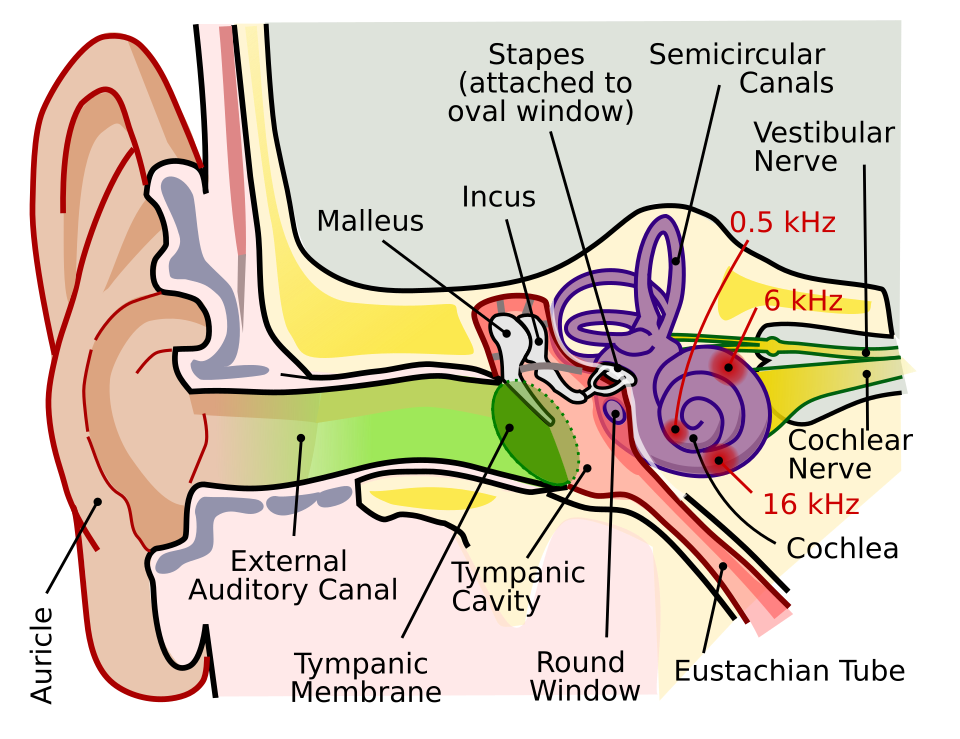 Label parts: outer ear, auditory nerve, brain filter (highlight the cochlea and filter step). (Image: Inductiveload, CC BY-SA 2.5, via Wikimedia Commons)
2. Treisman’s Attenuation Model (1964)
- Idea: The filter weakens (attenuates) irrelevant messages instead of blocking them completely.
- Process:
- All messages enter but are weakened (like turning down volume).
- Important words (e.g., your name) get boosted and reach consciousness.
- Strength: Explains the cocktail party effect!
- Weakness: Doesn’t explain how we switch attention between tasks.
graph LR
    A["Sensory Input"] --> B["Attenuator"]
    B --> C["Weakened Messages"]
    B --> D["Boosted Message\n(e.g., your name)"]
    D --> E["Consciousness"]
    C -->|"Mostly ignored"| F["Unprocessed"]
Attention in Real Life: Examples & Risks
| Scenario | Attention Type | Risk if Failed |
|---|---|---|
| Studying with music | Selective | Distraction → Poor memory |
| Driving + GPS | Divided | Accidents (cognitive overload) |
| Night shift work | Sustained | Microsleeps → Errors |
NEB-style question: "Why do students perform poorly in exams if they multitask (e.g., listening to music + studying)?" Answer: Multitasking forces divided attention, reducing focus on the primary task (studying). The brain struggles to allocate resources, leading to shallow processing and poor memory retention.
What is Consciousness?
Consciousness is awareness of ourselves and our environment. It includes:
- Self-awareness (knowing you exist).
- Perception of the world (seeing, hearing, feeling).
- Thoughts and feelings (happiness, fear).
Levels of Consciousness
| Level | Description | Example |
|---|---|---|
| Alertness | Fully awake, responsive | Studying in class |
| Drowsiness | Reduced focus, slow reactions | After lunch |
| Sleep | Unconscious, brain rests | Deep sleep (REM vs. non-REM) |
| Coma | No awareness, brain activity low | Medical emergency |
States of Consciousness
Consciousness changes based on internal (biology) and external (environment) factors.
1. Normal Waking Consciousness
- Characteristics: Logical thinking, full sensory awareness.
- Example: Solving a math problem.
2. Altered States of Consciousness (ASCs)
Temporary changes in perception, memory, or emotion caused by:
- Drugs (e.g., alcohol lowers inhibition).
- Hypnosis (heightened suggestibility).
- Meditation (deep relaxation, focus).
- Sleep (dreams, lucid dreaming).
Comparison Table:
| State | Perception | Memory | Control |
|---|---|---|---|
| Normal | Clear, logical | Accurate | Full |
| Hypnosis | Suggestible | Selective | Reduced |
| Drugs (e.g., LSD) | Distorted | Fragmented | Impaired |
| Meditation | Heightened awareness | Clear | Enhanced focus |
How Do We Measure Consciousness?
Psychologists use:
- Self-reports (e.g., "How alert are you on a scale of 1–10?").
- Behavioral tests (e.g., reaction time to stimuli).
- Brain scans (EEG measures electrical activity during sleep/meditation).
Example: An EEG shows slow delta waves during deep sleep and fast beta waves when alert.
Exam Tip: How to Score Full Marks
Define clearly:
- "Attention is the cognitive process of selectively focusing on..."
- "Consciousness refers to..."
Compare models:
- "Broadbent’s filter model blocks all irrelevant messages, while Treisman’s attenuation model weakens them."
Use real-life examples:
- "Divided attention fails when driving because..."
Label diagrams:
- If asked to draw a filter model, label:
- Sensory input → Filter → STM → Unprocessed messages.
- If asked to draw a filter model, label:
Common NEB questions:
- "Differentiate between selective and divided attention." (Use a table.)
- "How does hypnosis alter consciousness?" (Mention suggestibility, memory changes.)
Practice Questions (NEB Style)
Short Answer: "Explain the cocktail party effect with reference to Treisman’s model."
Long Answer: "Describe the levels of consciousness with examples. How does sleep deprivation affect sustained attention?"
Application: "Why do students perform better in exams when they avoid multitasking?"
Key Formula to Remember: Attention = Focused Processing Consciousness = Awareness + Perception + Thoughts
Visual Summary:
mindmap
  root((Attention & Consciousness))
    Types
      Selective
      Divided
      Sustained
    Models
      Broadbent (Filter)
      Treisman (Attenuation)
    Consciousness
      Levels (Alert → Sleep)
      States (Normal → Altered)
    Applications
      Studying
      Driving
      Hypnosis
Based on the NEB +2 Humanities syllabus for Psychology (Psy), unit 5.
Discussion
Loading…