PsychologyUnit 69 min read
Learning: Types, Theories & Applications
Unit 6 of Psychology explores how learning occurs through classical and operant conditioning, observational learning, and cognitive theories, with real-world examples and exam-focused practice.
TAKEAWAYS:
- Learning is a permanent change in behavior due to experience, not just growth or fatigue.
- Classical conditioning (Pavlov) links stimuli to responses; operant conditioning (Skinner) rewards/punishes behaviors.
- Observational learning (Bandura) shows we learn by watching others (modeling).
- Cognitive theories (Tolman, Kohler) emphasize mental processes like insight and latent learning.
- Applications include education, therapy, and workplace training.
What is Learning?
Learning is a permanent change in behavior or thought that happens because of experience. It is not temporary (like fatigue) or natural growth (like a child growing taller). Learning helps us adapt to our environment.
Key Features of Learning:
- Experience-based: Learning happens through practice or observation.
- Permanent change: Unlike forgetting or temporary fatigue, learning lasts.
- Behavioral or cognitive: It can change how we act or think.
Types of Learning
There are four main types of learning in psychology:
- Classical Conditioning (Pavlov)
- Operant Conditioning (Skinner)
- Observational Learning (Bandura)
- Cognitive Learning (Tolman, Kohler)
Let’s explore each in detail.
1. Classical Conditioning (Pavlov’s Dog Experiment)
Classical conditioning is a learning process where a neutral stimulus (like a bell) becomes associated with a natural stimulus (like food) to produce a conditioned response (like salivation).
How It Works:
- Unconditioned Stimulus (UCS): Naturally triggers a response (e.g., food → salivation).
- Unconditioned Response (UCR): Natural reaction to UCS (e.g., salivation).
- Neutral Stimulus (NS): Initially does not trigger a response (e.g., bell).
- Conditioned Stimulus (CS): After pairing with UCS, triggers a response (e.g., bell → salivation).
- Conditioned Response (CR): Learned response to CS (e.g., salivation to bell).
Pavlov’s Experiment (Step-by-Step):
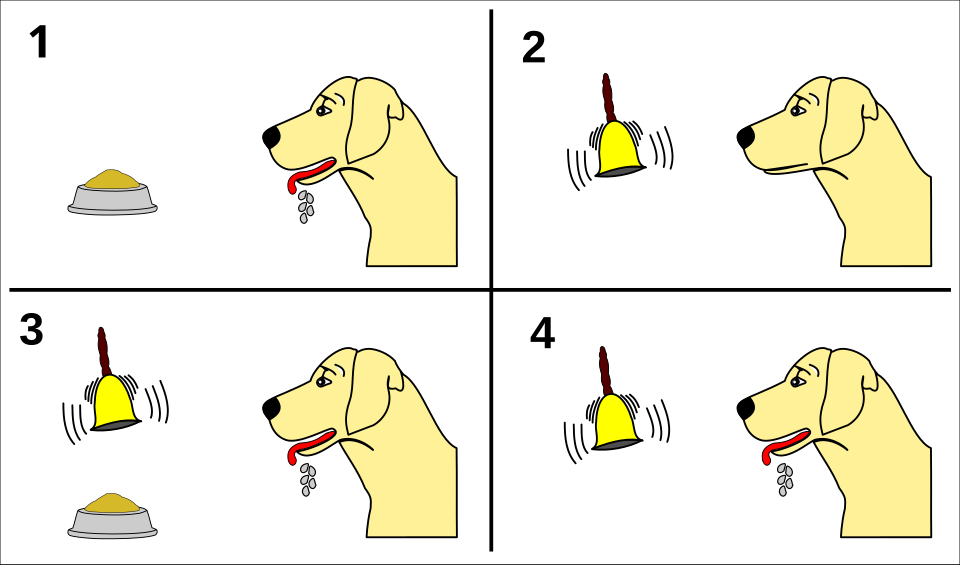 A dog salivating at the sound of a bell after conditioning (Image: Maxxl², CC BY-SA 4.0, via Wikimedia Commons)
Applications of Classical Conditioning:
- Therapy: Treating phobias (e.g., exposure therapy).
- Advertising: Associating products with positive emotions (e.g., a jingle with happiness).
- Education: Using praise to reinforce good behavior.
2. Operant Conditioning (Skinner’s Box)
Operant conditioning is learning through rewards (reinforcement) or punishments. Behavior increases if followed by a reinforcer and decreases if followed by a punisher.
Key Terms:
| Term | Definition |
|---|---|
| Reinforcement | Increases behavior (positive or negative). |
| Punishment | Decreases behavior (positive or negative). |
| Positive | Adding something (e.g., giving candy for good behavior). |
| Negative | Removing something (e.g., taking away chores for good grades). |
Skinner’s Experiment (Rat in a Box):
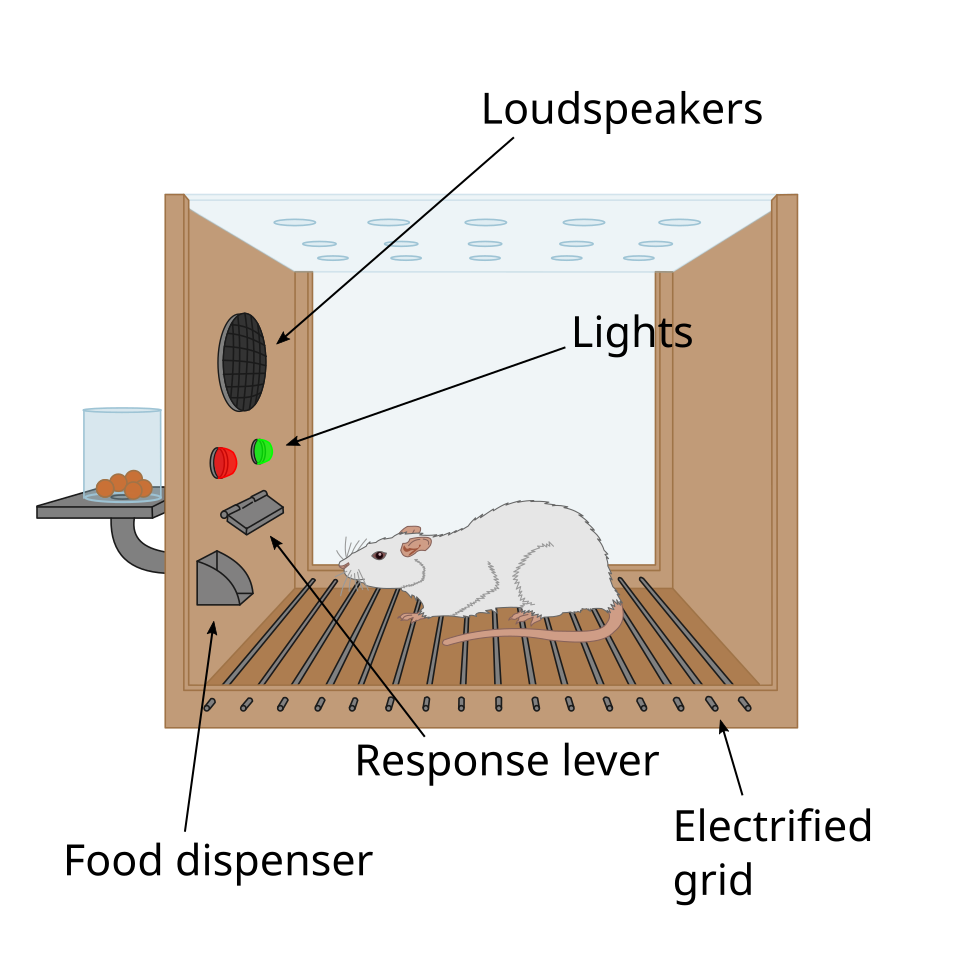 A rat pressing a lever to get food (Image: Original: AndreasJS Vector: Pixelsquid, CC BY-SA 3.0, via Wikimedia Commons)
Schedules of Reinforcement:
| Schedule | Example | Effect on Learning |
|---|---|---|
| Fixed Ratio | Reward after every 5 correct answers | Fast learning, high response rate |
| Variable Ratio | Slot machine (random rewards) | Very high response rate |
| Fixed Interval | Weekly test (reward after fixed time) | Slow, steady response |
| Variable Interval | Pop quiz (random timing) | Steady but moderate response |
3. Observational Learning (Bandura’s Bobo Doll)
We learn by watching others (models) and imitating their behavior. This is called social learning or modeling.
Bandura’s Experiment:
- Children watched an adult hit a Bobo doll (either rewarded, punished, or ignored).
- Later, the children imitated the aggressive behavior, especially if the model was rewarded.
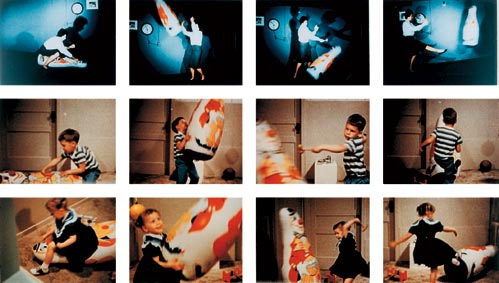 A child hitting a Bobo doll after watching an adult (Image: Okhanm, CC BY-SA 4.0, via Wikimedia Commons)
Key Processes in Observational Learning:
- Attention: Watching the model carefully.
- Retention: Remembering what was seen.
- Reproduction: Physically imitating the behavior.
- Motivation: Willingness to perform the behavior (e.g., if rewarded).
4. Cognitive Learning (Tolman & Kohler)
Unlike behaviorist theories (Pavlov, Skinner), cognitive learning focuses on mental processes like thinking, problem-solving, and insight.
Latent Learning (Tolman’s Rats)
- Rats explored a maze without reward but later found the path faster when a reward was introduced.
- Shows that learning can happen without immediate reinforcement.
Insight Learning (Kohler’s Chimps)
- A chimp suddenly realized how to stack boxes to reach a banana.
- This shows sudden understanding (insight) rather than trial-and-error learning.
Comparison of Learning Theories
| Theory | Key Idea | Example | Strengths | Weaknesses |
|---|---|---|---|---|
| Classical Conditioning | Association between stimuli | Pavlov’s dogs | Explains automatic responses | Limited to reflexive behaviors |
| Operant Conditioning | Reinforcement/punishment | Skinner’s rats | Useful in behavior modification | Ignores mental processes |
| Observational Learning | Learning by imitation | Bandura’s Bobo doll | Explains social behavior | Requires attention and memory |
| Cognitive Learning | Mental processes (insight, latent learning) | Kohler’s chimps | Explains complex problem-solving | Hard to measure directly |
Applications of Learning Theories
- Education:
- Teachers use reinforcement (grades, praise) to encourage learning.
- Students learn by observing good study habits from peers.
- Therapy:
- Exposure therapy (classical conditioning) treats phobias.
- Token economies (operant conditioning) reward good behavior in mental health.
- Workplace Training:
- On-the-job training (observational learning).
- Performance bonuses (operant conditioning).
Exam Tip: How to Score Full Marks
- Define clearly: Always start with a clear definition of the learning type (e.g., "Classical conditioning is...").
- Use examples: NEB loves real-life or experimental examples (Pavlov’s dogs, Skinner’s rats).
- Compare theories: Questions often ask to differentiate between classical and operant conditioning.
- Applications: Always link theories to real-world uses (education, therapy, advertising).
- Diagrams: Draw simple flowcharts (like Pavlov’s or Skinner’s experiments) to visualize processes.
NEB Board-Style Questions (Practice)
Short Answer (5 marks)
- Explain classical conditioning with Pavlov’s experiment. How is it different from operant conditioning?
- What is observational learning? Describe Bandura’s Bobo doll experiment.
- Differentiate between positive reinforcement and negative reinforcement with examples.
Long Answer (10 marks)
- Discuss the four types of learning with examples. How can these theories be applied in classroom teaching?
- "Learning is a permanent change in behavior." Explain this statement with reference to cognitive and behavioral theories.
Summary Table for Quick Revision
| Learning Type | Key Thinker | Main Idea | Example |
|---|---|---|---|
| Classical | Pavlov | Association of stimuli | Dog salivating to a bell |
| Operant | Skinner | Reinforcement/punishment | Rat pressing a lever for food |
| Observational | Bandura | Learning by imitation | Children copying aggressive behavior |
| Cognitive | Tolman/Kohler | Mental processes (insight, latent learning) | Rats learning a maze without reward |
Final Tip: Always relate theories to real life in your answers. NEB examiners love practical connections! 🚀
Based on the NEB +2 Humanities syllabus for Psychology (Psy), unit 6.
Discussion
Loading…