Life Skill EducationUnit 1210 min read
Financial Literacy: Budgeting, Saving, Investing & Rights
Unit 12 of Life Skill Education teaches how to manage money wisely—budgeting, saving, investing, financial rights, and avoiding scams—with real-life examples, NEB-style questions, and visual tools to prepare for exams.
TAKEAWAYS:
- Budgeting is the key to controlling income and expenses; use the 50-30-20 rule for balance.
- Saving builds financial security; emergency funds and fixed deposits are safe options.
- Investing grows wealth over time—stocks, bonds, and mutual funds have risks and rewards.
- Financial rights protect consumers; know how to complain and avoid fraud.
- Digital finance (online banking, UPI) is convenient but requires security awareness.
- NEB exams test definitions, real-life scenarios, and comparisons—practice with case studies.
What is Financial Literacy?
Financial literacy means understanding how to earn, save, spend, invest, and protect money. It helps you make smart choices about your finances and avoid debt traps.
Why is it important?
- Helps you plan for the future (education, home, retirement).
- Prevents unnecessary debt and financial stress.
- Lets you take advantage of opportunities (investments, business).
- Protects you from scams and fraud.
1. Budgeting: The Money Plan
A budget is a tool to track income and expenses. It ensures you spend less than you earn and save for goals.
How to Make a Budget
- List your income (salary, allowance, gifts).
- Track expenses (rent, food, transport, entertainment).
- Categorize spending:
- Needs (food, rent, bills).
- Wants (movies, shopping, dining out).
- Savings & Investments (emergency fund, stocks).
- Use the 50-30-20 Rule:
- 50% for needs.
- 30% for wants.
- 20% for savings/debt repayment.
Mermaid Diagram: Budgeting Flow
flowchart TD
    A["Income"] --> B["Needs (50%)"]
    A --> C["Wants (30%)"]
    A --> D["Savings/Investments (20%)"]
    B --> E["Rent, Food, Bills"]
    C --> F["Entertainment, Shopping"]
    D --> G["Emergency Fund, Stocks"]
Example: Monthly Budget for a Student
| Category | Amount (NPR) | Percentage |
|---|---|---|
| Income (Allowance) | 20,000 | 100% |
| Needs | 50% | |
| - Rent | 8,000 | 40% |
| - Food | 5,000 | 25% |
| - Transport | 2,000 | 10% |
| Wants | 30% | |
| - Movies | 2,000 | 10% |
| - Shopping | 3,000 | 15% |
| - Mobile/Internet | 1,000 | 5% |
| Savings | 20% | |
| - Emergency Fund | 4,000 | 20% |
2. Saving Money: Building a Safety Net
Saving means setting aside money for future needs (emergencies, goals). It reduces financial stress.
Types of Savings
| Type | Description | Example |
|---|---|---|
| Emergency Fund | Money for unexpected expenses (illness, job loss). | 3–6 months’ expenses in a bank. |
| Fixed Deposit | Lock money for a fixed time at higher interest. | 1-year FD at 6% interest. |
| Recurring Deposit | Save small amounts regularly. | NPR 5,000/month for 12 months. |
| Savings Account | Flexible access with low interest. | NPR 10,000/month in a bank. |
Why Save?
- Avoids borrowing money in emergencies.
- Helps achieve long-term goals (travel, education).
- Gives peace of mind.
Example Calculation: If you save NPR 5,000/month at 6% interest for 10 years:
- Total saved = NPR 6,00,000 (principal) + NPR 3,00,000 (interest) = NPR 9,00,000.
3. Investing: Growing Your Money
Investing means using money to earn more money over time. It beats saving alone because of compound interest.
Types of Investments
| Type | Risk Level | Liquidity | Example |
|---|---|---|---|
| Stocks | High | High | Buying shares of NMB Bank. |
| Bonds | Low | Medium | Government bonds (6% return). |
| Mutual Funds | Medium | Medium | Sipha Mutual Fund (diversified). |
| Real Estate | Medium | Low | Buying a flat to rent out. |
| Gold | Low-Medium | Low | Physical gold or gold ETFs. |
How Compound Interest Works
- Simple Interest: Earned only on the principal.
- Formula:
- Compound Interest: Earned on principal + past interest.
- Formula:
- Where:
- = Final amount
- = Principal (initial money)
- = Annual interest rate
- = Times interest is compounded per year
- = Time in years
Example: If you invest NPR 10,000 at 8% interest compounded annually for 5 years:
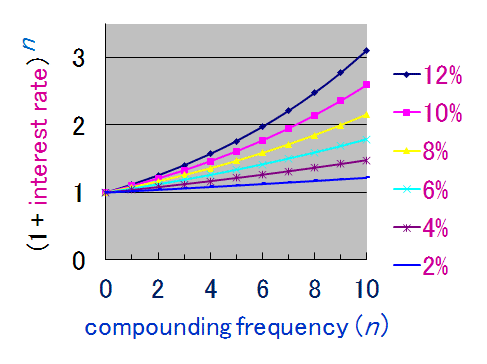 Shows how money grows faster over time (Image: Kazov, CC BY-SA 4.0, via Wikimedia Commons)
4. Financial Rights and Consumer Protection
Every consumer has rights to protect them from unfair practices.
Key Financial Rights in Nepal
- Right to Information: Banks must explain fees and terms clearly.
- Right to Choose: You can switch banks or financial services.
- Right to Fair Treatment: No discrimination in loans or services.
- Right to Redress: Complaint if cheated (e.g., fake loans, scams).
- Right to Privacy: Banks cannot share your data without consent.
How to File a Complaint?
- Contact the bank/financial institution (write a formal letter).
- File a complaint with:
- Nepal Rastra Bank (NRB) (for banking issues).
- Consumer Protection Board (for general fraud).
- Legal action if the issue is not resolved.
Example Scenario: You took a loan from a moneylender at 20% monthly interest (illegal in Nepal).
- Step 1: Stop payments and gather documents.
- Step 2: File a complaint with NRB or local court.
- Step 3: Demand refund of extra interest paid.
5. Digital Finance: Online Banking and UPI
Digital finance makes transactions faster and safer, but requires awareness of risks.
Benefits of Digital Banking
- Instant transfers (UPI, eSewa, Khalti).
- No need to carry cash.
- Lower fees than traditional banks.
- 24/7 access via mobile apps.
Risks and How to Avoid Them
| Risk | Solution |
|---|---|
| Phishing Scams | Never share OTPs or passwords. |
| Fake Apps/Websites | Download apps only from official stores. |
| Hacking | Use strong passwords and 2FA. |
| Unauthorized Transactions | Report immediately to the bank. |
Example of a Safe Transaction:
- Open Nepal Rastra Bank’s eSewa app.
- Enter password + OTP.
- Select UPI option and enter recipient’s VPN (Virtual Payment Address).
- Confirm and send NPR 5,000 to a friend.
6. Common Financial Mistakes to Avoid
| Mistake | Why It’s Bad | Solution |
|---|---|---|
| No Budget | Overspending, debt. | Track expenses monthly. |
| Living on Credit | High interest, financial stress. | Use credit cards wisely. |
| No Emergency Fund | Can’t handle unexpected costs. | Save 3–6 months’ expenses. |
| Impulse Buying | Wastes money on unnecessary items. | Wait 24 hours before buying. |
| Ignoring Investments | Money loses value to inflation. | Start investing early. |
Exam Tips for NEB Life Skill Education (Unit 12)
Definitions Matter:
- Know terms like budget, compound interest, financial literacy, UPI, NRB.
- Example question: "Define ‘budget’ and explain its importance in financial planning."
Case Study Questions:
- Expect scenarios like: "Rama earns NPR 25,000/month. Her expenses are rent (8,000), food (5,000), transport (2,000), and entertainment (3,000). How can she save 20% of her income?"
- Solution:
- Total expenses = 8,000 + 5,000 + 2,000 + 3,000 = NPR 18,000.
- Income = NPR 25,000.
- Savings = 25,000 – 18,000 = NPR 7,000 (28%).
- To save 20% (NPR 5,000), she must cut entertainment by NPR 2,000.
Comparison Tables:
- Questions may ask to compare saving vs. investing or UPI vs. cash.
- Example:
Aspect Savings Account Fixed Deposit Liquidity High Low Interest Low (3–5%) High (6–8%) Risk None None
Diagram-Based Questions:
- Draw budget pie charts or compound interest graphs.
- Example: "Draw a flowchart showing steps to file a complaint with NRB."
Real-Life Application:
- Questions may ask: "How would you invest NPR 50,000 for 5 years?"
- Answer:
- Option 1: Fixed Deposit (safe, 7% return).
- Option 2: Mutual Funds (higher risk, 10–12% return).
- Option 3: Stocks (very risky, but potential for 15%+).
Short Answer Practice:
- "What are three financial rights of consumers in Nepal?"
Answer:
- Right to information.
- Right to choose.
- Right to redress.
- "What are three financial rights of consumers in Nepal?"
Answer:
Final Checklist Before Exam
✅ Know the 50-30-20 budget rule. ✅ Understand compound interest vs. simple interest. ✅ Memorize financial rights and complaint procedures. ✅ Practice calculations (budgeting, interest). ✅ Revise digital finance safety tips.
Good luck! Financial literacy is a skill that will help you all your life. 🚀
Based on the NEB +2 Humanities syllabus for Life Skill Education (LSE), unit 12.
Discussion
Loading…