PsychologyUnit 1010 min read
Counselling & Guidance: Types, Skills, Models & NEB Exam Focus
Unit 10 of Psychology explores counselling theories, guidance techniques, and their applications in Nepal’s educational and social contexts—essential for NEB exams with case studies, comparisons, and real-world examples.
TAKEAWAYS:
- Counselling is a helping process (not advice-giving) with ethical guidelines, while guidance is proactive (preventive support).
- Rogers’ Client-Centered Therapy and Beck’s Cognitive Therapy are core models; NEB often contrasts them.
- Counselling skills (active listening, empathy) are tested via role-play scenarios in exams.
- Career guidance in Nepal uses tools like Holland’s RIASEC and DAT (Differential Aptitude Test).
- Ethical dilemmas (confidentiality, dual relationships) appear in short-answer questions.
- NEB exam pattern: 20% theory (definitions/models), 50% application (case studies), 30% comparison (e.g., counselling vs. guidance).
What is Counselling?
Counselling is a professional relationship where a trained helper (counsellor) helps a client explore their problems, gain insights, and make informed decisions. It is not about giving advice or fixing problems for the client.
Key Features of Counselling
mindmap
  root((Counselling))
    Features
      Client-Driven: "Client sets goals"
      Confidential: "Privacy protected"
      Non-Judgmental: "No blame or criticism"
      Process-Oriented: "Focus on 'how' not 'what'"
    Types
      Individual: "One-on-one"
      Group: "Multiple clients"
      Career: "Job/education choices"
      Crisis: "Emergency support"
    Skills
      Active Listening: "Paraphrasing, reflecting"
      Empathy: "Understanding feelings"
      Genuineness: "Authentic connection"
Counselling vs. Guidance: What’s the Difference?
| Aspect | Counselling | Guidance |
|---|---|---|
| Purpose | Solves existing problems | Prevents future problems |
| Timing | Reactive (after issues arise) | Proactive (before issues arise) |
| Focus | Deep emotional/psychological issues | Practical decisions (career, studies) |
| Example | Helping a student with depression | Helping a student choose a career |
Why does NEB ask this?
- Short-answer questions: "Distinguish between counselling and guidance in 5 points."
- Case studies: "A student is confused about college majors. Is this counselling or guidance?" → Answer: Guidance (proactive, decision-focused).
Major Counselling Theories
NEB exams love comparing theories. Here are the top 3 you must know:
1. Client-Centered Therapy (Carl Rogers)
- Core Idea: The client knows best; the counsellor provides a supportive environment.
- Key Techniques:
- Unconditional Positive Regard: Accept the client without judgment.
- Empathic Understanding: Reflect the client’s feelings ("It sounds like you’re feeling overwhelmed").
- Congruence: The counsellor is genuine (no fake sympathy).
- Visual Tool:
flowchart TD
  A["Client's Problem"] -->|"Shares"| B["Counsellor Listens"]
  B -->|"Reflects Feelings"| C["Client Gains Insight"]
  C -->|"Makes Change"| D["Problem Resolved"]
Solved Example (NEB-style): Question: "How would a Rogersian counsellor respond to a student who says, ‘I failed my exam; I’m worthless’?" Answer:
The counsellor would not say, "Don’t worry, you’ll pass next time." Instead, they’d reflect: "It sounds like you’re feeling really down about yourself right now. That must be painful."
2. Cognitive Behavioural Therapy (CBT) (Aaron Beck)
- Core Idea: Thoughts → Feelings → Actions. Change negative thoughts to improve mood.
- Key Techniques:
- Cognitive Restructuring: Challenge irrational beliefs.
- Behavioural Experiments: Test fears (e.g., public speaking).
- Homework: Clients practice new skills outside sessions.
- Example:
- Negative Thought: "I’ll never get a job."
- CBT Challenge: "What’s the evidence? Have you applied anywhere?"
3. Directive vs. Non-Directive Counselling
| Aspect | Directive (e.g., CBT) | Non-Directive (e.g., Rogers) |
|---|---|---|
| Role of Counsellor | Active (guides, suggests) | Passive (listens, reflects) |
| Client’s Role | Follows counsellor’s lead | Leads the session |
| Example | "Let’s list your strengths." | "How does that make you feel?" |
NEB Exam Alert:
- Short-answer: "Which theory is directive? Which is non-directive?"
- Application: "A counsellor says, ‘Why don’t you try meditation?’ Is this directive or non-directive?" → Directive (CBT-style).
Counselling Skills: The NEB Top 5
NEB tests these skills in role-play and short answers. Master them!
Active Listening
- What it is: Fully focusing on the speaker, not just waiting to reply.
- How to do it:
- Paraphrasing: "So you’re saying you feel stressed because of exams?"
- Minimal Encouragers: "Uh-huh," "Go on."
- Why it matters: Shows you’re engaged.
Empathy
- What it is: Understanding the client’s emotional world.
- Example:
- Client: "My parents are always criticizing me."
- Counsellor: "That must feel really hurtful and lonely."
Open-Ended Questions
- Bad: "Are you sad?" (Yes/No trap)
- Good: "How have you been feeling lately?"
Silence
- Why? Gives the client time to think.
- NEB Tip: "Silence is a skill"—don’t rush to fill it.
Self-Disclosure (Carefully!)
- Rule: Only share if it helps the client, not you.
- Example: "I once felt the same way, and I learned to..." (if relevant).
Guidance in Nepal: Tools and Techniques
NEB loves real-world applications. Here’s how guidance works in Nepalese schools:
1. Career Guidance Models
| Model | Description | Example in Nepal |
|---|---|---|
| Holland’s RIASEC | 6 personality types match 6 careers. | A student who loves art → Art/Design career. |
| DAT (Differential Aptitude Test) | Tests aptitudes (verbal, numerical, etc.). | Used in TU entrance exams. |
| Holland’s Codes | Realistic, Investigative, Artistic, Social, Enterprising, Conventional. |
Solved Example: Question: "A student scores high in ‘Social’ and ‘Artistic’ on RIASEC. What careers would you suggest?" Answer:
- Social + Artistic: Teaching (art), social work, graphic design, event management.
- NEB Tip: Always link theories to Nepal’s context (e.g., "In Nepal, teaching is a stable career").
2. Guidance Techniques in Schools
flowchart TD
  A["Guidance Process"] --> B["Assessment"]
  B --> C["Information"]
  C --> D["Decision Making"]
  D --> E["Follow-Up"]
  B -->|"Tools"| B1["Interviews"]
  B -->|"Tools"| B2["Tests (DAT, IQ)"]
  B -->|"Tools"| B3["Observation"]
  C -->|"Sources"| C1["Career Fairs"]
  C -->|"Sources"| C2["Brochures"]
  C -->|"Sources"| C3["Counsellor"]
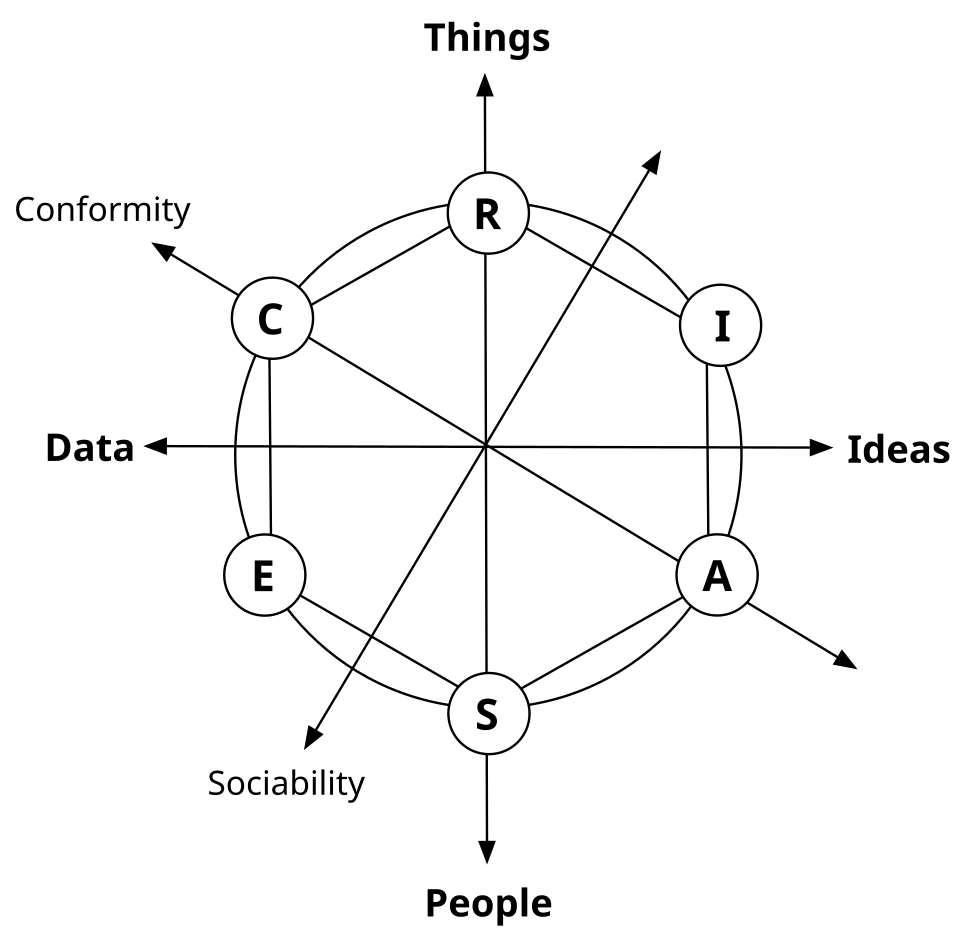 A hexagon with the 6 RIASEC codes (R-I-A-S-E-C) and example careers. (Image: Tim bates, CC BY-SA 4.0, via Wikimedia Commons)
Ethical Issues in Counselling
NEB tests ethics in case studies. Common dilemmas:
Confidentiality
- Rule: Never break confidentiality unless the client is a danger to themselves/others.
- Example: A student threatens suicide → report to authorities.
Dual Relationships
- Problem: Being friends with a client or counselling a family member.
- NEB Question: "Can a school counsellor also be a teacher’s friend? Why not?"
Answer:
No, because it creates conflicts of interest and power imbalances.
Cultural Sensitivity
- Example: In Nepal, some clients may avoid eye contact (a sign of respect). Don’t misinterpret this as dishonesty.
Counselling in Nepal: Challenges and Solutions
| Challenge | Solution | NEB Exam Link |
|---|---|---|
| Stigma against counselling | Awareness campaigns in schools. | "How would you reduce stigma in Nepal?" |
| Lack of trained counsellors | Government should fund training. | "Suggest one policy to improve counselling in Nepal." |
| Cultural barriers | Use local languages (Nepali, Maithili). | "How would you counsel a Gurung student?" |
Exam Tip: How NEB Tests This Unit
Theory Questions (20%)
- Define: "What is counselling?"
- Compare: "Directive vs. non-directive counselling."
Application (50%)
- Case Studies: "A student is anxious before exams. How would you counsel them using CBT?"
- Role-Play: "Pretend you’re a counsellor for a student who failed their SLC."
Comparison Tables (30%)
- "Differentiate between Rogers’ and Beck’s approaches."
- "Guidance vs. counselling."
Nepal Context (Always!)
- "How can counselling help reduce school dropout rates in Nepal?"
- "What are the challenges of career guidance in rural Nepal?"
Pro Tip:
- Memorize the RIASEC codes and CBT techniques.
- Practice writing short answers (5-6 points) for definitions.
- For case studies, use the SOAP method:
- Situation (describe the problem),
- Observation (client’s behaviour),
- Assessment (which theory to use),
- Plan (how to help).
Final NEB-Style Questions (Practice!)
Short Answer (5 points): "Explain any three counselling skills with examples."
Case Study (10 points): "Rama, a Class 12 student, says, ‘I don’t know what to study. My parents want me to be an engineer, but I love painting.’ As a counsellor, how would you guide her using Holland’s RIASEC model?"
Comparison (5 points): "Distinguish between client-centered therapy and cognitive behavioural therapy."
Remember:
- Counselling = Helping explore problems.
- Guidance = Helping make decisions.
- NEB loves comparisons, case studies, and Nepal examples!
Good luck! 🚀
Based on the NEB +2 Humanities syllabus for Psychology (Psy), unit 10.
Discussion
Loading…