Computer ScienceUnit 818 min read
Emerging Tech: AI, IoT, Blockchain, Cloud, Big Data & Cybersecurity
Unit 8 of Computer Science explores cutting-edge technologies reshaping industries—artificial intelligence, Internet of Things, blockchain, cloud computing, big data analytics, and cybersecurity threats. Learn their definitions, real-world applications, pros/cons, and how they integrate with existing systems.
TAKEAWAYS:
- AI/ML automates decisions using data (e.g., chatbots, fraud detection) but requires massive datasets and ethical oversight.
- IoT connects devices via sensors/actuators (e.g., smart homes, healthcare monitors) but raises privacy risks.
- Blockchain enables secure, decentralized transactions (e.g., cryptocurrencies, supply chains) with no single point of failure.
- Cloud computing offers scalable storage/compute (e.g., Google Drive, AWS) but depends on internet connectivity.
- Big data turns raw data into insights (e.g., Netflix recommendations) using tools like Hadoop.
- Cybersecurity protects systems from threats (e.g., phishing, ransomware) via firewalls, encryption, and ethical hacking.
1. Artificial Intelligence (AI) and Machine Learning (ML)
What is AI?
Artificial Intelligence (AI) is the simulation of human intelligence in machines. These machines can:
- Learn from data (e.g., self-driving cars analyzing traffic patterns).
- Reason and solve problems (e.g., medical diagnosis tools).
- Adapt to new situations (e.g., chatbots improving responses over time).
Key Subfields:
| Subfield | What It Does | Example |
|---|---|---|
| Machine Learning | Systems learn from data without explicit programming. | Spam email filters. |
| Natural Language Processing (NLP) | Machines understand/generate human language. | Google Translate. |
| Computer Vision | Machines interpret visual data (images/videos). | Face recognition in smartphones. |
| Robotics | Physical machines perform tasks autonomously. | Industrial robots in factories. |
How AI Works:
- Data Collection: Gather large datasets (e.g., customer reviews, sensor readings).
- Training: Feed data into algorithms (e.g., neural networks) to find patterns.
- Model Building: The algorithm creates a "model" (e.g., a decision tree or deep neural network).
- Prediction/Action: The model makes decisions or predictions (e.g., "This email is spam").
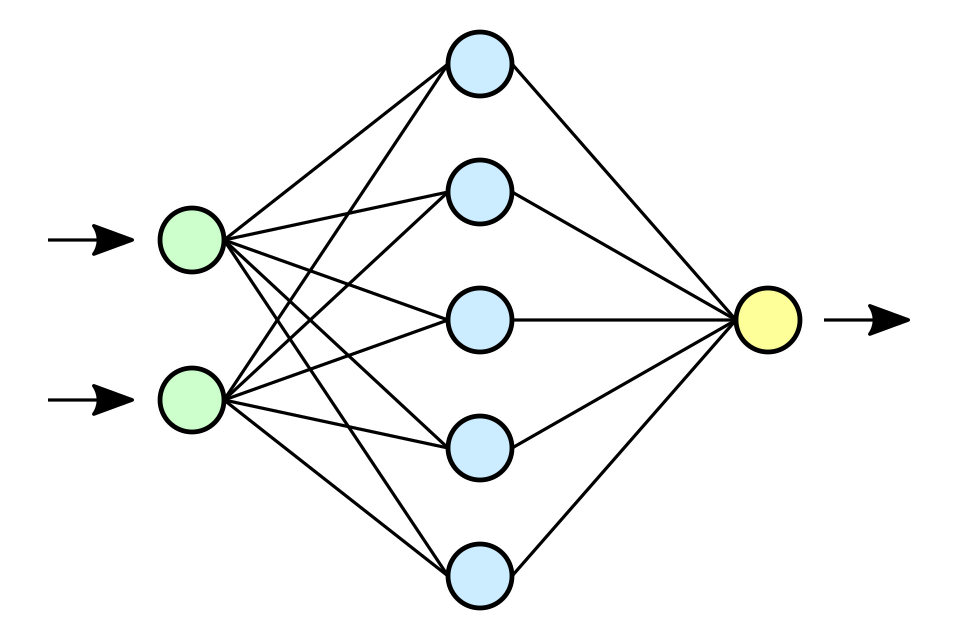 A simple neural network with input, hidden, and output layers. (Image: Dake, Mysid, CC BY 1.0, via Wikimedia Commons)
Machine Learning (ML) Algorithms
ML algorithms are the "recipes" AI uses to learn. Two main types:
| Type | Description | Example Algorithm | Use Case |
|---|---|---|---|
| Supervised Learning | Learns from labeled data (input + correct output). | Linear Regression, Decision Trees | Predicting house prices. |
| Unsupervised Learning | Finds hidden patterns in unlabeled data. | K-Means Clustering, PCA | Customer segmentation. |
| Reinforcement Learning | Learns by trial-and-error (rewards/punishments). | Q-Learning | Robot navigation. |
Example: Predicting Exam Scores Suppose a school uses ML to predict student scores based on:
- Hours studied (
X₁) - Attendance (
X₂) - Previous exam scores (
X₃)
Step-by-Step Trace:
Dataset:
Hours Studied Attendance (%) Previous Score Actual Score 5 80 70 75 3 60 80 65 ... ... ... ... Algorithm: Use Linear Regression to find a relationship like:
Predicted Score = 2*X₁ + 0.5*X₂ + 0.3*X₃ + 10Prediction: For a student with
X₁=4,X₂=70,X₃=75:Predicted Score = 2*4 + 0.5*70 + 0.3*75 + 10 = 8 + 35 + 22.5 + 10 = 75.5(≈ 76).
Advantages of AI:
- Automates repetitive tasks (e.g., data entry).
- Improves accuracy (e.g., medical diagnoses).
- Enables 24/7 services (e.g., customer support chatbots).
Disadvantages:
- Bias: AI can inherit biases from training data (e.g., facial recognition errors for darker skin tones).
- Job Displacement: Automation may replace some roles (e.g., assembly-line workers).
- Ethical Concerns: Privacy risks (e.g., AI analyzing personal data without consent).
2. Internet of Things (IoT)
What is IoT?
The Internet of Things (IoT) connects everyday objects to the internet, allowing them to send/receive data. These "smart" devices use:
- Sensors (e.g., temperature, motion).
- Actuators (e.g., lights, locks).
- Connectivity (Wi-Fi, Bluetooth, cellular).
How IoT Works:
- Device collects data (e.g., a smart thermostat senses room temperature).
- Data is sent to a cloud server or local gateway.
- Analysis: Software processes the data (e.g., "Turn on AC if temperature > 25°C").
- Action: Device responds (e.g., AC turns on).
IoT Applications
| Industry | Application | Example Device |
|---|---|---|
| Smart Homes | Remote control of appliances. | Smart lights, security cameras. |
| Healthcare | Remote patient monitoring. | Wearable glucose monitors. |
| Agriculture | Precision farming (soil moisture sensors). | Drones, soil sensors. |
| Transport | Traffic management, fleet tracking. | GPS-enabled buses, smart traffic lights. |
| Industry 4.0 | Predictive maintenance in factories. | Vibration sensors in machinery. |
Example: Smart Farming A farmer uses IoT to:
- Plant soil moisture sensors in fields.
- Connect sensors to a cloud dashboard.
- Receive alerts when soil is dry (e.g., "Irrigate Field B").
- Automate irrigation systems to water plants.
Advantages of IoT:
- Efficiency: Reduces waste (e.g., energy-saving smart grids).
- Convenience: Remote control (e.g., unlocking doors via smartphone).
- Safety: Early warnings (e.g., gas leaks detected by smart meters).
Disadvantages:
- Privacy Risks: Hackers can access personal data (e.g., smart cameras).
- Security Vulnerabilities: Weak passwords in default IoT devices.
- High Cost: Initial setup can be expensive.
3. Blockchain Technology
What is Blockchain?
Blockchain is a decentralized, digital ledger that records transactions across many computers. Key features:
- Immutable: Once data is added, it cannot be altered.
- Transparent: All participants can verify transactions.
- Secure: Uses cryptography (e.g., Bitcoin’s blockchain).
How Blockchain Works:
- Transaction: Alice sends 1 Bitcoin to Bob.
- Block Creation: The transaction is grouped with others into a "block."
- Validation: Miners (computers) solve complex math problems to verify the block.
- Addition to Chain: The validated block is added to the existing blockchain.
- Update: All network participants update their ledgers.
Types of Blockchain
| Type | Description | Example |
|---|---|---|
| Public Blockchain | Open to anyone (decentralized). | Bitcoin, Ethereum. |
| Private Blockchain | Restricted access (centralized control). | Enterprise supply chains. |
| Hybrid Blockchain | Mix of public/private features. | JPMorgan’s blockchain for payments. |
Example: Cryptocurrency (Bitcoin)
- Transaction: Ram sends 0.5 BTC to Sita.
- Block: This transaction is added to a block with others.
- Mining: Miners compete to solve a cryptographic puzzle (proof-of-work).
- Block Added: The winning miner adds the block to the Bitcoin blockchain.
- Update: All Bitcoin nodes update their ledgers to reflect the transaction.
Advantages of Blockchain:
- Security: No single point of failure (hacking one node doesn’t compromise the whole system).
- Transparency: All transactions are visible to participants.
- Decentralization: No banks or governments control it.
Disadvantages:
- Scalability: Slow transaction speeds (e.g., Bitcoin processes ~7 transactions/second vs. Visa’s ~24,000).
- Energy Use: Mining consumes massive energy (e.g., Bitcoin uses more electricity than some countries).
- Regulation: Governments struggle to regulate cryptocurrencies.
4. Cloud Computing
What is Cloud Computing?
Cloud computing delivers computing services (storage, servers, databases) over the internet ("the cloud"). Users access these services via:
- Software as a Service (SaaS): Ready-to-use apps (e.g., Google Docs).
- Platform as a Service (PaaS): Development tools (e.g., Google App Engine).
- Infrastructure as a Service (IaaS): Virtual machines/storage (e.g., AWS EC2).
How Cloud Computing Works:
- User Request: You upload a file to Google Drive.
- Cloud Server: Google’s servers store and manage the file.
- Delivery: You access the file from any device with internet.
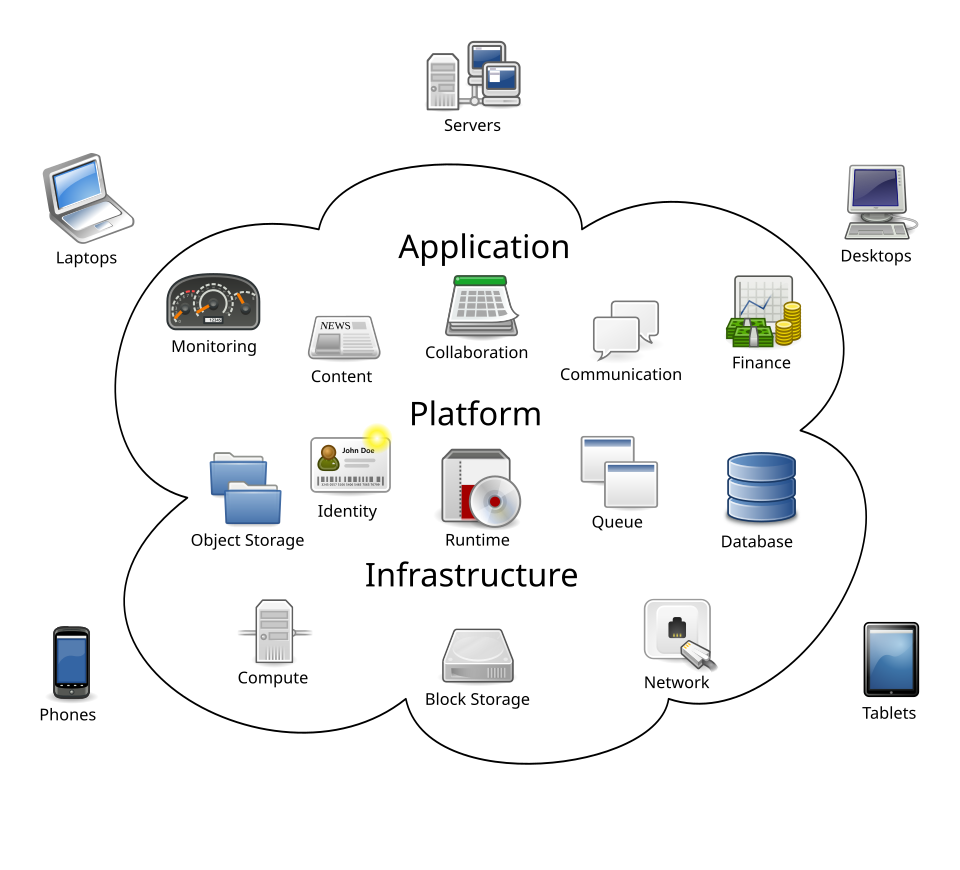 A diagram showing SaaS, PaaS, and IaaS layers with examples. (Image: Sam Johnston, CC BY-SA 3.0, via Wikimedia Commons)
Cloud Deployment Models
| Model | Description | Example |
|---|---|---|
| Public Cloud | Services provided by third parties. | AWS, Microsoft Azure. |
| Private Cloud | Dedicated cloud for a single organization. | A bank’s internal cloud. |
| Hybrid Cloud | Mix of public and private clouds. | Healthcare data on private cloud, backups on public cloud. |
| Multi-Cloud | Uses multiple cloud providers. | Netflix on AWS + Azure. |
Example: Netflix’s Cloud Strategy
- Uses AWS for streaming (IaaS/PaaS).
- CDN (Content Delivery Network): Serves content from servers closest to users for faster speeds.
- Machine Learning: Recommends shows based on user history (stored in AWS databases).
Advantages of Cloud Computing:
- Cost-Effective: No need to buy physical servers.
- Scalability: Easily upgrade/downgrade resources.
- Accessibility: Access data from anywhere with internet.
Disadvantages:
- Dependency on Internet: Offline access is limited.
- Security Risks: Data breaches (e.g., hackers accessing cloud storage).
- Vendor Lock-in: Difficult to switch providers.
5. Big Data Analytics
What is Big Data?
Big Data refers to extremely large datasets that are hard to process with traditional tools. Characteristics (4 Vs):
- Volume: Massive amount of data (e.g., terabytes/petabytes).
- Velocity: Data generated rapidly (e.g., social media posts).
- Variety: Different data types (text, images, videos).
- Veracity: Data quality/accuracy issues.
How Big Data Works:
- Data Collection: Gather data from sources (e.g., sensors, websites).
- Storage: Use tools like Hadoop or NoSQL databases.
- Processing: Analyze data with MapReduce or Spark.
- Visualization: Present insights via dashboards (e.g., Tableau).
Big Data Tools
| Tool | Purpose | Example Use Case |
|---|---|---|
| Hadoop | Distributed storage/processing. | Analyzing customer purchase history. |
| Spark | Fast data processing. | Real-time fraud detection. |
| NoSQL Databases | Flexible data storage (e.g., MongoDB). | Social media data storage. |
| Tableau/Power BI | Data visualization. | Sales performance dashboards. |
Example: Retail Analytics A supermarket uses Big Data to:
- Collect: Sales data, customer loyalty cards, inventory levels.
- Analyze: Identify trends (e.g., "Diapers sell more on weekends").
- Act: Adjust stock or run targeted promotions.
Advantages of Big Data:
- Better Decisions: Data-driven insights (e.g., stock market predictions).
- Personalization: Tailored recommendations (e.g., Amazon’s "Recommended for You").
- Efficiency: Optimize operations (e.g., reducing waste in manufacturing).
Disadvantages:
- High Cost: Requires expensive tools/hardware.
- Privacy Concerns: Collecting personal data raises ethical issues.
- Complexity: Needs skilled data scientists.
6. Cybersecurity Threats and Protections
Why Cybersecurity Matters
Cybersecurity protects systems, networks, and data from digital attacks. Common threats:
- Malware: Harmful software (viruses, ransomware).
- Phishing: Fake emails/tricks to steal data.
- DDoS Attacks: Overwhelming a server with traffic.
- Identity Theft: Stealing personal information.
Cybersecurity Measures
| Layer | Protection Method | Example |
|---|---|---|
| Preventive | Firewalls, encryption. | HTTPS for websites. |
| Detective | Intrusion detection systems (IDS). | Alerts for suspicious login attempts. |
| Corrective | Backup/recovery plans. | Restoring data after a ransomware attack. |
| Ethical Hacking | Penetration testing. | Companies hire hackers to find vulnerabilities. |
Example: Phishing Attack Prevention
- Threat: A fake email claims to be from your bank, asking for login details.
- Red Flags:
- Urgent language ("Your account will be locked!").
- Suspicious email address (e.g.,
bank@secure.com→bank@secure123.xyz).
- Action:
- Verify the sender’s email.
- Hover over links to check the URL.
- Contact the bank directly via official channels.
Advantages of Cybersecurity:
- Protects Data: Safeguards personal/financial information.
- Ensures Compliance: Meets legal requirements (e.g., GDPR).
- Maintains Trust: Builds customer confidence (e.g., secure online shopping).
Disadvantages:
- Cost: Implementing security measures is expensive.
- False Sense of Security: Over-reliance on tools can lead to neglect of basic practices (e.g., weak passwords).
Exam Tip: How to Score Full Marks
Define Clearly:
- Start answers with definitions (e.g., "Blockchain is a decentralized ledger...").
- Example: "IoT is the network of physical devices embedded with sensors..."
Use Diagrams:
- Draw simple diagrams for processes (e.g., IoT workflow, blockchain structure).
- Label all parts (e.g., "Sensor → Gateway → Cloud").
Compare and Contrast:
- Use tables to compare technologies (e.g., public vs. private blockchain).
- Highlight key differences (e.g., "Public blockchain is open; private is restricted").
Real-World Examples:
- NEB loves practical applications. Mention:
- AI: Chatbots (e.g., Siri), fraud detection.
- IoT: Smart homes, healthcare monitors.
- Blockchain: Cryptocurrencies, supply chain tracking.
- Cloud: Netflix, Google Drive.
- Big Data: Amazon recommendations, weather forecasting.
- Cybersecurity: Two-factor authentication, firewalls.
- NEB loves practical applications. Mention:
Advantages/Disadvantages:
- Always include 2–3 pros and cons for each technology.
- Example for Cloud Computing:
"Advantages: Cost-effective, scalable. Disadvantages: Internet dependency, security risks."
Short-Answer Tips:
- For 1-mark questions, give a one-line definition (e.g., "IoT is the network of interconnected devices...").
- For 3–5-mark questions, structure answers as:
- Definition.
- One example.
- One advantage and one disadvantage.
Common NEB Question Types:
- Describe IoT with a diagram. → Draw a smart home setup with sensors → cloud → mobile app.
- Compare public and private blockchain. → Use a table with columns: Access, Use Case, Security.
- Explain how AI works with an example. → Use the exam score prediction trace above.
- What are cybersecurity threats? → List 3 threats (malware, phishing, DDoS) + 1 prevention method.
Practice Questions (NEB-Style)
Short Answer (1–3 marks)
- Define Big Data and give one tool used for its analysis.
- What is the difference between SaaS and PaaS in cloud computing?
- Name two applications of IoT in healthcare.
- Why is blockchain called "immutable"?
Long Answer (5–7 marks)
- Explain the working of Artificial Intelligence with an example of a real-world application. Discuss two advantages and two disadvantages of AI.
- Draw a labeled diagram of an IoT-based smart home system and explain how it works. Mention two security challenges of IoT.
- Compare public and private blockchain using a table. Give one example of each.
- What is cloud computing? Describe the three service models (SaaS, PaaS, IaaS) with examples. What are two risks of using cloud services?
Model Answers (For Reference)
Q1: Big Data refers to extremely large and complex datasets that cannot be processed using traditional data processing tools. One tool used for its analysis is Hadoop, which provides distributed storage and processing.
Q5: Artificial Intelligence (AI) is the simulation of human intelligence in machines, enabling them to learn, reason, and adapt. It works in three main steps:
- Data Collection: Gather large datasets (e.g., customer reviews, medical records).
- Training: Feed data into algorithms (e.g., neural networks) to find patterns.
- Prediction/Action: The trained model makes decisions (e.g., diagnosing diseases).
Example: Fraud Detection in Banking Banks use AI to analyze transaction patterns. If a credit card is used in two different countries within an hour, the AI flags it as suspicious and alerts the user.
Advantages:
- Accuracy: AI reduces human error (e.g., medical diagnoses).
- Automation: Saves time (e.g., chatbots handling customer queries).
Disadvantages:
- Bias: AI can inherit biases from training data (e.g., facial recognition errors).
- Job Loss: Automation may replace some jobs (e.g., assembly-line workers).
Good luck with your NEB exam! Practice drawing diagrams and explaining examples aloud to master this unit.
Based on the NEB +2 Management syllabus for Computer Science (Comp), unit 8.
Discussion
Loading…