Life Skill EducationUnit 99 min read
Environment & Sustainable Dev: Ecosystems, Pollution, Green Living
Unit 9 of Life Skill Education explores how humans interact with nature, the dangers of pollution, and practical ways to protect our planet for future generations—with real-world examples, case studies, and NEB-style questions.
TAKEAWAYS:
- Ecosystems are like "nature’s recycling plants" where living things depend on each other for survival.
- Pollution (air, water, soil) harms health and ecosystems—we must reduce waste and use clean energy.
- Sustainable development means meeting today’s needs without ruining tomorrow’s resources.
- Green living includes simple habits like recycling, saving water, and planting trees.
- Disasters (floods, landslides) are worsened by deforestation and poor waste management.
- NEB exams test definitions, causes/effects of pollution, and solutions—always link answers to real-life examples.
1. What is the Environment?
The environment is everything around us—air, water, land, plants, animals, and even people. It includes:
- Natural environment: Forests, rivers, mountains (created by nature).
- Built environment: Cities, roads, buildings (made by humans).
- Social environment: Culture, traditions, and communities.
Why does it matter?
- We depend on nature for food, clean air, and water.
- Pollution and deforestation destroy habitats and harm health.
- A healthy environment = better life for all living things.
2. Ecosystems: Nature’s Balance
An ecosystem is a community of living things (plants, animals, microbes) interacting with their non-living surroundings (sunlight, water, soil).
Key Parts of an Ecosystem
classDiagram
    class Biotic {
        +Plants (Producers)
        +Animals (Consumers)
        +Microbes (Decomposers)
    }
    class Abiotic {
        +Sunlight
        +Water
        +Air
        +Soil
    }
    Biotic --> Abiotic : "Depend on"
    Abiotic --> Biotic : "Support"
How Ecosystems Work
- Producers (plants) make food using sunlight (photosynthesis).
- Consumers (animals) eat plants or other animals.
- Decomposers (fungi, bacteria) break down dead matter, returning nutrients to the soil.
Example: Forest Ecosystem
- Producers: Trees (oak, pine) → make oxygen and food.
- Consumers: Deer (eat plants), foxes (eat deer).
- Decomposers: Mushrooms, worms → recycle dead leaves into soil.
What happens if balance is broken?
- Too many deer → eat all plants → no food for other animals.
- Pollution → kills fish → affects birds that eat them.
3. Environmental Pollution: Causes & Effects
Pollution is when harmful substances contaminate air, water, or soil, making them unsafe.
Types of Pollution
| Type | Causes | Effects on Health & Nature | Example in Nepal |
|---|---|---|---|
| Air | Vehicles, factories, burning trash | Breathing problems, acid rain, global warming | Kathmandu’s smog in winter |
| Water | Plastic waste, chemicals, sewage | Waterborne diseases, fish die | Bagmati River pollution in Kathmandu |
| Soil | Pesticides, plastic, industrial waste | Crops fail, soil becomes infertile | Farmland near factories in Chitwan |
| Noise | Loud traffic, construction | Hearing loss, stress in animals | Busy streets in Pokhara |
| Light | Too many streetlights, billboards | Disrupts animal sleep, wastes electricity | Bright lights in Thamel at night |
Why does pollution matter?
- Human health: Asthma, cancer, skin diseases.
- Wildlife: Animals die (e.g., turtles eating plastic bags).
- Economy: Tourist places lose beauty (e.g., polluted lakes).
4. Sustainable Development: Balancing Needs
Sustainable development means using resources wisely so future generations also have what they need.
Three Pillars of Sustainability
mindmap
  root((Sustainable Development))
    Economic
      +Jobs
      +Fair trade
      +Recycling industries
    Social
      +Education
      +Healthcare
      +Community involvement
    Environmental
      +Renewable energy
      +Protect forests
      +Reduce waste
How Nepal Can Be More Sustainable
✅ Use renewable energy (solar panels, small hydro projects). ✅ Plant trees (reforestation to stop landslides). ✅ Recycle waste (separate plastic, paper, metal). ✅ Save water (fix leaks, use rainwater). ✅ Support local farmers (reduce food waste).
Example: Community Forest in Nepal
- Villagers manage forests together.
- They plant trees, protect wildlife, and earn income from eco-tourism.
- Result: Clean air, less soil erosion, and jobs for locals.
5. Green Living: Small Steps for Big Change
We can all help the environment with daily habits:
| Action | How to Do It | Benefit |
|---|---|---|
| Reduce waste | Use reusable bags, avoid single-use plastic | Less pollution, cleaner streets |
| Save energy | Turn off lights, use LED bulbs | Lower electricity bills, less CO₂ |
| Save water | Fix leaks, take short showers | More water for farms and animals |
| Plant trees | Join tree-planting drives | Cleaner air, more oxygen |
| Eat local food | Buy from nearby markets | Less fuel used for transport |
Example: A Student’s Green Pledge
- Morning: Drink boiled water (instead of bottled).
- School: Bring a steel water bottle (no plastic cups).
- Evening: Turn off fans when not in use.
- Weekend: Pick up 5 pieces of trash from a park.
6. Disaster Risk Reduction (DRR)
Natural disasters (floods, landslides, earthquakes) are worse when the environment is damaged.
How Deforestation Causes Disasters
flowchart TD
    A["Deforestation"] --> B["Less trees to hold soil"]
    B --> C["Soil erosion increases"]
    C --> D["Landslides & floods"]
    D --> E["Houses & roads damaged"]
How to Reduce Risks? ✔ Plant trees (roots hold soil). ✔ Build strong houses (earthquake-resistant). ✔ Avoid cutting forests near rivers. ✔ Have emergency plans (know evacuation routes).
Example: Nepal’s 2015 Earthquake
- Cause: Weak buildings + deforestation (less tree roots to stabilize soil).
- Solution: Now, Nepal builds earthquake-safe schools and promotes community forests.
7. Your Role in Protecting the Environment
You don’t need to be a scientist—small actions add up!
What You Can Do Today
- At Home:
- Sort waste (plastic, paper, food).
- Use cloth bags instead of plastic.
- At School:
- Start a green club to plant trees.
- Organize a clean-up drive.
- In Your Community:
- Teach friends about saving water.
- Report pollution (e.g., illegal dumping).
Remember: Every tree planted, every plastic bag refused, and every light turned off helps the planet.
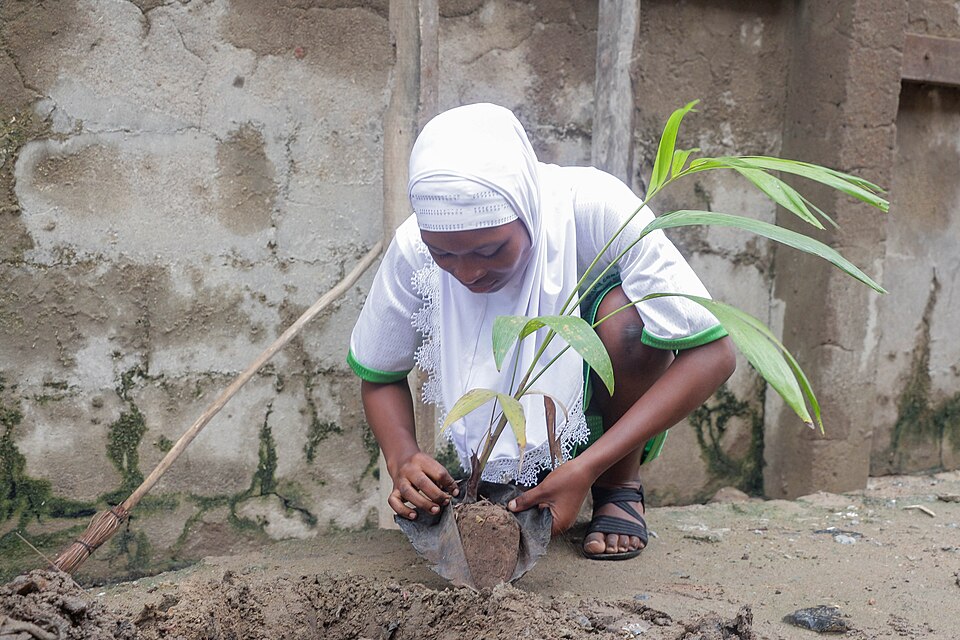 A class 12 student planting a sapling with teachers (Image: Fquasie, CC BY-SA 4.0, via Wikimedia Commons)
Exam Tip: How to Score Full Marks in NEB Questions
NEB exams test definitions, causes, effects, and solutions. Follow this structure:
1. Short Answer Questions (SAQ)
Question: What is an ecosystem? Give one example. Answer: An ecosystem is a community of living things (plants, animals, microbes) interacting with their non-living surroundings (sunlight, water, soil). Example: A pond ecosystem where fish, frogs, algae, and water plants live together.
2. Long Answer Questions (LAQ)
Question: Describe the causes and effects of water pollution. How can we reduce it? Answer: Causes of water pollution:
- Dumping plastic and chemicals in rivers.
- Sewage and industrial waste.
- Agricultural runoff (pesticides).
Effects:
- Fish and plants die → loss of biodiversity.
- Waterborne diseases (cholera, diarrhea).
- Unsafe drinking water → health problems.
Solutions:
- Treat wastewater before releasing it.
- Ban single-use plastics.
- Plant trees near rivers to filter pollutants.
- Use eco-friendly farming (less pesticides).
3. Case Study Questions
Question: A village near Chitwan National Park is facing floods. Explain how deforestation is linked to this problem and suggest two solutions. Answer: Link to deforestation:
- Cutting trees removes roots that hold soil.
- Heavy rain washes away soil → floods.
Solutions:
- Reforestation: Plant trees to stabilize soil.
- Build check dams: Slow down floodwater.
4. Diagram-Based Questions
Question: Draw and label a food chain. Explain the role of decomposers. Answer:
graph LR
    A["Grass"] --> B["Grasshopper"]
    B --> C["Frog"]
    C --> D["Snake"]
    D --> E["Hawk"]
    E --> F["Decomposers"]
    F --> A
Role of decomposers:
- Break down dead plants/animals.
- Return nutrients to the soil → helps new plants grow.
5. Common Mistakes to Avoid
❌ Vague answers: Don’t write "Pollution is bad." → Explain how it’s bad. ❌ No examples: Always use Nepal-related cases (e.g., Bagmati River, Kathmandu smog). ❌ Ignoring solutions: NEB loves practical steps (e.g., "Use reusable bags").
Final Checklist Before Submitting
✔ Define key terms (ecosystem, pollution, sustainable development). ✔ Give causes + effects (with examples). ✔ Suggest solutions (realistic and doable). ✔ Use diagrams where needed (food chain, pollution types). ✔ Link to Nepal (show you understand local issues).
Good luck! 🌱💧🌍 (Remember: The environment is your responsibility—start acting today!)
Based on the NEB +2 Management syllabus for Life Skill Education (LSE), unit 9.
Discussion
Loading…