BiologyUnit 139 min read
Earthworm: Anatomy, Physiology, Economic Importance & NEB Exam Focus
Unit 13 of Biology covers the anatomy, physiology, reproduction, and ecological/economic importance of earthworms, with NEB exam-style questions and solved examples for Class 11 students.
---

## **Introduction to Earthworm**
Earthworms are **annelid worms** belonging to the phylum **Annelida**. They are **hermaphrodites** (have both male and female reproductive organs) and play a crucial role in soil fertility. Earthworms are often called **"farmer’s friends"** because they improve soil structure by burrowing and enriching it with nutrients.

### **Why Study Earthworms?**
- They help in **soil aeration** (oxygen supply) and **drainage**.
- They act as **natural ploughs** by turning soil layers.
- They are used as **bioindicators** (show pollution levels in soil).
- They are **model organisms** in biological research.

---

## **External Features of Earthworm**
Earthworms have a **segmented body** with **100–150 segments** (called **metameres**). Each segment has tiny bristles called **setae** that help in movement.


### **Key External Features**
| **Part**         | **Description**                                                                 |
|-------------------|---------------------------------------------------------------------------------|
| **Mouth**         | Located at the **1st segment (peristomium)**; used for ingestion.              |
| **Clitellum**     | A thick, glandular band around **segments 14–16**; secretes mucus during mating. |
| **Anus**          | Located at the **last segment**; for egestion (removal of waste).               |
| **Setae**         | Bristle-like structures on each segment; help in movement.                     |

---

## **Internal Anatomy of Earthworm**
The body cavity (**coelom**) is filled with **coelomic fluid**, which acts as a **hydrostatic skeleton** for movement.

### **1. Digestive System**
Earthworms have a **complete digestive system** with:
- **Mouth** → **Pharynx** → **Esophagus** → **Crop** → **Gizzard** → **Intestine** → **Anus**


#### **Functions of Digestive Organs**
| **Organ**  | **Function**                                                                 |
|------------|-----------------------------------------------------------------------------|
| **Crop**   | Stores food temporarily.                                                   |
| **Gizzard**| Grinds food with the help of **ingested soil and small stones**.           |
| **Intestine** | Absorbs nutrients; **typhlosole** (folded inner wall) increases surface area. |

**Example:** If an earthworm eats **decaying leaves**, the **gizzard** grinds them into fine particles, and the **intestine** absorbs nutrients like **nitrogen and phosphorus**, which enrich the soil.

---

### **2. Circulatory System**
Earthworms have a **closed circulatory system** with:
- **Dorsal blood vessel** (carries blood forward)
- **Ventral blood vessel** (carries blood backward)
- **5 pairs of aortic arches** (heart-like structures that pump blood)


**Blood Composition:**
- **Red blood pigment (hemoglobin)** → Helps in oxygen transport (but no red blood cells).
- **No white blood cells** → Defense is through **coelomocytes** (immune cells in the body cavity).

---

### **3. Respiratory System**
Earthworms **breathe through their skin** (cutaneous respiration). Their skin must stay **moist** for gas exchange.

**Adaptations for Respiration:**
- **Thin, permeable skin** → Allows oxygen to diffuse in and carbon dioxide out.
- **Coelomic fluid** → Helps in gas transport.
- **Setae** → Prevent skin from drying.

**Example:** If an earthworm is kept in **dry soil**, it will **suffocate** because its skin cannot exchange gases efficiently.

---

### **4. Excretory System**
Earthworms excrete waste through **nephridia** (segmental excretory tubes).


**Types of Nephridia:**
| **Type**          | **Location**               | **Function**                          |
|-------------------|----------------------------|---------------------------------------|
| **Septal nephridia** | Between segments (except 1st, last, clitellum) | Remove metabolic waste. |
| **Integrumentary nephridia** | Open to outside via pores | Help in excretion. |
| **Pharyngeal nephridia** | Near pharynx (1st few segments) | Present only in some species. |

**Example:** If an earthworm is exposed to **heavy metals (e.g., lead)**, its **nephridia** will work harder to excrete toxic substances, but prolonged exposure can **damage them**.

---

### **5. Nervous System**
Earthworms have a **simple nervous system** with:
- **Brain (cerebral ganglia)** → Located above the pharynx.
- **Ventral nerve cord** → Runs along the belly with **ganglia** in each segment.
- **No brain** (but has **ganglia** that act like a brain).


**Example:** If you **touch an earthworm’s anterior end**, it will **contract backward** because sensory neurons send signals to the **ganglia**, which trigger muscle contraction.

---

### **6. Reproductive System**
Earthworms are **hermaphrodites** (both male and female organs in one individual).


#### **Reproduction Process (Step-by-Step)**
1. **Mating:** Two worms align ventrally (belly-to-belly) and exchange **sperm**.
2. **Clitellum secretes mucus** → Forms a **cocoon**.
3. **Eggs + Sperm** are released into the cocoon.
4. **Cocoon slides off** → Develops into young worms in **2–3 weeks**.

**Example:** If two earthworms **do not align properly**, fertilization **will not occur**, and no cocoon will be formed.

---

## **Movement in Earthworm**
Earthworms move using **hydrostatic skeleton** and **setae**.

### **How Movement Happens?**
1. **Anterior end is fixed** by setae.
2. **Longitudinal muscles contract** → Body elongates.
3. **Setae release** → Body moves forward.
4. **Posterior end is fixed** → New setae grip.
5. **Circular muscles contract** → Body shortens and pulls forward.

```mermaid
flowchart TD
    A["Anterior end fixed"] --> B["Longitudinal muscles contract"]
    B --> C["Body elongates"]
    C --> D["Setae release"]
    D --> E["Body moves forward"]
    E --> F["Posterior end fixed"]
    F --> G["Circular muscles contract"]
    G --> H["Body shortens & pulls forward"]
Example: If an earthworm’s setae are damaged, it will slip and move poorly.
Economic Importance of Earthworm
| Role | Explanation |
|---|---|
| Soil aeration | Burrowing provides oxygen to soil microbes. |
| Soil fertility | Their castings (worm dung) are rich in nitrogen, phosphorus, and potassium. |
| Natural ploughing | Turns soil, helping seed germination. |
| Bioindicator | Their presence indicates healthy soil; absence shows pollution. |
| Bait in fishing | Used as live bait in fishing. |
| Laboratory model | Studied in regeneration and nervous system research. |
Example: Farmers use earthworm compost (vermicompost) to increase crop yield because it improves soil structure and nutrient availability.
NEB Exam-Style Questions & Solutions
Short Answer Questions (SAQ)
Q1: Why is the earthworm called a "farmer’s friend"? Explain with two reasons. Answer:
- Improves soil fertility by converting organic waste into nutrient-rich castings.
- Aerates soil by burrowing, which helps root respiration and water drainage.
Q2: Draw a labeled diagram of the digestive system of an earthworm. Answer:
Long Answer Questions (LAQ)
Q3: Describe the circulatory system of an earthworm with a labeled diagram. How is it different from humans? Answer:
Differences from Humans:
| Feature | Earthworm | Human |
|---|---|---|
| Blood color | Red (hemoglobin in plasma) | Red (hemoglobin in RBCs) |
| Heart | 5 pairs of aortic arches | 1 heart with 4 chambers |
| Blood vessels | Dorsal & ventral vessels | Arteries, veins, capillaries |
| Blood cells | No RBCs or WBCs | RBCs (oxygen), WBCs (immunity) |
Q4: Explain the process of reproduction in earthworms. Why is cross-fertilization necessary? Answer:
- Two worms align ventrally and exchange sperm.
- Clitellum secretes mucus → Forms a cocoon.
- Eggs + Sperm fertilize inside the cocoon.
- Cocoon slides off → Develops into young worms.
Why cross-fertilization?
- Prevents inbreeding (genetic diversity).
- Ensures better survival of offspring.
Exam Tip
✅ For NEB exams, focus on:
- Diagrams (external anatomy, digestive, circulatory, reproductive systems).
- Functions of organs (e.g., gizzard grinds food, nephridia excretes waste).
- Economic importance (soil fertility, bioindicator, vermicompost).
- Movement mechanism (hydrostatic skeleton + setae).
- Reproduction process (hermaphrodite, clitellum, cocoon formation).
❌ Avoid memorizing:
- Exact number of segments (varies by species).
- Complex chemical processes (e.g., digestion enzymes).
- Unnecessary details about other annelids (e.g., leeches).
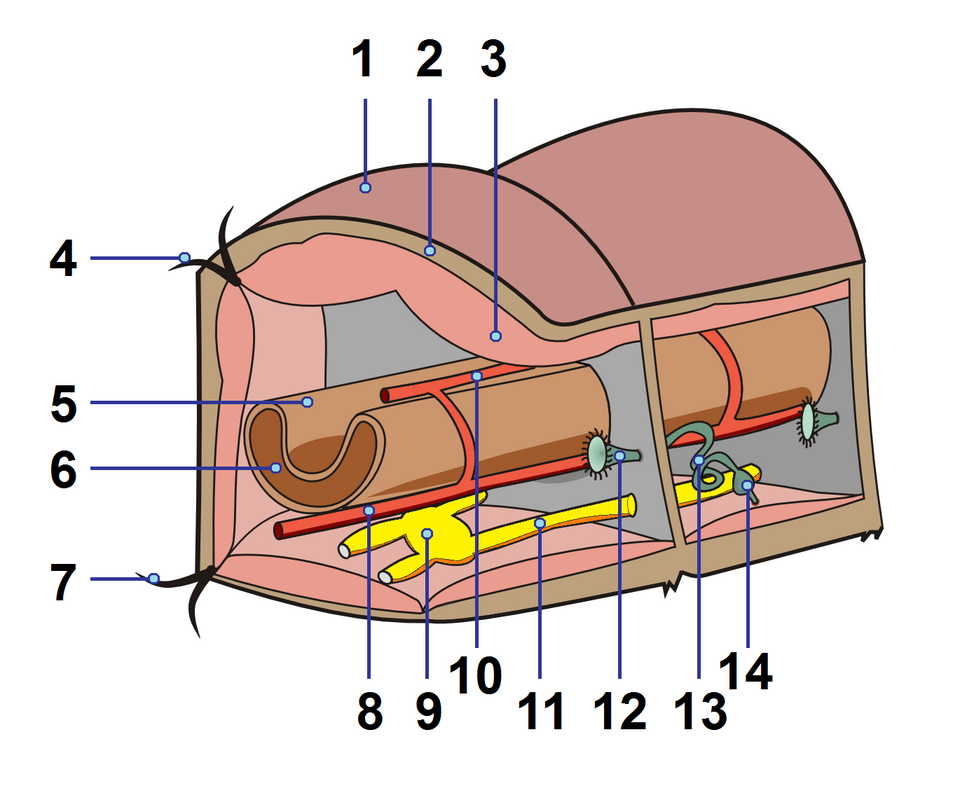 Labeled cross-section showing digestive, circulatory, and nervous systems. (Image: Oligochaeta_anatomy.svg: Reytan / *derivative work: B kimmel, Public domain, via Wikimedia Commons)
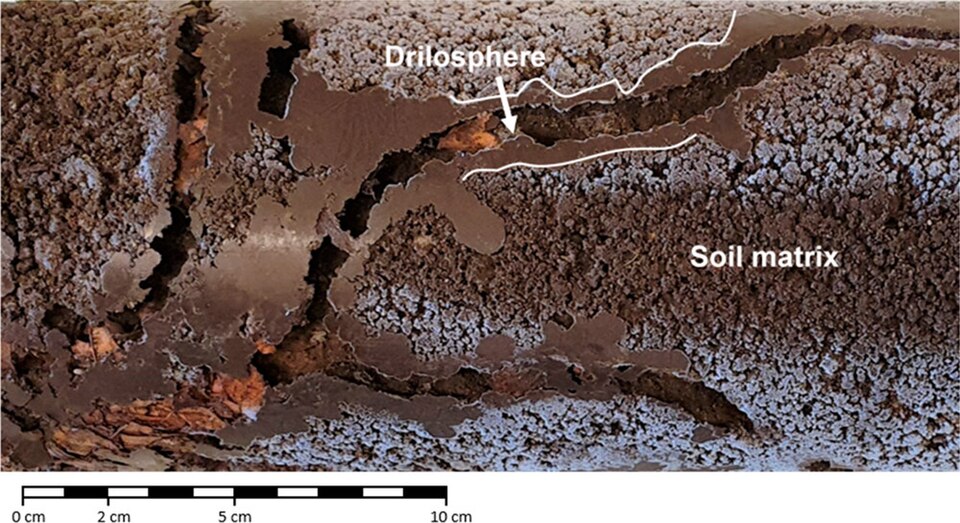 Shows how it improves soil structure. (Image: Wiebke Mareile Heinze, Denise M. Mitrano, Elma Lahive, John , CC BY-SA 4.0, via Wikimedia Commons)
Based on the NEB +2 Science syllabus for Biology (Bio), unit 13.
Discussion
Loading…