BiologyUnit 810 min read
Flowering Plant Morphology: Roots, Stems, Leaves, Flowers, Fruits & Seeds
Unit 8 of Biology explores the external structure (morphology) of flowering plants (angiosperms), covering roots, stems, leaves, flowers, fruits, and seeds, their functions, adaptations, and how they help plants survive and reproduce.
TAKEAWAYS:
- Flowering plants have specialized roots, stems, leaves, flowers, fruits, and seeds with distinct structures and functions.
- Roots absorb water and minerals, stems support and transport nutrients, and leaves perform photosynthesis.
- Flowers are the reproductive organs, with fruits and seeds ensuring the survival of the next generation.
- Adaptations in morphology help plants survive in different environments (e.g., thorns, tendrils, floating leaves).
- Classification of plant parts helps identify and study their roles in growth and reproduction.
What is Morphology?
Morphology is the study of the external structure of organisms. In flowering plants (angiosperms), morphology helps us understand how different parts like roots, stems, leaves, flowers, fruits, and seeds are built and how they work together.
Why Study Morphology?
- Helps identify plants.
- Explains how plants survive in different environments.
- Shows how plants reproduce and spread.
1. Roots: The Underground Support System
Roots are the underground part of a plant. They have three main functions:
- Anchor the plant firmly in the soil.
- Absorb water and minerals.
- Store food (e.g., carrots, beets).
Types of Roots
There are two main types of root systems:
A. Taproot System
- Single main root grows deep into the soil.
- Smaller roots (lateral roots) branch out from the main root.
- Example: Carrot, radish, mustard.
B. Fibrous Root System
- Many thin roots spread out in all directions.
- No single main root.
- Example: Wheat, rice, grass.
Adaptations of Roots
- Pneumatophores: Roots that grow above water to absorb air (e.g., mangroves).
- Prop roots: Roots that grow above ground for extra support (e.g., banyan tree).
- Storage roots: Roots that store food (e.g., sweet potato).
2. Stems: The Plant’s Skeleton
Stems are the supporting structure of a plant. They:
- Hold leaves, flowers, and fruits.
- Transport water, minerals, and food between roots and leaves.
- Store food (e.g., potato, ginger).
Types of Stems
A. Herbaceous Stems
- Soft and green (not woody).
- Example: Sunflower, tomato.
B. Woody Stems
- Hard and strong (made of wood).
- Example: Mango, oak.
C. Modified Stems
- Tubers: Underground stems that store food (e.g., potato).
- Runners: Stems that grow horizontally above ground (e.g., strawberry).
- Thorns: Modified stems for protection (e.g., rose).
Functions of Stems
| Function | Example |
|---|---|
| Support | Tree trunk |
| Transport | Xylem and phloem in stems |
| Storage | Potato (tuber) |
| Reproduction | Runners in strawberry |
3. Leaves: The Food Factories
Leaves are the photosynthetic organs of plants. They:
- Capture sunlight to make food (photosynthesis).
- Exchange gases (oxygen and carbon dioxide).
- Transpire (release water vapor).
Parts of a Leaf
- Petiole: Stalk that attaches the leaf to the stem.
- Leaf Blade (Lamina): Flat part where photosynthesis happens.
- Midrib: Main vein running through the leaf.
- Veins: Network of tubes that transport water and food.
Types of Leaves
A. Simple Leaves
- Single blade per petiole.
- Example: Mango, guava.
B. Compound Leaves
- Multiple leaflets attached to a single petiole.
- Example: Neem, rose.
Adaptations of Leaves
- Floating leaves: Found in aquatic plants (e.g., lotus).
- Spines: Modified leaves for protection (e.g., cactus).
- Tendrils: Modified leaves for climbing (e.g., pea plant).
4. Flowers: The Reproductive Organs
Flowers are the reproductive structures of flowering plants. They produce seeds for the next generation.
Parts of a Flower
- Sepals: Green, leaf-like parts that protect the flower bud.
- Petals: Colorful parts that attract pollinators (e.g., bees, butterflies).
- Stamens (Male parts):
- Anther: Produces pollen (male gametes).
- Filament: Supports the anther.
- Carpels (Female parts):
- Stigma: Receives pollen.
- Style: Connects stigma to ovary.
- Ovary: Contains ovules (female gametes).
Types of Flowers
| Type | Description | Example |
|---|---|---|
| Complete | Has all four parts (sepals, petals, stamens, carpels). | Rose |
| Incomplete | Lacks one or more parts. | Lily (no sepals) |
| Perfect | Has both stamens and carpels. | Mustard |
| Imperfect | Lacks stamens or carpels. | Cucumber (male and female flowers separate) |
| Unisexual | Only male or female flowers. | Papaya |
| Bisexual | Both male and female parts. | Sunflower |
5. Fruits and Seeds: The Next Generation
After fertilization, the ovary develops into a fruit, and the ovules become seeds.
Types of Fruits
A. Simple Fruits
- Develop from a single ovary.
- Example: Mango, apple, tomato.
B. Aggregate Fruits
- Develop from multiple ovaries of a single flower.
- Example: Raspberry, strawberry.
C. Multiple Fruits
- Develop from ovaries of multiple flowers.
- Example: Pineapple, fig.
Types of Seeds
- Monocot seeds: Single cotyledon (e.g., maize, wheat).
- Dicot seeds: Two cotyledons (e.g., gram, pea).
6. Adaptations in Flowering Plants
Flowering plants have many adaptations to survive in different environments:
| Adaptation | Example | Function |
|---|---|---|
| Thorns | Rose | Protection from herbivores |
| Tendrils | Pea | Climbing and support |
| Floating leaves | Lotus | Survival in water |
| Succulent stems | Cactus | Water storage in deserts |
| Bright petals | Sunflower | Attract pollinators |
Solved Examples
Example 1: Identifying Root Types
Question: Classify the roots of a carrot and a wheat plant. Solution:
- Carrot: Taproot system (single main root).
- Wheat: Fibrous root system (many thin roots).
Example 2: Parts of a Flower
Question: Label the parts of a flower diagram. Solution:
Example 3: Types of Fruits
Question: Is a strawberry a simple, aggregate, or multiple fruit? Solution:
- Strawberry is an aggregate fruit because it develops from multiple ovaries of a single flower.
NEB Board-Style Questions
Short Answer Questions
Define morphology. Why is it important in the study of flowering plants?
- Morphology is the study of the external structure of organisms.
- It helps identify plants, understand their functions, and adaptations.
Differentiate between taproot and fibrous root systems with examples.
- Taproot: Single main root (e.g., carrot).
- Fibrous: Many thin roots (e.g., wheat).
What are the functions of stems in plants?
- Support, transport, storage, and reproduction.
Draw and label the parts of a leaf.
- (Use the figure above as reference.)
What are the male and female reproductive parts of a flower?
- Male: Stamens (anther + filament).
- Female: Carpels (stigma + style + ovary).
Long Answer Questions
Describe the structure and functions of roots, stems, and leaves in flowering plants.
- Roots: Anchor, absorb water/minerals, store food.
- Stems: Support, transport, store food, reproduce.
- Leaves: Photosynthesis, gas exchange, transpiration.
Explain the different types of fruits with examples.
- Simple: Mango (single ovary).
- Aggregate: Raspberry (multiple ovaries of one flower).
- Multiple: Pineapple (ovaries of multiple flowers).
How do adaptations in flowering plants help them survive in different environments?
- Thorns (protection), tendrils (climbing), floating leaves (aquatic survival), succulent stems (water storage).
Exam Tip
- Memorize Definitions: Know the definitions of taproot, fibrous root, complete/incomplete flowers, etc.
- Diagrams: Practice drawing and labeling diagrams of roots, stems, leaves, and flowers.
- Examples: Remember examples for each type (e.g., carrot for taproot, wheat for fibrous root).
- Adaptations: Learn adaptations and their functions (e.g., thorns for protection).
- Comparisons: Be ready to compare different parts (e.g., monocot vs. dicot seeds).
- NEB Style: For long answers, divide your answer into clear points (e.g., structure, function, examples).
 A comparison of taproot and fibrous root systems. (Image: Henry A. Dreer (Firm); Henry G. Gilbert Nursery and Seed Tra, Public domain, via Wikimedia Commons)
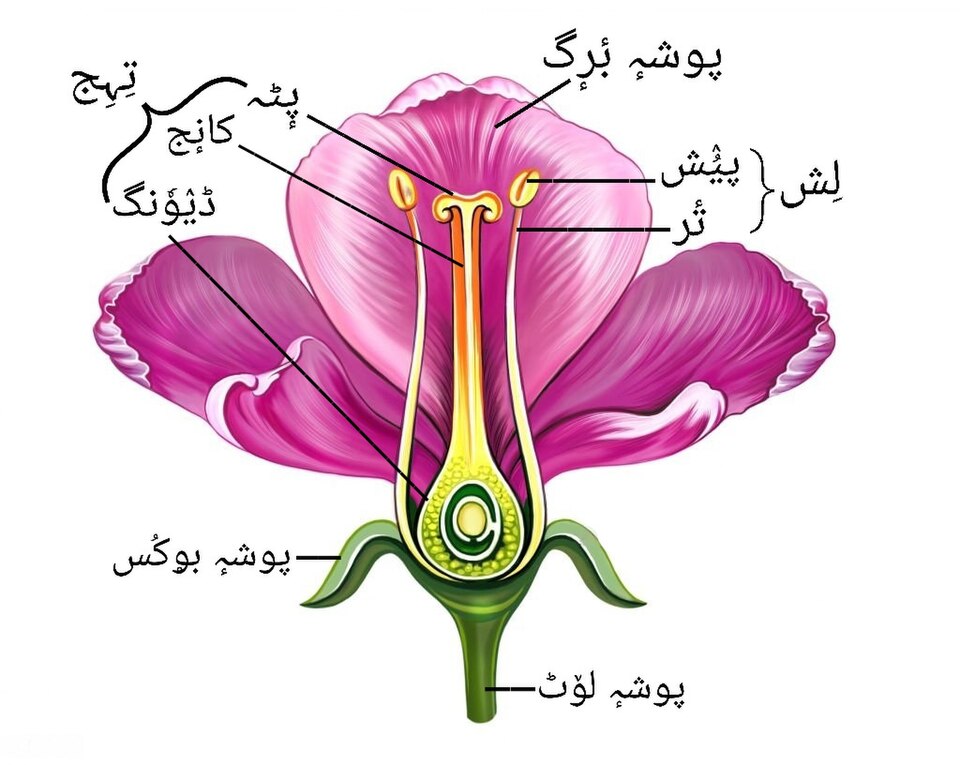 A detailed labelled diagram of a flower's reproductive parts. (Image: Humzah Rouf Phumboo, CC BY 4.0, via Wikimedia Commons)
Based on the NEB +2 Science syllabus for Biology (Bio), unit 8.
Discussion
Loading…