ChemistryUnit 810 min read
Hydrogen: Properties, Preparation, Uses & Compounds
Unit 8 of Chemistry explores hydrogen’s unique position in the periodic table, its physical/chemical properties, industrial preparation (electrolysis, Bosch process), laboratory methods, reactions with metals/non-metals, and key compounds (water, acids, hydrides). Includes NEB-style questions and solved examples.
---

## **What is Hydrogen?**
Hydrogen is the **first element** in the periodic table with **atomic number 1** and **atomic mass 1**. It is the **lightest and most abundant** element in the universe. On Earth, it is mostly found in **combined forms** like water (H₂O) and hydrocarbons (e.g., methane, CH₄).

### **Key Facts About Hydrogen**
- **Symbol**: H
- **Position in the periodic table**: Group 1 (Alkali metals), but it is **not a metal** (it is a **non-metal**).
- **Isotopes**:
  - **Protium (¹H)**: Most common (99.98%), 1 proton, no neutrons.
  - **Deuterium (²H or D)**: 1 proton, 1 neutron (used in heavy water, D₂O).
  - **Tritium (³H or T)**: 1 proton, 2 neutrons (radioactive, used in nuclear reactions).


---

## **Physical Properties of Hydrogen**
Hydrogen is a **colorless, odorless, and tasteless gas** at room temperature. Its properties change with temperature and pressure:

| **Property**       | **Details**                                                                 |
|--------------------|-----------------------------------------------------------------------------|
| **State at room temp** | Gas (boiling point = -252.87°C)                                            |
| **Density**        | Very low (0.09 g/L at STP, lighter than air)                                |
| **Solubility**     | Slightly soluble in water (0.0018 g/L at 0°C)                               |
| **Conductivity**   | Poor conductor of heat and electricity (non-metal)                         |
| **Diffusion**      | Diffuses **32 times faster** than oxygen (lightest gas)                   |

**Why is hydrogen special?**
- It exists as a **diatomic molecule (H₂)** in nature (unlike noble gases like He, which are monatomic).
- It has **only one electron** in its shell, making it highly reactive.

---

## **Chemical Properties of Hydrogen**
Hydrogen is **highly reactive** due to its **single unpaired electron**. It forms **covalent bonds** with non-metals and **ionic/hydrides** with metals.

### **1. Reaction with Metals (Formation of Hydrides)**
Hydrogen reacts with **alkali and alkaline earth metals** to form **hydrides** (saline or ionic hydrides).

**Example Reactions:**
- With **Sodium (Na)**:
  \[ 2Na + H_2 \rightarrow 2NaH \]
  (Sodium hydride, NaH, is a white solid that reacts violently with water.)

- With **Calcium (Ca)**:
  \[ Ca + H_2 \rightarrow CaH_2 \]
  (Calcium hydride, CaH₂, is used as a **drying agent** in organic chemistry.)

```mermaid
flowchart TD
    A["Metal (Na, Ca, etc.)"] -->|+ H₂| B["Hydride (NaH, CaH₂)"]
    B -->|+ Water| C["Hydroxide + H₂"]
    style A fill:#f9f, B fill:#bbf, C fill:#f96
2. Reaction with Non-Metals (Formation of Covalent Compounds)
Hydrogen forms covalent compounds with non-metals like oxygen, nitrogen, carbon, and halogens.
| Non-Metal | Reaction with H₂ | Product | Uses of Product |
|---|---|---|---|
| Oxygen (O₂) | Water (H₂O) | Drinking, sanitation, industrial use | |
| Nitrogen (N₂) | Ammonia (NH₃) | Fertilizers, explosives, cleaning agents | |
| Carbon (C) | Methane (CH₄) | Fuel (natural gas), cooking | |
| Chlorine (Cl₂) | Hydrogen chloride (HCl) | Stomach acid, lab reagent |
3. Reaction with Metalloids (e.g., Boron)
- Forms covalent hydrides like boranes (B₂H₆).
- Used in rocket fuels and semiconductors.
Preparation of Hydrogen
Hydrogen can be prepared in the laboratory and on an industrial scale.
1. Laboratory Preparation
Hydrogen is prepared by reacting zinc (Zn) or iron (Fe) with dilute hydrochloric acid (HCl) or dilute sulfuric acid (H₂SO₄).
Reaction with Zinc and HCl:
- Procedure:
- Take granulated zinc in a test tube.
- Add dilute HCl (1:1 with water).
- Collect hydrogen gas by downward displacement of water (since H₂ is lighter than air).
Why not concentrated HCl?
- Concentrated HCl produces chlorine gas (Cl₂) instead of H₂ due to oxidation.
2. Industrial Preparation
Hydrogen is produced on a large scale using two main methods:
A. Electrolysis of Water (Hofmann Voltameter)
- Water is split into hydrogen and oxygen using electricity.
- Reaction:
- Conditions:
- Use dilute sulfuric acid (H₂SO₄) or NaOH to increase conductivity.
- Cathode (negative): H₂ gas evolves.
- Anode (positive): O₂ gas evolves.
B. Bosch Process (Industrial Hydrogen from Water Gas)
- Water gas (CO + H₂) is mixed with steam and passed over iron catalyst at 450°C.
- Reactions:
- (Exothermic)
- (Endothermic, recycles CO)
- Advantages:
- Cheap and large-scale production.
- Used in ammonia (NH₃) synthesis.
C. From Natural Gas (Steam Reforming)
- Methane (CH₄) reacts with steam at high temperature (700–1100°C) and nickel catalyst.
- Reaction:
- Used in: Petroleum refineries and Haber process for ammonia.
Uses of Hydrogen
Hydrogen has diverse applications in industry, medicine, and daily life.
| Category | Uses | Example |
|---|---|---|
| Fuel | Used in rockets (liquid H₂ + O₂), hydrogen-powered cars. | Space shuttles, fuel cells |
| Industrial | Haber process (NH₃), Fritz process (margarine), hydrogenation of oils. | Fertilizers, vegetable ghee |
| Laboratory | Reducing agent (converts metal oxides to metals). | Extracting Cu from CuO |
| Medicine | Hydrogen gas therapy for inflammation, balloon inflation (amniocentesis). | Medical treatments |
| Metallurgy | Reduction of metal oxides (e.g., tungsten, molybdenum). | Steel industry |
Hydrogen as a Fuel
Hydrogen is a clean fuel because it burns to form only water:
Advantages of Hydrogen Fuel
✅ No pollution (only water vapor is produced). ✅ High energy content (1 kg H₂ = 3x energy of gasoline). ✅ Renewable (can be produced from water using solar/wind energy).
Challenges
❌ Storage issues (H₂ is highly flammable and requires high-pressure tanks). ❌ Infrastructure (limited hydrogen refueling stations). ❌ Production cost (electrolysis requires electricity).
Important Compounds of Hydrogen
1. Water (H₂O)
- Structure: Bent shape (104.5° angle), polar molecule.
- Properties:
- High boiling point (100°C) due to hydrogen bonding.
- Universal solvent (dissolves many substances).
- Uses: Drinking, cooking, industrial processes.
2. Heavy Water (D₂O)
- Deuterium oxide (D = ²H).
- Properties:
- Higher density than normal water (1.1 g/cm³).
- Slower neutron absorption (used in nuclear reactors).
- Uses: Nuclear power plants, research.
3. Hydrogen Peroxide (H₂O₂)
- Structure: Non-planar, polar molecule.
- Properties:
- Bleaching agent, disinfectant.
- Decomposes to water + oxygen:
- Uses: Hair bleach, wound cleaning, rocket propellant.
4. Ammonia (NH₃)
- Structure: Trigonal pyramidal, polar molecule.
- Properties:
- Basic in nature (turns red litmus blue).
- Highly soluble in water.
- Uses: Fertilizers (urea), cleaning agents, explosives (TNT).
NEB-Style Solved Examples
Example 1: Stoichiometry of Hydrogen Reaction
Question: How much hydrogen gas (in liters at STP) is produced when 65 g of zinc reacts with excess HCl? Solution:
- Molar mass of Zn = 65 g/mol.
- Moles of Zn = .
- From the reaction , 1 mol Zn produces 1 mol H₂.
- At STP, 1 mol of any gas = 22.4 L.
- Volume of H₂ = 22.4 L.
Answer: 22.4 liters of H₂.
Example 2: Electrolysis Calculation
Question: In the electrolysis of water, how many grams of hydrogen are produced if 96,500 C of electricity is passed? (1 Faraday = 96,500 C) Solution:
- Reaction: .
- For 2 mol e⁻, 1 mol H₂ is produced.
- 96,500 C = 1 Faraday liberates 1 mol e⁻.
- Moles of H₂ = mol (since 2 e⁻ are needed per H₂ molecule).
- Mass of H₂ = .
Answer: 1 gram of hydrogen.
NEB Board-Style Questions
Short Answer Questions
- Why is hydrogen placed in Group 1 of the periodic table if it is not a metal?
- Write the reaction of hydrogen with copper(II) oxide. What is its use in the laboratory?
- How is heavy water (D₂O) different from normal water (H₂O)?
- Explain why hydrogen is used as a fuel in rockets.
- What is the role of a catalyst in the Bosch process?
Long Answer Questions
- Describe the laboratory preparation of hydrogen using zinc and dilute HCl. Write the balanced equation and explain why concentrated HCl cannot be used.
- Explain the industrial preparation of hydrogen by the Bosch process. Why is steam used in this process?
- Discuss the uses of hydrogen in different fields (industry, medicine, fuel). Also mention its disadvantages as a fuel.
- Compare the physical and chemical properties of hydrogen with those of helium (He) and oxygen (O₂).
Exam Tip
✅ Memorize key reactions (e.g., Zn + HCl, electrolysis of water). ✅ Understand the difference between laboratory and industrial preparation. ✅ Know the uses of hydrogen compounds (H₂O, NH₃, H₂O₂). ✅ Practice stoichiometry problems (moles, volume at STP). ✅ Draw diagrams for:
- Lab setup (Zn + HCl).
- Electrolysis of water.
- Molecular shapes (H₂O, NH₃). ✅ NEB loves comparisons (e.g., H₂ vs. He, lab vs. industrial methods).
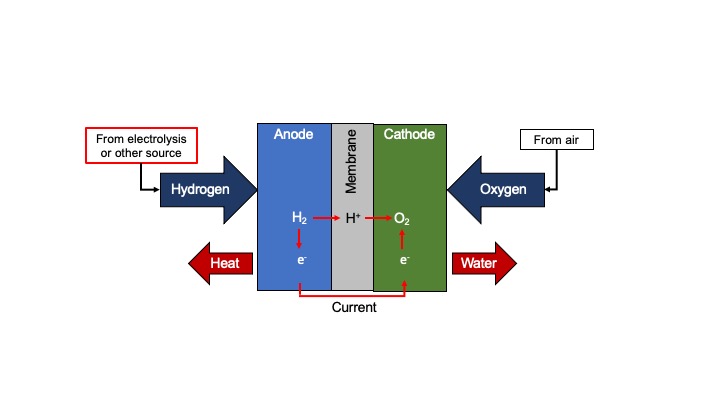 How a hydrogen fuel cell works (proton exchange membrane) (Image: Emma Ambrogi, CC BY-SA 4.0, via Wikimedia Commons)
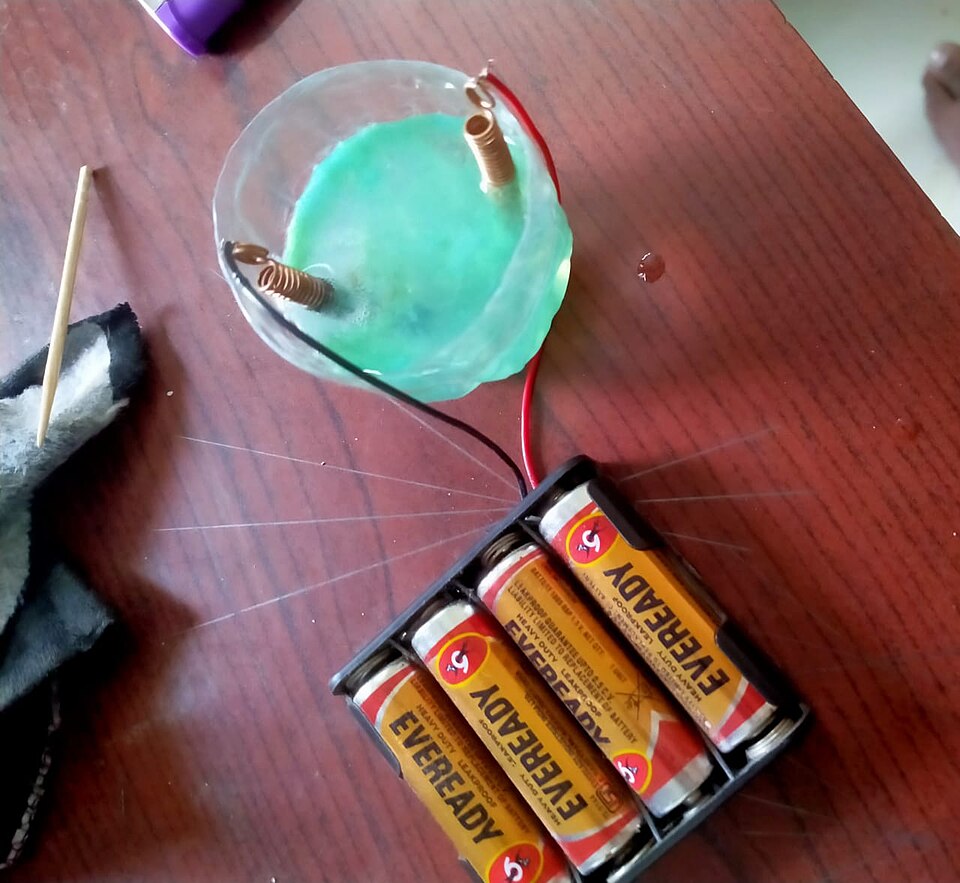 Lab apparatus for H₂ and O₂ collection (Image: Vanadict, CC0, via Wikimedia Commons)
Based on the NEB +2 Science syllabus for Chemistry (Chem), unit 8.
Discussion
Loading…