ChemistryUnit 94 min read
Oxygen, Ozone & Water: Properties, Uses & Environmental Role
Unit 9 of Chemistry explores oxygen’s physical/chemical properties, ozone’s formation and role in the atmosphere, water’s structure, and their industrial/commercial applications—with NEB-style questions and solved examples.
Oxygen: The Life-Sustaining Gas
1. Physical Properties of Oxygen
Oxygen is a colorless, odorless, and tasteless gas at room temperature. It is slightly soluble in water (about 30 mL/L at 20°C) and denser than air (molar mass = 32 g/mol). It supports combustion (burning) and is essential for respiration.
2. Chemical Properties of Oxygen
Oxygen reacts with most elements to form oxides:
- Combustion: Rapid reaction with oxygen (e.g., burning of magnesium). figure {"type":"reaction","reactants":[{"element":"O₂","state":"gas","energy":"UV light"}],"products":[{"element":"O","state":"atom"},{"element":"O","state":"atom"}],"caption":"O₂ + UV → 2O (Photodissociation)"}
#### **2. Structure of Ozone**
Ozone has a **bent shape** (angle ≈ 117°) due to **resonance** between two Lewis structures:


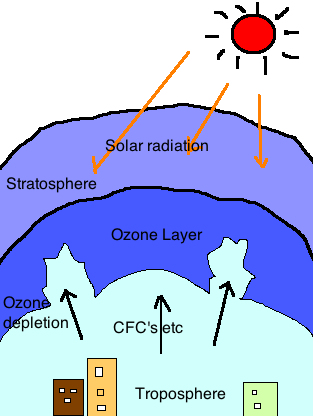
#### **3. Role of Ozone Layer**
- **Absorbs UV radiation**: Protects life from harmful UV rays.
- **Depletion causes**: **CFCs (chlorofluorocarbons)** break ozone into O₂.
  figure
{"type":"hydrogen-bonding","molecules":[{"type":"water","label":"H₂O","hbonds":2}],"caption":"Hydrogen bonds in water (H₂O)"}
2. Chemical Properties of Water
- Acts as an acid or base (amphoteric): mermaid mindmap root((Oxygen vs. Ozone)) Oxygen Gas at room temp Supports combustion Used in respiration Ozone Blue gas with pungent smell Absorbs UV radiation Used as disinfectant Similarities Both allotropes of oxygen React with metals to form oxides
---
### **Exam Tip: How to Score Full Marks**
1. **Diagrams**: Always draw **reaction diagrams** (e.g., ozone formation) and **structures** (e.g., water’s hydrogen bonding).
2. **Balanced equations**: Write **word equations** and **balanced chemical equations** for reactions (e.g., rusting, combustion).
3. **Applications**: Link properties to uses (e.g., "Oxygen supports combustion → used in welding").
4. **Environmental impact**: Discuss **ozone depletion** and **water hardness** in short-answer questions.
5. **NEB-style questions**: Practice **matching columns** (e.g., uses of oxygen) and **true/false** (e.g., "Ozone is harmful to breathe").
---
### **Solved Examples**
**Example 1**: Calculate the volume of oxygen produced when 24 g of KClO₃ decomposes.
**Solution**:
- Molar mass of KClO₃ = 39 + 35.5 + 3×16 = 122.5 g/mol.
- Moles of KClO₃ = 24 g / 122.5 g/mol = 0.196 mol.
- From the equation **2KClO₃ → 2KCl + 3O₂**, 2 moles of KClO₃ produce 3 moles of O₂.
- So, 0.196 mol KClO₃ produces (3/2) × 0.196 = **0.294 mol O₂**.
- At STP, 1 mole of gas = 22.4 L → Volume of O₂ = 0.294 × 22.4 L = **6.58 L**.
**Example 2**: Why does ice float on water?
**Answer**: Ice has a **hexagonal crystal structure** with **more space between H₂O molecules** due to hydrogen bonding, making it **less dense** than liquid water.
---
### **NEB Board-Style Questions**
**Short Answer**:
1. Explain why ozone is harmful at ground level but beneficial in the stratosphere.
2. Write the balanced equation for the reaction of magnesium with oxygen.
**Long Answer**:
3. Describe the **preparation, properties, and uses of oxygen** with examples.
4. How is **hard water softened**? Explain with a chemical reaction.
**Multiple Choice**:
5. Which of the following is **not** a use of oxygen?
a) Welding
b) Bleaching
c) Respiration
d) Rocket fuel
**Answer**: b) Bleaching (ozone is used for bleaching).
---

Based on the NEB +2 Science syllabus for Chemistry (Chem), unit 9.
Discussion
Loading…