PhysicsUnit 185 min read
Dispersion: Light Splitting, Prisms, and Rainbow Formation
Unit 18 of Physics explains how white light splits into colors (dispersion), how prisms work, and why rainbows form—key concepts for NEB exams with solved problems and board-style questions.
What is Dispersion?
Dispersion is the splitting of white light into its component colors (red, orange, yellow, green, blue, indigo, violet). This happens because different colors of light bend differently when they pass through a transparent medium like glass or water.
Why does dispersion happen?
- Light is made of different wavelengths (colors).
- When light enters a prism (or any medium), it slows down and bends (refracts).
- Shorter wavelengths (violet, blue) bend more than longer wavelengths (red, orange).
- This causes white light to split into a spectrum (rainbow of colors).
How a Prism Works
A prism is a triangular glass block that refracts light twice:
- First refraction: Light enters the prism and bends toward the normal (due to slower speed in glass).
- Inside the prism: Different colors travel at slightly different speeds, causing them to separate.
- Second refraction: Light exits the prism and bends away from the normal, emerging as a rainbow.
Rainbow Formation (Natural Dispersion)
Rainbows form when:
- Sunlight enters a water droplet.
- Light refracts inside the droplet.
- Light reflects off the inner surface of the droplet.
- Light refracts again as it exits, splitting into colors.
Angle of Deviation
The angle of deviation (δ) is how much light bends when passing through a prism.
- For a prism with angle A, the deviation depends on the refractive index (μ) of the prism material.
- Formula: (For small angles, this gives the minimum deviation when light passes symmetrically.)
Example: A prism with and deviates light by:
Applications of Dispersion
| Application | How it works | Example |
|---|---|---|
| Spectroscopes | Splits light to analyze elements. | Used in astronomy to study stars. |
| Prisms in binoculars | Separates and recombines light for clarity. | Helps in long-distance viewing. |
| Rainbow formation | Natural dispersion in raindrops. | Seen after rain with sunlight. |
| Optical instruments | Corrects color distortion in lenses. | Used in cameras and telescopes. |
NEB-Style Solved Problems
Problem 1: Calculate the angle of deviation
A prism has an angle of and a refractive index of . Find the angle of minimum deviation.
Solution: Given:
- Prism angle
- Refractive index
Using the formula:
Answer: The angle of minimum deviation is 36°.
Problem 2: Why is a violet light ray deviated more than a red light ray in a prism?
Solution:
- Violet light has a shorter wavelength and higher frequency.
- It travels slower in glass than red light.
- Since , violet light has a higher refractive index (μ).
- Thus, it bends more than red light.
NEB Board-Style Questions
Short Answer (5 marks)
- Explain the phenomenon of dispersion with a labeled diagram of a prism.
- Why does a rainbow appear after rain? Draw a ray diagram to show how colors separate in a raindrop.
Long Answer (10 marks)
- Derive the formula for the angle of deviation in a prism. A prism has an angle of and a refractive index of . Calculate its angle of minimum deviation.
- Discuss the applications of dispersion in everyday life and scientific instruments.
Exam Tip
- Memorize the order of colors in a spectrum: ROYGBIV (Red, Orange, Yellow, Green, Blue, Indigo, Violet).
- Understand why violet bends more: Shorter wavelength → higher refractive index → more deviation.
- Practice prism deviation calculations: Use for minimum deviation.
- Draw diagrams: Always label the prism angle, incident ray, emergent ray, and color separation.
- Compare natural vs. artificial dispersion: Rainbows (natural) vs. prisms (artificial).
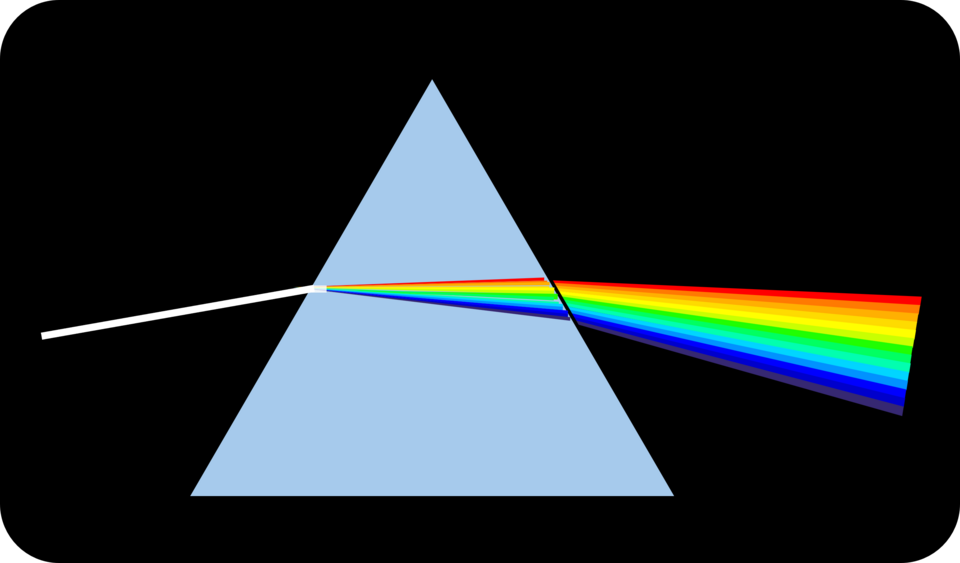 A labeled diagram showing how white light splits into colors in a glass prism. (Image: PhysicsEtc, CC0, via Wikimedia Commons)
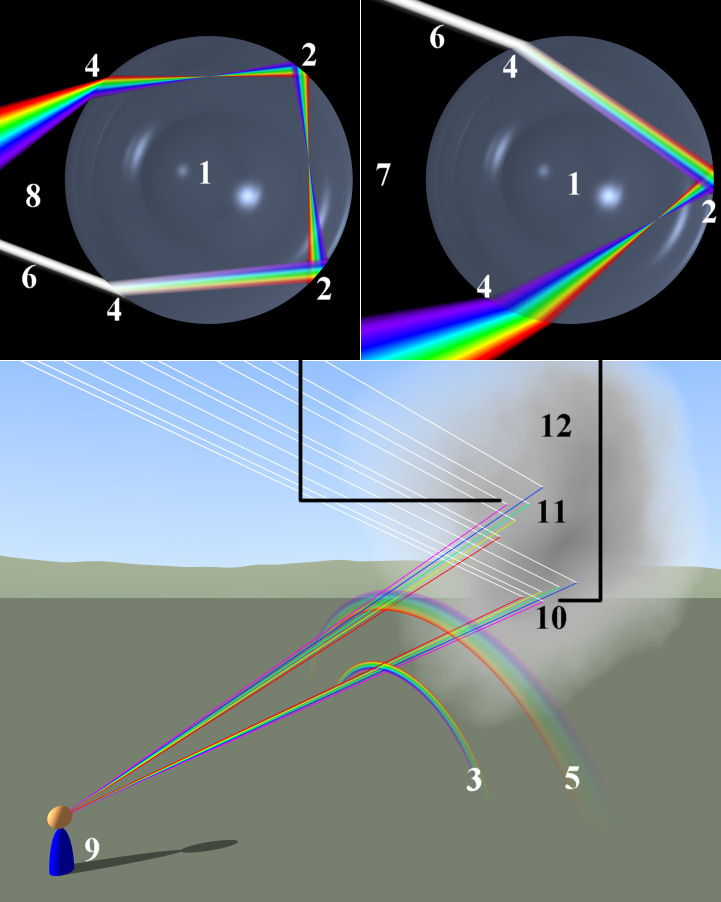 A cross-section of a raindrop showing internal reflection and refraction. (Image: Peo, CC BY-SA 3.0, via Wikimedia Commons)
Based on the NEB +2 Science syllabus for Physics (Phy), unit 18.
Discussion
Loading…