PhysicsUnit 178 min read
Lenses: Types, Ray Diagrams, Lens Formula & Applications
Unit 17 of Physics covers convex and concave lenses, ray tracing rules, lens formula (1/f = 1/v − 1/u), magnification, and real-world uses like spectacles, cameras, and microscopes—with solved NEB-style problems and exam tips.
What is a Lens?
A lens is a transparent piece of glass or plastic with at least one curved surface. It bends (refracts) light rays to form images. Lenses are everywhere: in glasses, cameras, microscopes, and telescopes.
Types of Lenses
There are two main types of lenses:
Convex Lens (Converging Lens)
- Thicker in the middle, thinner at the edges.
- Bends parallel rays inward to meet at a point (focus).
- Used in magnifying glasses, cameras, and projectors.
Concave Lens (Diverging Lens)
- Thinner in the middle, thicker at the edges.
- Bends parallel rays outward, making them appear to diverge from a point (virtual focus).
- Used in spectacles for short-sightedness and in optical instruments.
Key Terms and Definitions
1. Optical Centre (O)
- The central point of the lens.
- A ray passing through O goes straight without bending.
2. Principal Axis
- An imaginary straight line passing through O and the centres of curvature of the lens surfaces.
3. Focus (F) and Focal Length (f)
- Convex Lens: Parallel rays meet at the real focus (F) after refraction. The distance from O to F is the focal length (f).
- Concave Lens: Parallel rays appear to diverge from the virtual focus (F). The focal length is negative by convention.
4. Object Distance (u)
- Distance from the object to the lens (always negative for real objects in lens formula conventions).
5. Image Distance (v)
- Distance from the lens to the image.
- Positive for real images (formed on the opposite side of the object).
- Negative for virtual images (formed on the same side as the object).
6. Magnification (m)
- Ratio of image height to object height.
- Formula: .
- Positive m: Image is upright.
- Negative m: Image is inverted.
Rules for Ray Tracing
To locate the image formed by a lens, use these three rules for ray tracing:
Ray Parallel to Principal Axis
- After refraction, it passes through the focus (F) for a convex lens.
- For a concave lens, it appears to diverge from the virtual focus (F).
Ray Passing Through the Optical Centre (O)
- Goes straight without bending.
Ray Passing Through the Focus (for Convex Lens) or Directed Towards the Focus (for Concave Lens)
- After refraction, it emerges parallel to the principal axis.
flowchart TD
    A["Ray 1: Parallel to Principal Axis"] -->|"Convex Lens"| B["Passes through F"]
    A -->|"Concave Lens"| C["Appears to diverge from F"]
    D["Ray 2: Through O"] --> E["Goes straight"]
    F["Ray 3: Through F (Convex) or Towards F (Concave)"] -->|"Convex"| G["Parallel to Principal Axis"]
    F -->|"Concave"| H["Parallel to Principal Axis"]
Lens Formula and Magnification
The lens formula relates object distance (u), image distance (v), and focal length (f):
Magnification (m) is given by:
Sign Conventions
| Quantity | Convex Lens (Real Object) | Concave Lens (Real Object) |
|---|---|---|
| f | Positive | Negative |
| u | Negative | Negative |
| v | Positive (real image) | Negative (virtual image) |
| m | Positive (upright) or Negative (inverted) | Always Positive (upright) |
Solved Examples
Example 1: Convex Lens
Problem: An object is placed 20 cm from a convex lens of focal length 10 cm. Find the image distance and magnification.
Solution: Given:
- cm (object is real),
- cm.
Using the lens formula:
Magnification:
- Image distance (v): 20 cm (real, inverted, same size as object).
Example 2: Concave Lens
Problem: An object is placed 15 cm from a concave lens of focal length 10 cm. Find the image distance and magnification.
Solution: Given:
- cm,
- cm.
Using the lens formula:
Magnification:
- Image distance (v): 30 cm (virtual, upright, magnified).
Comparison of Convex and Concave Lenses
| Feature | Convex Lens | Concave Lens |
|---|---|---|
| Shape | Thicker in the middle | Thinner in the middle |
| Focal Length (f) | Positive | Negative |
| Image Type | Real or Virtual | Always Virtual |
| Magnification | Can be >1, =1, or <1 | Always <1 (diminished) |
| Uses | Magnifying glass, camera, projector | Spectacles for short-sightedness |
Applications of Lenses
Convex Lenses:
- Magnifying Glass: Produces a magnified virtual image.
- Camera: Forms a real, inverted image on the film/sensor.
- Projector: Produces a magnified real image on a screen.
- Spectacles: Corrects long-sightedness (hypermetropia).
Concave Lenses:
- Spectacles: Corrects short-sightedness (myopia).
- Optical Instruments: Used in combination with convex lenses to reduce aberrations.
mindmap
  root((Lenses))
    Convex Lens
      Magnifying Glass
      Camera
      Projector
      Spectacles (Hypermetropia)
    Concave Lens
      Spectacles (Myopia)
      Optical Instruments
NEB Board-Style Questions
Short Answer Questions
Define focal length of a lens. How does it differ for convex and concave lenses?
- Answer: Focal length is the distance between the optical centre and the focus. For convex lenses, it is positive; for concave lenses, it is negative.
State the lens formula. What does a negative magnification indicate?
- Answer: Lens formula: . Negative magnification indicates the image is inverted.
Why is a concave lens used in spectacles for short-sightedness?
- Answer: A concave lens diverges light rays, shifting the image back to the retina, which is too far forward in short-sighted eyes.
Long Answer Questions
An object of height 5 cm is placed 10 cm in front of a convex lens of focal length 15 cm. Find the position, nature, and size of the image formed.
- Solution: Given: cm, cm, object height cm. Magnification:
- Answer: The image is 30 cm from the lens on the same side as the object, virtual, upright, and 15 cm tall.
Draw ray diagrams to show the formation of a virtual image by a concave lens when the object is placed in front of it.
- Answer: Use the three ray rules for a concave lens (as shown in the earlier figure).
Exam Tip
- Memorize the Lens Formula: and magnification .
- Sign Conventions: Always use the correct signs for , , and (negative for real objects and concave lenses).
- Ray Diagrams: Practice drawing ray diagrams for both convex and concave lenses to visualize image formation.
- Applications: Know the practical uses of lenses in daily life (e.g., spectacles, cameras).
- Numerical Problems: Solve problems step-by-step, showing all calculations clearly. Watch out for units (always use cm) and signs.
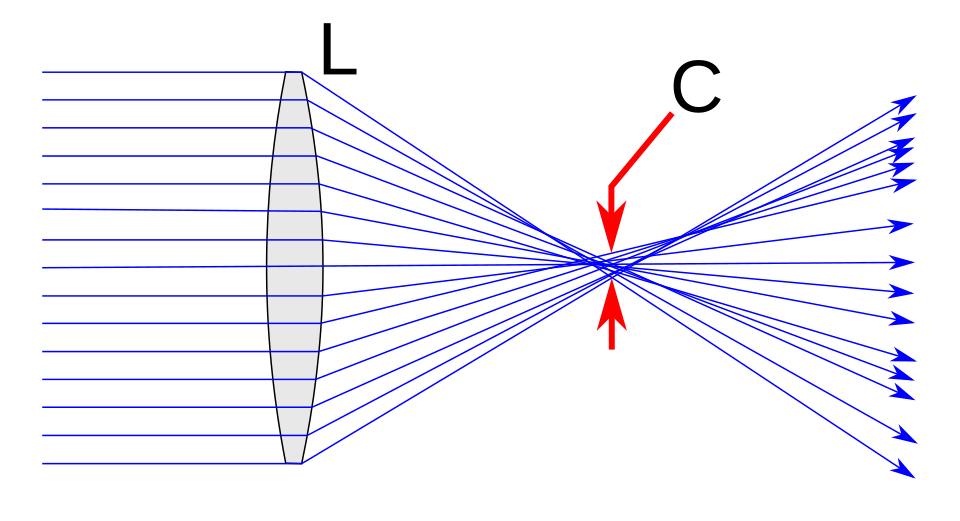 A standard labelled diagram of a convex lens showing rays, focus, and image formation. (Image: Chetvorno, CC0, via Wikimedia Commons)
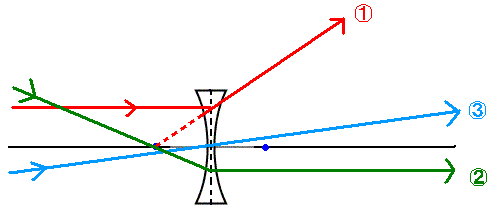 A standard labelled diagram of a concave lens showing rays, virtual focus, and image formation. (Image: Takuzaburou, Public domain, via Wikimedia Commons)
Based on the NEB +2 Science syllabus for Physics (Phy), unit 17.
Discussion
Loading…