PhysicsUnit 46 min read
Newton's Laws, Forces & Momentum: Types, Equations & Applications
Unit 4 of Physics covers Newton’s three laws of motion, free-body diagrams, friction, momentum, impulse, and collisions—explaining how forces cause motion, change velocity, and conserve momentum in real-world scenarios.
TAKEAWAYS
- Newton’s 1st Law explains inertia: objects stay at rest or in motion unless acted on by an unbalanced force.
- Newton’s 2nd Law () links force, mass, and acceleration—key to solving motion problems.
- Newton’s 3rd Law states that forces always act in equal and opposite pairs (action-reaction).
- Friction (static, kinetic) opposes motion and depends on surface type and normal force.
- Momentum () is conserved in collisions (elastic/inelastic), and impulse () changes momentum.
- Free-body diagrams visualize forces acting on an object to solve equilibrium or acceleration problems.
1. Newton’s Laws of Motion
Newton’s laws describe how forces affect motion. They form the foundation of classical mechanics.
1.1 Newton’s First Law (Law of Inertia)
- Definition: An object remains at rest or in uniform motion unless acted upon by an external force.
- Key Idea: Inertia is the resistance to change in motion (depends on mass).
- Example: A book on a table stays at rest until you push it.
1.2 Newton’s Second Law ()
- Definition: The net force on an object equals its mass times acceleration.
- Key Idea: Force causes acceleration; more force = more acceleration (if mass is constant).
- Equation:
- Example: Pushing a 10 kg box with 20 N force gives .
1.3 Newton’s Third Law (Action-Reaction)
- Definition: For every action, there is an equal and opposite reaction.
- Key Idea: Forces always come in pairs (e.g., you push a wall, the wall pushes back).
- Example: A rocket expels gas backward to move forward.
flowchart TD
    A["Action: Rocket pushes gas backward"] -->|"Force: F"| B["Reaction: Gas pushes rocket forward"]
2. Types of Forces
Forces can be contact (push/pull) or non-contact (gravity, magnetism).
2.1 Contact Forces
- Friction: Opposes motion (static: before moving; kinetic: while moving).
- Equation:
- Example: Sliding a book on a table stops due to kinetic friction.
2.2 Non-Contact Forces
- Gravity: (weight = mass × gravitational acceleration).
- Electromagnetic Force: Attraction/repulsion between charges.
3. Free-Body Diagrams (FBD)
A free-body diagram shows all forces acting on an object.
How to Draw an FBD
- Draw the object as a dot/box.
- Label all forces with arrows (e.g., downward, upward).
- Include friction if applicable.
flowchart TD
    A["Object"] -->|"F_g"| B["Downward"]
    A -->|"N"| C["Upward"]
A -->|"f_k"| D["Left (opposes motion)"]Example: A 5 kg block on a table with applied horizontally.
- Forces: , , , .
- Net force: → .
4. Momentum and Collisions
Momentum () is conserved in isolated systems.
4.1 Conservation of Momentum
- Law: Total momentum before = total momentum after a collision.
- Equation:
- Example: A 2 kg ball (4 m/s) hits a 3 kg ball at rest → final velocities?
4.2 Impulse ()
- Definition: Change in momentum = impulse (force × time).
- Example: Catching a ball reduces force by increasing time (soft hands).
5. Solved Examples
Example 1: Newton’s 2nd Law
A 1000 kg car accelerates at . Find the net force. Solution:
Example 2: Friction
A 5 kg box is pushed with 30 N. Coefficient of kinetic friction () = 0.2. Find acceleration. Solution:
- Normal force .
- Friction .
- Net force .
- Acceleration .
6. NEB Board-Style Questions
Short Answer
- State Newton’s 3rd Law and give an example.
- Why does a car skid when brakes are applied suddenly?
Long Answer
- A 2 kg block slides on a frictionless table with 4 m/s. It collides with a 3 kg block at rest. Find their velocities after collision (assume elastic).
- Draw an FBD for a book on an inclined plane with angle θ.
Exam Tip
- Diagrams: Always draw FBDs for force problems.
- Units: Use SI units (N, kg, m/s²).
- Conservation: Momentum is conserved only in isolated systems (no external forces).
- Tricks: For collisions, use and solve algebraically.
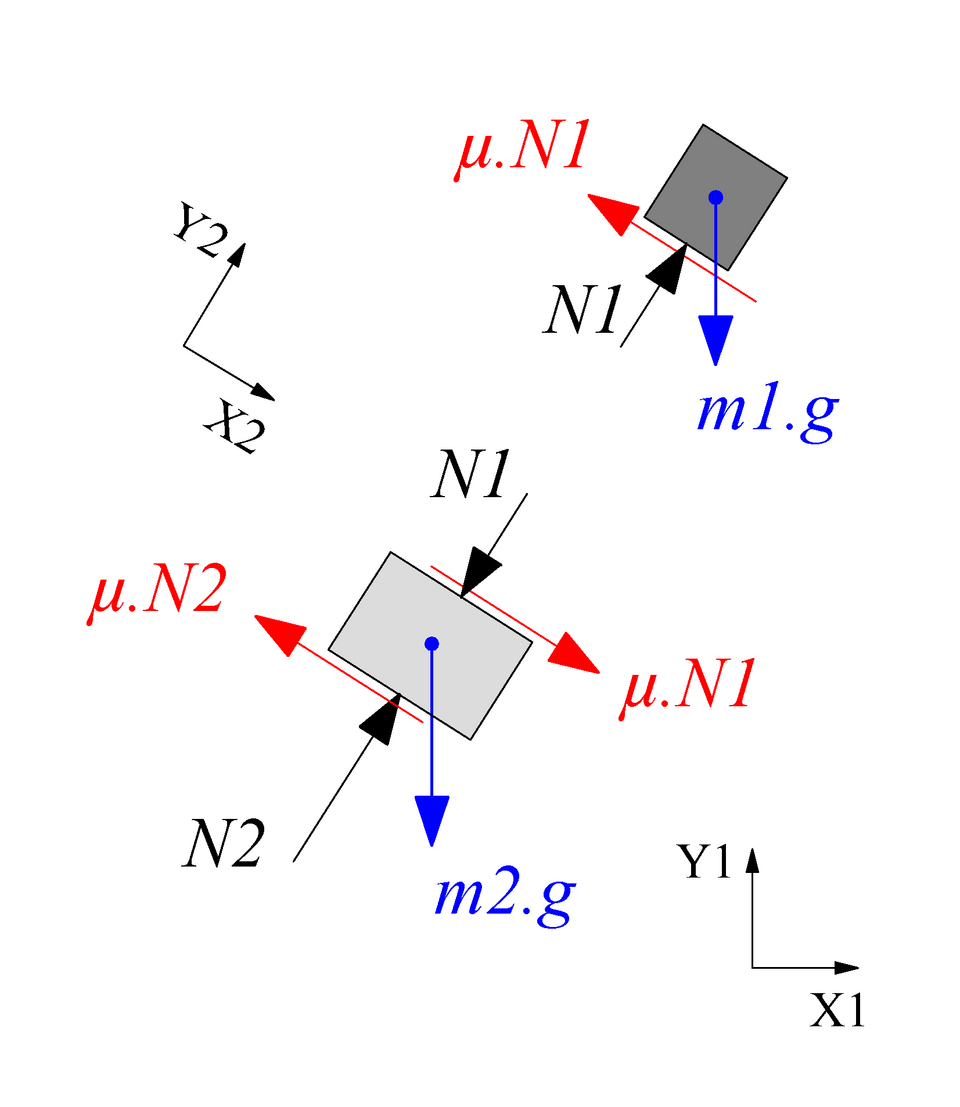 A labeled FBD showing forces on a block on an incline. (Image: Aboalbiss, CC BY-SA 3.0, via Wikimedia Commons)
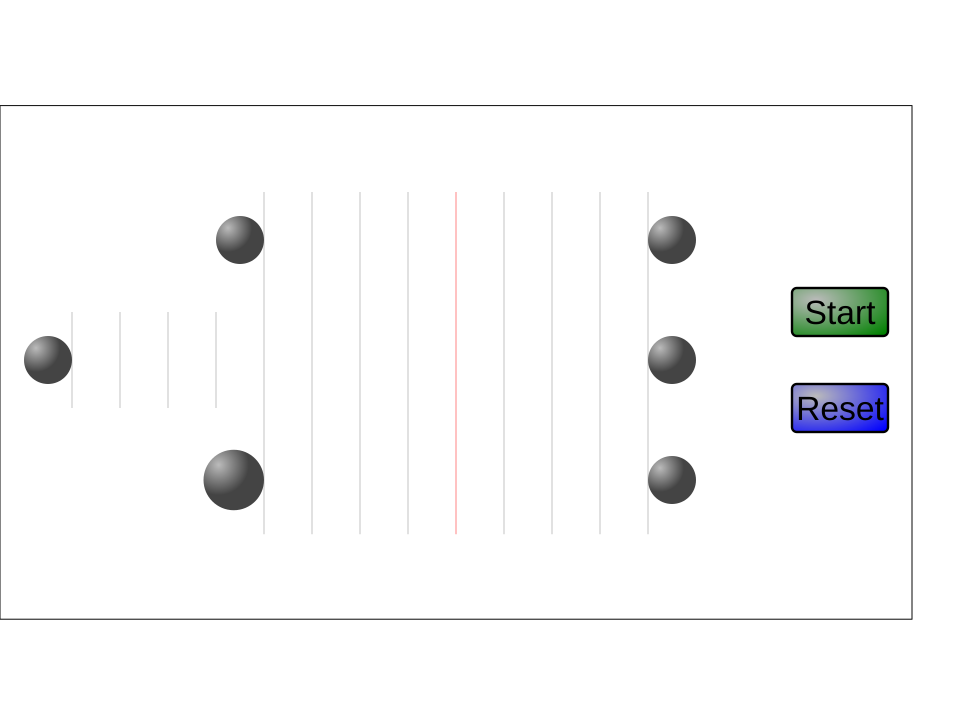 Two balls colliding to show momentum transfer. (Image: JohannesDurst, CC BY-SA 4.0, via Wikimedia Commons)
Based on the NEB +2 Science syllabus for Physics (Phy), unit 4.
Discussion
Loading…