PhysicsUnit 87 min read
Elasticity: Stress, Strain, Hooke’s Law, Young’s Modulus, Applications
Unit 8 of Physics explains how materials deform under force—stress, strain, Hooke’s law, elastic limit, and real-world applications like springs, bridges, and rubber bands. Learn formulas, graphs, and why some objects break while others bend back.
---

## What is Elasticity?
Elasticity is the property of a material to **return to its original shape and size** after the deforming force is removed. Think of a rubber band: when you stretch it and release, it snaps back. But if you stretch it too much, it may break or stay deformed—that’s called **plastic deformation**.

### Key Terms:
- **Elastic Body**: Returns to original shape after force is removed (e.g., rubber, steel springs).
- **Plastic Body**: Does not return to original shape (e.g., clay, putty).
- **Elastic Limit**: Maximum force beyond which a material does not return to its original shape.


---

## Stress and Strain
When a force acts on an object, it causes **deformation**. We measure this deformation using two quantities:

### 1. **Stress (σ)**
Stress is the **internal force per unit area** acting inside a material. It is caused by external forces like tension, compression, or shear.
**Formula**:
\[
\sigma = \frac{F}{A}
\]
- \(F\) = Applied force (Newton, N)
- \(A\) = Cross-sectional area (m²)
- **Unit**: Pascal (Pa) or N/m²

**Types of Stress**:
```mermaid
graph TD
    A[Stress] --> B[Tensile Stress]
    A --> C[Compressive Stress]
    A --> D[Shear Stress]
    B -->|Pulling apart| E[Example: Stretching a wire]
    C -->|Pushing together| F[Example: Crushing a can]
    D -->|Sliding forces| G[Example: Cutting with scissors]
2. Strain (ε)
Strain measures how much an object deforms compared to its original size. It is a dimensionless quantity (no units). Formula: [ \epsilon = \frac{\Delta L}{L_0} ]
- (\Delta L) = Change in length (m)
- (L_0) = Original length (m)
Types of Strain:
graph TD
    A["Strain"] --> B["Longitudinal Strain"]
    A --> C["Shear Strain"]
    B -->|"Length change"| D["Example: Stretching a spring"]
    C -->|"Angle change"| E["Example: Twisting a rod"]
Hooke’s Law
Robert Hooke discovered that within the elastic limit, stress is directly proportional to strain: [ \sigma \propto \epsilon \quad \text{or} \quad \sigma = Y \cdot \epsilon ] where (Y) is the Young’s modulus (a property of the material).
Worked Example 1: Calculating Stress and Strain
A steel wire of length 2 m and cross-sectional area (10^{-6}) m² is stretched by 0.5 mm under a force of 500 N. Calculate:
- Stress on the wire.
- Strain produced.
- Young’s modulus of steel.
Solution:
- Stress: [ \sigma = \frac{F}{A} = \frac{500}{10^{-6}} = 5 \times 10^8 , \text{Pa} ]
- Strain: [ \epsilon = \frac{\Delta L}{L_0} = \frac{0.5 \times 10^{-3}}{2} = 2.5 \times 10^{-4} ]
- Young’s Modulus: [ Y = \frac{\sigma}{\epsilon} = \frac{5 \times 10^8}{2.5 \times 10^{-4}} = 2 \times 10^{11} , \text{Pa} ]
Young’s Modulus (Y)
Young’s modulus is a measure of stiffness of a material. It tells us how much stress is needed to produce a given strain.
- High Y: Stiff material (e.g., steel, diamond).
- Low Y: Flexible material (e.g., rubber, rubber bands).
Stress-Strain Graph
The relationship between stress and strain is shown in a stress-strain graph. Here’s what it tells us:
Key Points from the Graph:
- Elastic Region (O to A): Stress ∝ Strain (Hooke’s law applies).
- Elastic Limit (A): Beyond this, permanent deformation occurs.
- Yield Point (B): Material starts to deform plastically.
- Ultimate Tensile Strength (C): Maximum stress before breaking.
- Fracture Point (D): Material breaks.
Applications of Elasticity
Elasticity is used in many real-life applications:
| Application | Material Used | Why? |
|---|---|---|
| Springs | Steel, Phosphor Bronze | High Young’s modulus → stores energy efficiently. |
| Bridges | Steel, Concrete | Withstands compressive and tensile stresses. |
| Rubber Bands | Rubber | Low Young’s modulus → stretches easily but returns to shape. |
| Shock Absorbers | Special Alloys | Absorbs energy by deforming elastically. |
| Surgical Instruments | Stainless Steel | High elastic limit → does not bend under force. |
Solved Problems (NEB Style)
Problem 1:
A copper wire of length 2.5 m and radius 1 mm is stretched by 1 mm when a force of 100 N is applied. Calculate:
- Stress in the wire.
- Strain produced.
- Young’s modulus of copper.
Solution:
- Area of wire: Stress:
- Strain:
- Young’s Modulus:
Problem 2:
Define:
- Elasticity.
- Plasticity.
- Elastic Limit.
Solution:
- Elasticity: The property of a material to return to its original shape and size after the deforming force is removed.
- Plasticity: The property of a material to retain its deformed shape after the force is removed (permanent deformation).
- Elastic Limit: The maximum stress that a material can withstand without permanent deformation.
Exam Tip
Memorize Formulas:
- Stress ()
- Strain ()
- Young’s Modulus ()
Understand Graphs:
- Know the regions (elastic, plastic, fracture) in a stress-strain graph.
- Identify elastic limit, yield point, and ultimate tensile strength.
Unit Conversions:
- Always convert units to SI units (N, m, Pa) before calculations.
Real-World Applications:
- Relate concepts to everyday objects (springs, rubber bands, bridges).
Numerical Problems:
- Practice calculating stress, strain, and Young’s modulus.
- Watch out for significant figures and unit consistency.
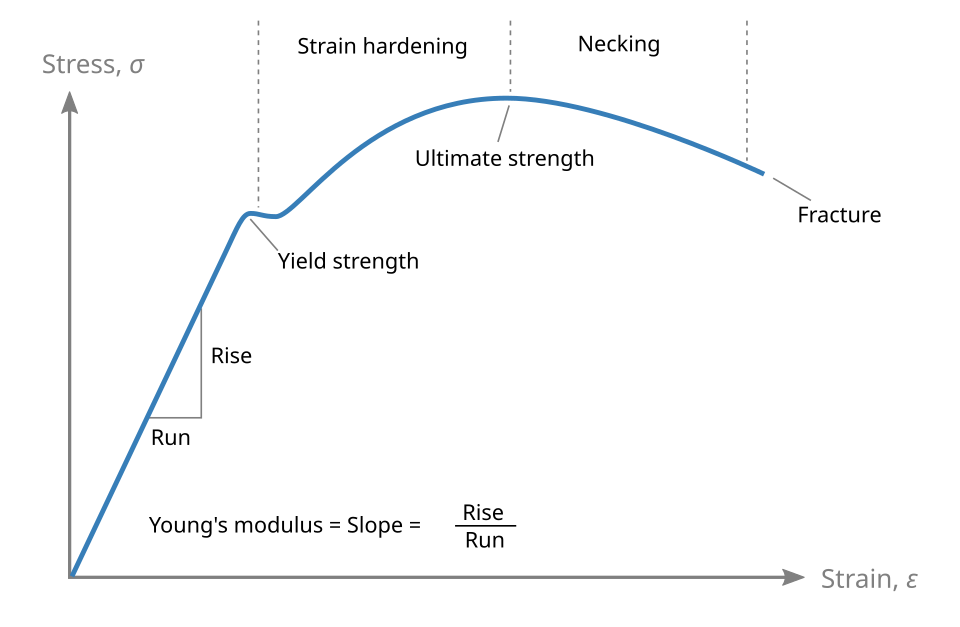 A typical stress-strain graph showing elastic and plastic regions. (Image: Nicoguaro, CC BY 4.0, via Wikimedia Commons)
Based on the NEB +2 Science syllabus for Physics (Phy), unit 8.
Discussion
Loading…