PhysicsUnit 710 min read
Gravitation: Newton’s Laws, Orbits, Escape Velocity & Kepler’s Rules
Unit 7 of Physics explains how gravity works—Newton’s law of gravitation, Kepler’s laws of planetary motion, gravitational potential energy, and how to calculate escape velocity and orbital speed. You’ll learn why planets orbit the Sun, how gravity depends on mass and distance, and how to solve problems using these ide
---

## What is Gravitation?
Gravitation is the **force of attraction** between any two objects in the universe. It is the weakest of the four fundamental forces but has an infinite range. Everything with mass experiences gravity. For example, the Earth pulls you toward its center, keeping you on the ground. Similarly, the Moon is pulled toward the Earth, causing tides.

### Newton’s Law of Universal Gravitation
Sir Isaac Newton proposed that **every object in the universe attracts every other object with a force** that depends on:
1. The **mass of the objects** (the bigger the mass, the stronger the force).
2. The **distance between them** (the farther apart, the weaker the force).

The formula for gravitational force \( F \) between two objects is:

\[
F = G \frac{m_1 m_2}{r^2}
\]

Where:
- \( F \) = gravitational force (in Newtons, N)
- \( G \) = universal gravitational constant (\( 6.67 \times 10^{-11} \, \text{N m}^2/\text{kg}^2 \))
- \( m_1 \) and \( m_2 \) = masses of the two objects (in kg)
- \( r \) = distance between the centers of the two objects (in meters)

---
```figure
{"type":"graph","fns":[{"expr":"1/x^2","label":"F ∝ 1/r²"}],"x":[0.5,5],"points":[{"x":1,"y":1,"label":"r = 1 m"}],"xlabel":"Distance (r)","ylabel":"Force (F)"}
Caption: The graph shows that gravitational force decreases rapidly as distance increases (inverse square law).
Key Concepts
1. Gravitational Force vs. Weight
- Gravitational Force: The force of attraction between two objects (e.g., Earth and Moon).
- Weight: The gravitational force exerted by the Earth on an object (e.g., your weight is the force Earth pulls you with).
The weight ( W ) of an object is calculated as:
[ W = m \cdot g ]
Where:
- ( W ) = weight (N)
- ( m ) = mass of the object (kg)
- ( g ) = acceleration due to gravity (on Earth, ( g = 9.8 , \text{m/s}^2 ))
Example: If your mass is 60 kg, your weight on Earth is: [ W = 60 \times 9.8 = 588 , \text{N} ]
2. Acceleration Due to Gravity (( g ))
The acceleration due to gravity on Earth’s surface is ( 9.8 , \text{m/s}^2 ). This means an object in free fall (ignoring air resistance) speeds up by 9.8 m/s every second.
Why is ( g ) different on the Moon? The Moon has less mass and a smaller radius than Earth, so its gravitational pull is weaker. On the Moon, ( g = 1.62 , \text{m/s}^2 ).
Example: If you drop a ball from a height of 20 m on Earth, how fast will it be moving just before it hits the ground?
We use the equation: [ v^2 = u^2 + 2 a s ] Where:
- ( u = 0 , \text{m/s} ) (starting from rest)
- ( a = g = 9.8 , \text{m/s}^2 )
- ( s = 20 , \text{m} )
[ v^2 = 0 + 2 \times 9.8 \times 20 = 392 ] [ v = \sqrt{392} \approx 19.8 , \text{m/s} ]
3. Kepler’s Laws of Planetary Motion
Johannes Kepler described how planets move around the Sun using three laws:
First Law (Law of Orbits)
Planets move in elliptical orbits with the Sun at one focus.
Second Law (Law of Areas)
A line joining a planet to the Sun sweeps out equal areas in equal times. This means planets move faster when closer to the Sun.
Third Law (Law of Periods)
The square of the time period () of a planet’s orbit is proportional to the cube of the semi-major axis () of its orbit:
Example: If Earth’s orbital period is 1 year and its average distance from the Sun is 1 AU (Astronomical Unit), how long would it take Mars to orbit the Sun if it is 1.52 AU from the Sun?
Using Kepler’s Third Law:
4. Gravitational Potential Energy
Gravitational potential energy () is the energy an object has due to its position in a gravitational field. Near Earth’s surface, it is given by:
Where:
- = gravitational potential energy (J)
- = mass of the object (kg)
- = acceleration due to gravity ()
- = height above a reference point (usually Earth’s surface, m)
Example: What is the gravitational potential energy of a 5 kg object lifted to a height of 10 m?
5. Escape Velocity
Escape velocity is the minimum speed an object must reach to break free from a planet’s or moon’s gravitational pull without further propulsion.
The formula for escape velocity () is:
Where:
- = gravitational constant ()
- = mass of the planet (kg)
- = radius of the planet (m)
Example: Calculate the escape velocity from Earth’s surface.
- Mass of Earth () =
- Radius of Earth () =
Note: The actual escape velocity from Earth is about 11.2 km/s.
6. Orbital Velocity
Orbital velocity is the speed required to maintain a stable circular orbit around a planet or star.
The formula for orbital velocity () is:
Example: Calculate the orbital velocity of a satellite orbiting Earth at a height of 300 km (radius = 6,670 km).
Comparison Table: Escape Velocity vs. Orbital Velocity
| Feature | Escape Velocity | Orbital Velocity |
|---|---|---|
| Definition | Speed to break free from gravity. | Speed to stay in a stable orbit. |
| Formula | ||
| Relation | Half of escape velocity for the same . | |
| Example (Earth) | 11.2 km/s | 7.9 km/s (for low Earth orbit) |
Applications of Gravitation
- Artificial Satellites: Satellites orbit Earth due to gravitational force.
- Rocket Launching: Rockets must reach escape velocity to leave Earth’s gravity.
- Tides: The Moon’s gravity causes ocean tides on Earth.
- Planetary Motion: Kepler’s laws explain why planets follow elliptical orbits.
Solved Examples (NEB Style)
Example 1: Gravitational Force
Question: Calculate the gravitational force between two objects of masses 500 kg and 1000 kg separated by a distance of 2 m.
Solution:
Example 2: Weight on the Moon
Question: If a person weighs 600 N on Earth, what will be their weight on the Moon? (Given: , )
Solution: First, find the mass of the person:
Now, calculate weight on the Moon:
Example 3: Kepler’s Third Law
Question: Jupiter’s average distance from the Sun is 5.2 AU. If Earth’s orbital period is 1 year, how long does it take Jupiter to orbit the Sun?
Solution: Using Kepler’s Third Law:
NEB Board-Style Questions
Short Answer Questions
- State Newton’s Law of Universal Gravitation.
- Why does the weight of an object decrease as we go higher from Earth’s surface?
- What is the difference between escape velocity and orbital velocity?
- Explain Kepler’s Second Law of planetary motion.
- Define gravitational potential energy. Give its formula.
Long Answer Questions
- Derive the formula for escape velocity. Calculate the escape velocity of the Moon given:
- Mass of Moon =
- Radius of Moon =
- Explain how artificial satellites are launched into orbit. Why must they have the correct orbital velocity?
- Using Kepler’s Third Law, compare the orbital periods of Mercury and Venus if their average distances from the Sun are 0.39 AU and 0.72 AU, respectively.
- A satellite of mass 500 kg is orbiting Earth at a height of 500 km. Calculate:
- Its orbital velocity.
- Its kinetic energy in orbit.
- Discuss the role of gravitation in the formation of tides on Earth.
Exam Tip
- Memorize Key Formulas: Gravitational force, escape velocity, orbital velocity, and Kepler’s Third Law are frequently tested.
- Unit Consistency: Always ensure units are consistent (e.g., mass in kg, distance in m).
- Diagrams: Draw clear diagrams for Kepler’s laws, elliptical orbits, and gravitational fields.
- Numerical Problems: Practice calculating gravitational force, weight, and orbital velocities.
- Conceptual Questions: Be ready to explain why objects fall, how satellites stay in orbit, and the difference between weight and mass.
 Sir Isaac Newton, who discovered the law of gravitation after seeing an apple fall. (Image: National Institute of Standards and Technology, Public domain, via Wikimedia Commons)
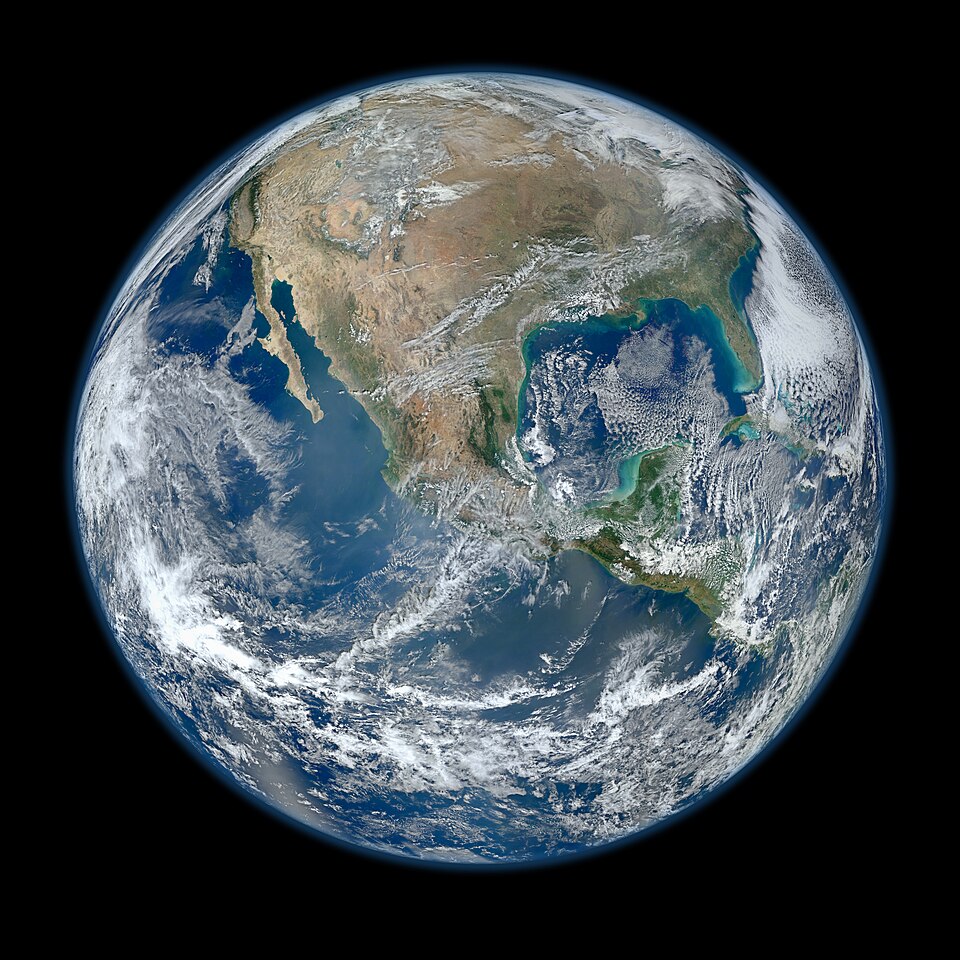 How artificial satellites stay in orbit due to gravitational force. (Image: NASA/NOAA/GSFC/Suomi NPP/VIIRS/Norman Kuring, Public domain, via Wikimedia Commons)
Based on the NEB +2 Science syllabus for Physics (Phy), unit 7.
Discussion
Loading…