PhysicsUnit 16 min read
Physical Quantities, Units, Dimensions & Measurement
Unit 1 of Physics introduces the 7 fundamental quantities, their SI units, dimensional formulas, and how to derive units of other quantities. Learn how to convert units, check consistency using dimensions, and solve problems using dimensional analysis—key skills for all physics exams.
What are Physical Quantities?
Physical quantities are properties of objects or events that can be measured and have units. They describe everything around us—like length, mass, time, or temperature.
Types of Physical Quantities
- Fundamental Quantities: Cannot be broken down into simpler quantities.
- Example: Length, mass, time.
- Derived Quantities: Made by combining fundamental quantities.
- Example: Area (length × length), speed (distance/time).
The 7 Fundamental Quantities (SI System)
The International System of Units (SI) defines 7 base quantities. Memorize these—they are the building blocks of physics!
Why 7? These are independent—no derived quantity can replace them.
Units and Their Conversions
Units allow us to compare and measure quantities. The SI system is the standard, but other units (like inches, pounds) are still used.
Common Unit Conversions (Length)
| Unit | Symbol | Relation to Metre (m) |
|---|---|---|
| Kilometre | km | 1 km = 1000 m |
| Centimetre | cm | 1 cm = 0.01 m |
| Millimetre | mm | 1 mm = 0.001 m |
| Micrometre | µm | 1 µm = 10⁻⁶ m |
| Nanometre | nm | 1 nm = 10⁻⁹ m |
Example 1: Convert 5 km to metres. Solution: 1 km = 1000 m 5 km = 5 × 1000 m = 5000 m
Example 2: Convert 250 cm to metres. Solution: 1 cm = 0.01 m 250 cm = 250 × 0.01 m = 2.5 m
Dimensional Analysis
Dimensions tell us what kind of quantity we are dealing with (e.g., length [L], mass [M], time [T]).
Dimensional Formulas
Every derived quantity has a formula in terms of fundamental dimensions.
| Quantity | Formula | Dimensions |
|---|---|---|
| Area | Length × Length | [L²] |
| Volume | Length³ | [L³] |
| Speed | Distance/Time | [LT⁻¹] |
| Acceleration | Speed/Time | [LT⁻²] |
| Force | Mass × Acceleration | [MLT⁻²] |
| Work/Energy | Force × Distance | [ML²T⁻²] |
| Power | Work/Time | [ML²T⁻³] |
Example 3: Find the dimensions of density (mass/volume). Solution:
- Mass = [M]
- Volume = [L³]
- Density = Mass/Volume = [M]/[L³] = [ML⁻³]
Checking Consistency Using Dimensions
Dimensional analysis helps us verify equations and find unknowns.
Rule:
- Both sides of an equation must have the same dimensions.
Example 4: Check if the equation for kinetic energy (KE = ½ mv²) is dimensionally correct. Solution:
- KE = ½ mv²
- Dimensions of KE: [ML²T⁻²] (from Work/Energy table)
- Dimensions of ½ mv²:
- m = [M]
- v² = [LT⁻¹]² = [L²T⁻²]
- So, mv² = [M] × [L²T⁻²] = [ML²T⁻²]
- Both sides match! The equation is correct.
Deriving Units of Derived Quantities
We can derive units using the dimensional formula.
Example 5: Derive the unit of pressure (Force/Area). Solution:
- Force = Mass × Acceleration = kg × (m/s²) = kg·m·s⁻² (Newton, N)
- Area = m²
- Pressure = Force/Area = (kg·m·s⁻²)/m² = kg·m⁻¹·s⁻²
- SI unit: Pascal (Pa) = 1 N/m²
Significant Figures and Errors
Significant Figures
- Non-zero digits are always significant (e.g., 523 has 3 significant figures).
- Zeros between non-zero digits are significant (e.g., 5002 has 4).
- Leading zeros are not significant (e.g., 0.0042 has 2).
- Trailing zeros are significant only if there’s a decimal (e.g., 400. has 3, but 400 has 1).
Example 6: How many significant figures in 0.0035060? Solution: 4 (3, 5, 0, 6—leading zeros don’t count).
Types of Errors
- Systematic Error: Repeated in the same direction (e.g., faulty instrument).
- Random Error: Unpredictable (e.g., human reaction time).
- Instrumental Error: Due to the measuring tool.
Dimensional Formulae and Their Uses
Applications of Dimensional Analysis
- Deriving formulae (e.g., time period of a pendulum).
- Checking correctness of equations.
- Finding relationships between quantities.
Example 7: A student derives the time period (T) of a simple pendulum as: T = 2π √(L/g) Verify using dimensions. Solution:
- L = [L]
- g = Acceleration = [LT⁻²]
- √(L/g) = √([L]/[LT⁻²]) = √[T²] = [T]
- So, T = [T] (correct, as time period must be in time).
NEB Board-Style Questions (Practice)
Short Answer (2 marks)
- Define dimensional formula. Give an example.
- Convert 3.5 hours to seconds.
- What are the SI units of (a) force, (b) power?
- Why is dimensional analysis important in physics?
Long Answer (5 marks)
- Derive the unit of density using dimensional analysis. Also, convert 2.5 g/cm³ to kg/m³.
- A student measures the length of a table as 1.25 m, 1.28 m, and 1.23 m in three trials. Calculate the mean value and absolute error.
- Check the dimensional consistency of the equation:
s = ut + ½ at², where:
- s = displacement,
- u = initial velocity,
- a = acceleration,
- t = time.
Exam Tip
✅ Memorize the 7 fundamental quantities and their units—they appear in every unit! ✅ Practice dimensional analysis—it’s tested in every physics problem. ✅ Unit conversions are common—master km to m, cm to m, etc. ✅ Significant figures matter in experiments—always report correctly. ✅ Check dimensions before solving problems to avoid mistakes.
Final Note: This unit is the foundation of physics. Master it, and the rest will be easier! 🚀
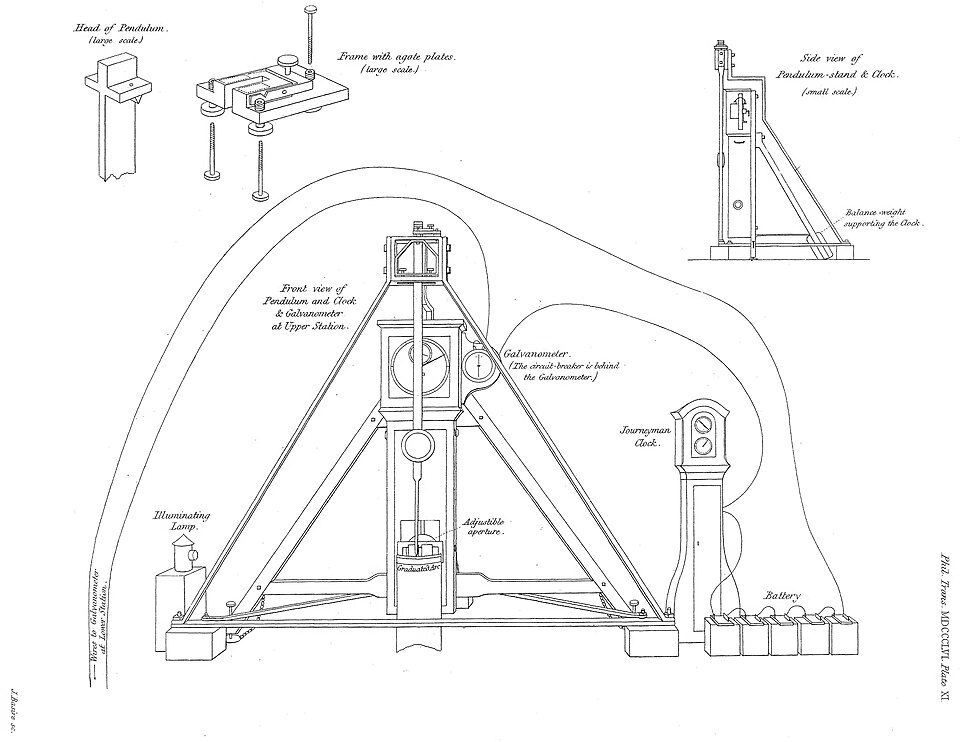 A labelled diagram of a simple pendulum for the time period example. (Image: George Biddell Airy, Public domain, via Wikimedia Commons)
Based on the NEB +2 Science syllabus for Physics (Phy), unit 1.
Discussion
Loading…