PhysicsUnit 27 min read
Vectors: Types, Operations, and Applications
Unit 2 of Physics introduces vectors—physical quantities with both magnitude and direction—and teaches how to add, subtract, and resolve them, with real-world applications in motion, forces, and fields.
TAKEAWAYS:
- Vectors have magnitude and direction, while scalars have only magnitude.
- Vector addition follows the parallelogram or triangle law, and components simplify calculations.
- Unit vectors (î, ĵ, k̂) break vectors into x, y, z components for easy math.
- Dot and cross products give scalar and vector results, respectively, with key physics uses.
- Vectors model displacement, velocity, acceleration, and forces in 2D/3D motion.
- Always draw diagrams to visualize vector operations—NEB exams test this heavily.
---

### What is a Vector?
A **vector** is a physical quantity that has **both magnitude (size) and direction**. Examples include:
- **Displacement**: 5 m **north**
- **Velocity**: 10 m/s **east**
- **Force**: 20 N **at 30° to the horizontal**

A **scalar** has only magnitude (e.g., mass = 5 kg, temperature = 25°C).


**Key Idea**:
> *"If you can answer ‘how much?’ and ‘which way?’, it’s a vector."*

---

### Representing Vectors
Vectors are written in **bold** (e.g., **A**) or with an arrow (e.g., \(\vec{A}\)). In 2D, they’re often shown as arrows with:
- **Magnitude**: Length of the arrow (e.g., 5 units).
- **Direction**: Angle from the positive x-axis (e.g., 30°).

**Example**:
If **A** = 4 m **east** and **B** = 3 m **north**, their vector sum **R** = **A** + **B** is found using the **parallelogram law** (see figure above).

---

### Vector Addition: Methods and Rules
#### 1. **Triangle Law**
Place the tail of **B** at the head of **A**. The resultant **R** is the vector from the tail of **A** to the head of **B**.

```figure
{"type":"triangle","points":[{"x":0,"y":0,"label":"A"},{"x":4,"y":0,"label":"B"},{"x":4,"y":3,"label":"R"},{"x":0,"y":0,"to":{"x":4,"y":0},"arrow":true},{"x":4,"y":0,"to":{"x":4,"y":3},"arrow":true},{"x":0,"y":0,"to":{"x":4,"y":3},"arrow":true,"dashed":true}],"caption":"Triangle law: A + B = R"}
2. Parallelogram Law
Place A and B tail-to-tail. Complete the parallelogram; the diagonal is R.
3. Component (i-j) Method
Break vectors into x (î) and y (ĵ) components:
- A = (A_x \mathbf{i} + A_y \mathbf{j})
- R = ((A_x + B_x)\mathbf{i} + (A_y + B_y)\mathbf{j})
Example: If A = 3î + 4ĵ and B = –î + 2ĵ, then: R = (3–1)î + (4+2)ĵ = 2î + 6ĵ.
Vector Subtraction
Subtracting B from A (A – B) is the same as adding A to –B (the negative of B).
Steps:
- Find –B (reverse direction of B).
- Add A + (–B) using the triangle law.
Unit Vectors and Components
A unit vector has magnitude 1 and points in a given direction. Common unit vectors:
- î: 1 unit along the +x-axis.
- ĵ: 1 unit along the +y-axis.
- k̂: 1 unit along the +z-axis (3D).
Example: A vector C = 6 m at 45° to the x-axis can be written as: C = (C_x \mathbf{i} + C_y \mathbf{j}) where:
- (C_x = 6 \cos 45° = 6 \times \frac{\sqrt{2}}{2} = 3\sqrt{2}) m
- (C_y = 6 \sin 45° = 3\sqrt{2}) m
Dot Product (Scalar Product)
The dot product of two vectors A and B is a scalar: [ \mathbf{A} \cdot \mathbf{B} = |\mathbf{A}| |\mathbf{B}| \cos \theta ] where (\theta) is the angle between them.
Uses:
- Work done ((W = \mathbf{F} \cdot \mathbf{d})).
- Projection of vectors.
Example: If A = 2î + 3ĵ and B = –î + 4ĵ, then: [ \mathbf{A} \cdot \mathbf{B} = (2)(–1) + (3)(4) = –2 + 12 = 10 ]
Cross Product (Vector Product)
The cross product of A and B is a vector perpendicular to both, with magnitude: [ |\mathbf{A} \times \mathbf{B}| = |\mathbf{A}| |\mathbf{B}| \sin \theta ] Direction: Given by the right-hand rule.
Uses:
- Torque ((\boldsymbol{\tau} = \mathbf{r} \times \mathbf{F})).
- Magnetic force ((\mathbf{F} = q \mathbf{v} \times \mathbf{B})).
Example: For A = î + 2ĵ and B = 3ĵ + 4k̂: [ \mathbf{A} \times \mathbf{B} = \begin{vmatrix} \mathbf{i} & \mathbf{j} & \mathbf{k} \ 1 & 2 & 0 \ 0 & 3 & 4 \ \end{vmatrix} = (8–0)\mathbf{i} – (4–0)\mathbf{j} + (3–0)\mathbf{k} = 8\mathbf{i} – 4\mathbf{j} + 3\mathbf{k} ]
Applications of Vectors
| Field | Vector Quantity | Example |
|---|---|---|
| Mechanics | Displacement, Velocity | Projectile motion |
| Electricity | Electric Field, Force | Coulomb’s law |
| Magnetism | Magnetic Field | Lorentz force |
| Engineering | Stress, Strain | Beam analysis |
Solved Examples
Example 1: Vector Addition (Triangle Law)
Problem: Two forces act on a point: F₁ = 6 N east and F₂ = 8 N north. Find the resultant force.
Solution:
- Draw F₁ and F₂ tail-to-tail.
- Complete the triangle. The resultant R is the hypotenuse.
- Use Pythagoras’ theorem: [ R = \sqrt{6^2 + 8^2} = \sqrt{36 + 64} = 10 \text{ N} ]
- Direction: (\theta = \tan^{-1}(\frac{8}{6}) = 53.13°) north of east.
Example 2: Component Method
Problem: A boat moves at 5 m/s east and 3 m/s north. Find its velocity vector.
Solution: Magnitude: Direction:
NEB Board-Style Questions
Short Answer (5 marks)
- Define:
- (a) Vector quantity
- (b) Unit vector
- Explain the parallelogram law of vector addition with a diagram.
- Given and , find:
- (a)
- (b)
Long Answer (10 marks)
- A plane flies 300 km north then 400 km east. Find:
- (a) The displacement vector.
- (b) The angle of the resultant with the north direction.
- Derive the formula for the dot product of two vectors. How is it used to calculate work done?
Common Mistakes to Avoid
- Ignoring direction: Always include the angle or components.
- Mixing scalars and vectors: Speed ≠ velocity; mass ≠ weight.
- Forgetting units: Answers like "5 m/s" are incomplete without direction.
- Cross product direction: Use the right-hand rule to avoid sign errors.
Exam Tip
- Draw diagrams: NEB often asks for graphical solutions. Label all vectors clearly.
- Show steps: Even for simple additions, write:
- Component breakdown.
- Magnitude calculation (Pythagoras’ theorem).
- Direction (arctan or angle from axes).
- Practice component math: Most questions test resolving vectors into î and ĵ.
- Memorize formulas:
- Dot product:
- Cross product magnitude:
- Watch units: If the answer is in N but you give kg·m/s², lose marks!
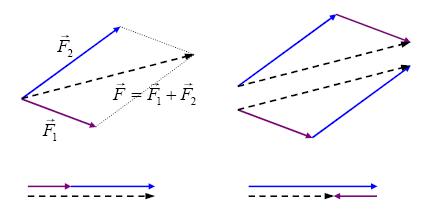 A labeled diagram showing two forces and their resultant. (Image: Ilevanat, CC BY-SA 3.0, via Wikimedia Commons)
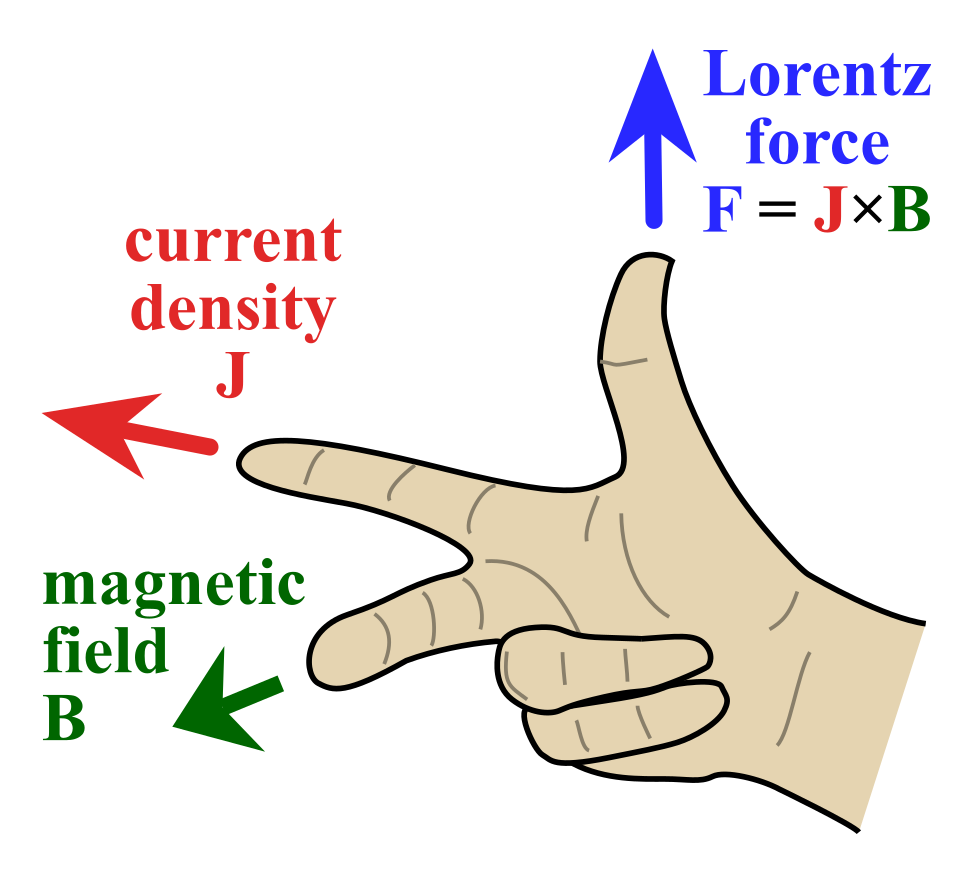 Illustration of how to determine the direction of . (Image: Tokamac, CC BY-SA 4.0, via Wikimedia Commons)
Based on the NEB +2 Science syllabus for Physics (Phy), unit 2.
Discussion
Loading…