PhysicsUnit 219 min read
Potential, Potential Difference & Potential Energy – Definitions, Work & Conservation
Unit 21 of Physics explains electric potential, potential difference, potential energy, and their relationships with work and conservation laws. Learn how to calculate potential difference, relate it to electric fields, and apply the principle of conservation of energy in circuits and systems.
TAKEAWAYS:
- Electric potential is the work done per unit charge to bring a charge from infinity to a point in an electric field.
- Potential difference (V) between two points is the work done per unit charge to move a charge between them.
- Potential energy (U) of a charge in an electric field depends on its position and the field.
- The conservation of energy in electric fields means that the total energy (kinetic + potential) remains constant if no work is done by external forces.
- Potential difference is measured in volts (V), and potential energy is measured in joules (J).
- The electric potential due to a point charge follows the inverse-square law, just like gravitational potential.
What is Electric Potential?
Electric potential at a point in an electric field is defined as the work done per unit positive charge to bring a charge from infinity to that point. It is a scalar quantity (has only magnitude, no direction).
Key Points:
- Symbol: (or )
- Unit: Volt (V), named after Alessandro Volta.
- Formula: where is the work done and is the test charge.
Visualizing Potential:
Imagine a positive charge placed in space. The electric field around it exerts a force on other charges. To bring another positive charge closer to it, you must do work against the repulsive force. The electric potential at a point is like the "height" of that point in an electric "hill." The higher the potential, the more work you need to do to bring a charge there.
This graph shows how electric potential decreases as you move farther from a point charge. The potential is highest near the charge and drops off rapidly.
Potential Difference (Voltage)
Potential difference (PD) between two points is the work done per unit charge to move a charge from one point to another in an electric field. It is also called voltage.
Key Points:
- Symbol: (potential difference between points A and B)
- Unit: Volt (V)
- Formula: where is the work done to move charge from A to B.
Example:
Suppose you move a charge of between two points A and B, and the work done is . The potential difference between A and B is:
Relationship Between Electric Field and Potential
The electric field () and electric potential () are related. For a uniform electric field (like between two parallel plates), the potential difference is given by: where:
- = electric field strength (N/C)
- = distance between the two points (m)
Worked Example:
A uniform electric field of exists between two parallel plates separated by . Calculate the potential difference between the plates.
In a uniform electric field, the potential decreases linearly from the positive plate to the negative plate.
Potential Due to a Point Charge
The electric potential at a distance from a point charge is given by: where:
- (Coulomb’s constant)
- = charge (C)
- = distance from the charge (m)
Worked Example:
Calculate the electric potential at a point away from a charge of ().
This graph shows how potential decreases as distance from the charge increases.
Potential Energy of a Charge in an Electric Field
The electric potential energy (U) of a charge at a point in an electric field is the work done to bring it from infinity to that point. It is given by: where:
- = potential energy (J)
- = charge (C)
- = electric potential (V)
Worked Example:
A charge of is placed at a point where the electric potential is . Calculate its potential energy.
Conservation of Energy in Electric Fields
In an electric field, the total energy (kinetic + potential) of a charge remains constant if no external work is done. This is similar to conservation of mechanical energy in gravity.
Key Idea:
- If a charge moves from a point of high potential to low potential, its potential energy decreases, and its kinetic energy increases (and vice versa).
- Mathematically: where = kinetic energy, = potential energy, and subscripts and denote initial and final states.
Worked Example:
A charge of moves from a point at to a point at . If its initial kinetic energy is , what is its final kinetic energy? Using conservation of energy:
Comparison Table: Potential vs. Potential Difference vs. Potential Energy
| Quantity | Symbol | Unit | Definition | Relationship to Work/Energy |
|---|---|---|---|---|
| Electric Potential | Volt (V) | Work done per unit charge to bring a charge from infinity to a point. | ||
| Potential Difference | Volt (V) | Work done per unit charge to move a charge between two points. | ||
| Potential Energy | Joule (J) | Work done to bring a charge from infinity to a point (or between points). |
Applications of Potential and Potential Difference
- Batteries: Provide a potential difference to drive current in circuits.
- Capacitors: Store energy in the form of electric potential.
- Electric Power Transmission: High-voltage transmission reduces energy loss.
- Electrostatic Precipitators: Used in industries to remove pollutants from smoke.
- Medical Equipment: Defibrillators use high voltage to restart hearts.
NEB Board-Style Questions
Short Answer Questions
- Define electric potential. How is it related to work done?
- A charge of is moved between two points with a potential difference of . Calculate the work done.
- What is the potential difference between two points if of work is done to move of charge between them?
- Explain why electric potential is a scalar quantity, while electric field is a vector quantity.
Long Answer Questions
- Derive the expression for the electric potential due to a point charge. How does it vary with distance?
- A uniform electric field of exists between two parallel plates separated by . Calculate:
- The potential difference between the plates.
- The work done to move a charge of from the negative to the positive plate.
- Explain the principle of conservation of energy in an electric field. A charge of moves from a point at to a point at . If its initial kinetic energy is , find its final kinetic energy.
Exam Tip
- Understand the Definitions: Always remember that potential is work per unit charge, and potential difference is the difference in potential between two points.
- Units Matter: Potential is in volts (V), potential energy in joules (J). Never mix them up!
- Sign Conventions: Potential is higher near positive charges and lower near negative charges. Potential difference is .
- Conservation of Energy: In problems involving motion of charges, always check if energy is conserved. Use .
- Practical Applications: Know how potential difference is used in real-life devices like batteries, capacitors, and power transmission.
- Graphs and Diagrams: Draw diagrams to visualize electric fields and potential variations. Label points clearly.
- Numerical Problems: Practice calculating work done, potential difference, and potential energy using the given formulas. Always show your steps.
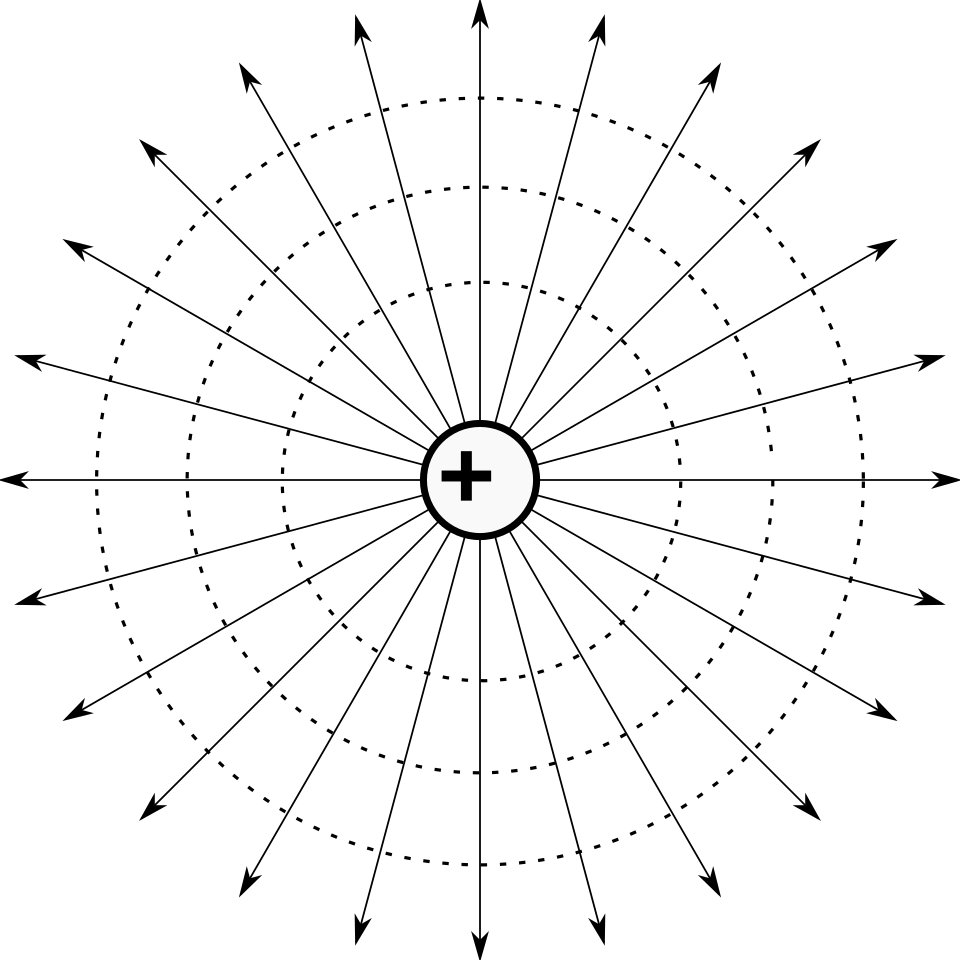 Electric potential lines (red) and equipotential surfaces (blue) around a positive charge. (Image: Balajijagadesh, CC BY-SA 4.0, via Wikimedia Commons)
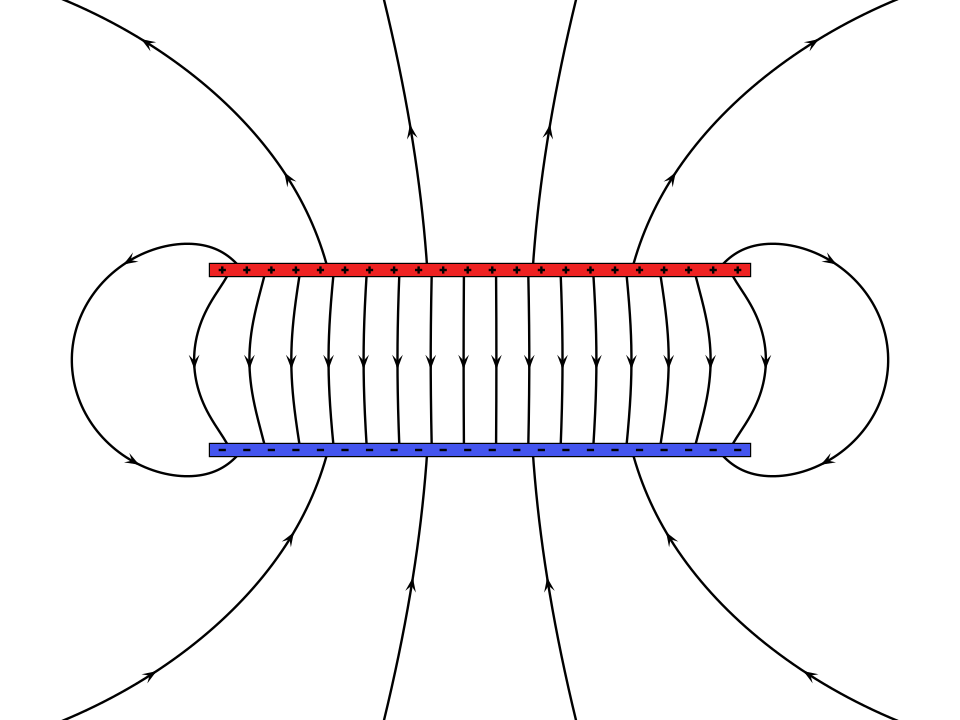 Uniform electric field between two parallel plates with potential difference. (Image: Geek3, CC BY-SA 4.0, via Wikimedia Commons)
Based on the NEB +2 Science syllabus for Physics (Phy), unit 21.
Discussion
Loading…