PhysicsUnit 226 min read
Capacitors: Charge Storage, Types, and Applications
Unit 22 of Physics covers capacitors—how they store charge, their types (parallel-plate, cylindrical, spherical), capacitance formulas, factors affecting capacitance, and real-world uses like filters and energy storage.
What is a Capacitor?
A capacitor is an electronic device that stores electrical energy in an electric field. It consists of two conductors (called plates) separated by an insulating material (called a dielectric).
- When connected to a battery, one plate gains +Q charge, and the other gains -Q charge.
- The potential difference (V) between the plates depends on the charge (Q) stored and the capacitance (C) of the capacitor.
Capacitance (C)
Capacitance is the ability of a capacitor to store charge. It is defined as:
- Unit: Farad (F), where 1 F = 1 C/V.
- 1 Farad is a very large unit, so we often use microfarad (µF) or picofarad (pF).
Factors Affecting Capacitance
The capacitance of a parallel-plate capacitor depends on:
- Area of the plates (A): Larger plates → more charge stored → higher C.
- Distance between plates (d): Smaller distance → stronger electric field → higher C.
- Dielectric constant (K): The dielectric material between plates increases C by a factor of K (e.g., air has K=1, mica has K=6).
The formula is: where:
- (permittivity of free space).
Types of Capacitors
1. Parallel-Plate Capacitor
- Two parallel metal plates separated by a dielectric.
- Used in circuits, filters, and tuning devices.
2. Cylindrical Capacitor
- Two coaxial cylinders (one inside the other).
- Used in cables and radio frequency applications.
- Formula: where = inner radius, = outer radius, = length.
3. Spherical Capacitor
- Two concentric spherical shells.
- Used in high-voltage applications.
- Formula: where = inner radius, = outer radius.
Capacitors in Series and Parallel
1. Capacitors in Parallel
- Total capacitance (C_eq) increases.
- Formula:
- Voltage across each capacitor is the same (V).
graph LR
    A["Battery"] --> B["C1"]
    A --> C["C2"]
    B --> D["Common Point"]
    C --> D
    D --> E["Ground"]
2. Capacitors in Series
- Total capacitance (C_eq) decreases.
- Formula:
- Charge on each capacitor is the same (Q).
graph LR
    A["Battery"] --> B["C1"]
    B --> C["C2"]
    C --> D["Ground"]
Energy Stored in a Capacitor
A charged capacitor stores electrical potential energy (U) given by:
- Used in flash cameras, defibrillators, and energy storage devices.
Applications of Capacitors
| Application | Example | Why? |
|---|---|---|
| Filters | Audio circuits, power supplies | Smooths out voltage fluctuations. |
| Timing Circuits | Digital clocks, oscillators | Controls charge/discharge time. |
| Energy Storage | Flash cameras, electric cars | Stores and releases energy quickly. |
| Coupling/Decoupling | Radio transmitters, amplifiers | Blocks DC while allowing AC signals. |
Solved Example 1: Calculating Capacitance
Problem: A parallel-plate capacitor has plates of area 100 cm² separated by 2 mm of mica (K=6). Find its capacitance.
Solution:
- Convert area to m²:
- Use the formula:
- Calculate:
Answer: 26.55 nF
Solved Example 2: Capacitors in Series
Problem: Two capacitors, C₁ = 2 µF and C₂ = 3 µF, are connected in series to a 12 V battery. Find:
- Equivalent capacitance.
- Charge on each capacitor.
- Voltage across each capacitor.
Solution:
- Equivalent capacitance (C_eq):
- Total charge (Q): (Same for both capacitors in series.)
- Voltage across C₁ (V₁) and C₂ (V₂): (Check: , which matches the battery voltage.)
Answer:
- 1.2 µF
- 14.4 µC on each
- 7.2 V (C₁), 4.8 V (C₂)
NEB Board-Style Questions
Short Answer (3 marks)
- Define capacitance. Write the formula for capacitance of a parallel-plate capacitor and state the factors affecting it.
- Two capacitors of 4 µF and 6 µF are connected in parallel to a 12 V battery. Find the total charge stored.
Long Answer (5 marks)
- Derive the formula for capacitance of a cylindrical capacitor. A coaxial cable has inner radius 1 mm, outer radius 4 mm, and length 1 m. If the space between them is filled with a dielectric of K=2, find its capacitance.
- Explain how capacitors are used in timing circuits. Draw a simple circuit diagram showing a capacitor and resistor in series with a battery.
Exam Tip
✅ Memorize formulas for parallel-plate, cylindrical, and spherical capacitors. ✅ Practice series-parallel combinations—NEB often tests equivalent capacitance. ✅ Understand energy storage—questions may ask for energy in terms of Q or V. ✅ Draw diagrams—label plates, dielectrics, and connections clearly. ✅ Unit conversions—always convert cm² to m² and mm to m before calculations.
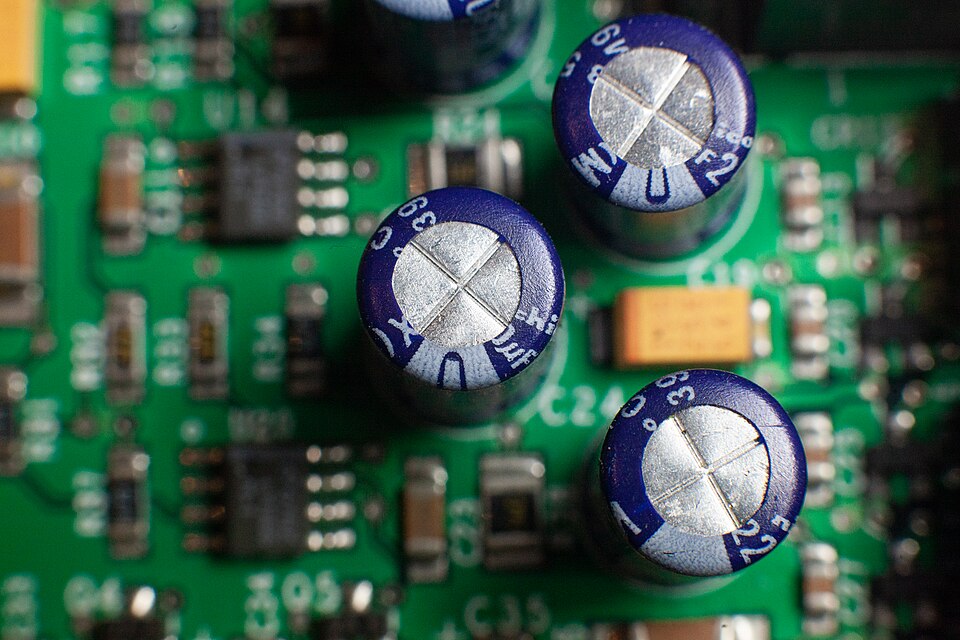 Capacitor symbol and real-world example (e.g., in a smartphone) (Image: Giovanna 27, CC BY 4.0, via Wikimedia Commons)
Based on the NEB +2 Science syllabus for Physics (Phy), unit 22.
Discussion
Loading…