PhysicsUnit 169 min read
Refraction through Prisms: Angles, Deviation, Dispersion & Applications
Unit 16 of Physics explains how light bends through prisms, how to calculate angles of deviation, and why prisms split white light into colors. This note covers prism geometry, minimum deviation, prism formulas, and real-world uses like periscopes and spectroscopes.
TAKEAWAYS:
- A prism bends light twice (entry and exit) and splits it into colors due to dispersion.
- The angle of deviation (δ) depends on the prism angle (A) and the angle of incidence (i).
- At minimum deviation (δₘ), the light path inside the prism is parallel, simplifying calculations.
- Dispersion occurs because different colors (wavelengths) refract differently.
- Prisms are used in periscopes, binoculars, and spectroscopes to bend or split light.
- The prism formula relates A, δₘ, and the refractive index (n) of the prism material.
---

### **What is a Prism?**
A **prism** is a transparent optical device with **two inclined plane surfaces** (usually triangular in cross-section) that refract light. When light enters one face, it bends (refracts), travels through the prism, and bends again as it exits the second face.

```figure
{"type":"prism","angle":60,"light":{"entry":{"angle":50,"side":"left"},"exit":{"angle":50,"side":"right"}},"caption":"Light entering and exiting a prism at equal angles (i = e)."}
Key Terms
- Angle of the prism (A): The angle between the two refracting surfaces.
- Angle of incidence (i): Angle between the incident ray and the normal at the first surface.
- Angle of emergence (e): Angle between the emergent ray and the normal at the second surface.
- Angle of deviation (δ): The angle between the incident ray and the emergent ray.
- Angle of refraction (r): Angle between the refracted ray and the normal inside the prism.
How Does Light Bend in a Prism?
When light enters the prism, it bends towards the normal (if entering from air to glass, since glass is denser). Inside the prism, it travels in a straight line but changes direction at the second surface, bending away from the normal as it exits into air.
Relationship Between Angles
At the first surface (air → prism): [ n_1 \sin i = n_2 \sin r_1 ] where:
- (n_1 = 1) (air),
- (n_2 = n) (refractive index of prism material),
- (i) = angle of incidence,
- (r_1) = angle of refraction inside the prism.
At the second surface (prism → air): [ n \sin r_2 = 1 \cdot \sin e ] where:
- (r_2) = angle of incidence at the second surface (inside the prism),
- (e) = angle of emergence.
Since the prism angle (A = r_1 + r_2), we can relate all angles.
Angle of Deviation (δ)
The total deviation (δ) is the angle between the incident ray and the emergent ray. It is given by: [ \delta = i + e - A ] where:
- (i) = angle of incidence,
- (e) = angle of emergence,
- (A) = angle of the prism.
Worked Example 1: Calculating Deviation
A light ray enters a prism of angle (A = 60^\circ) with an angle of incidence (i = 50^\circ). If the refractive index of the prism is (n = 1.5), find:
- The angle of refraction (r_1) at the first surface.
- The angle of deviation (δ).
Solution:
Using Snell’s law at the first surface: [ 1 \cdot \sin 50^\circ = 1.5 \cdot \sin r_1 ] [ \sin r_1 = \frac{\sin 50^\circ}{1.5} = \frac{0.766}{1.5} = 0.511 ] [ r_1 = \sin^{-1}(0.511) = 30.7^\circ \approx 30^\circ ]
Since (A = r_1 + r_2), and assuming symmetry (for simplicity, (r_1 = r_2)): [ r_2 = A - r_1 = 60^\circ - 30^\circ = 30^\circ ] Now, apply Snell’s law at the second surface: [ 1.5 \cdot \sin 30^\circ = 1 \cdot \sin e ] [ \sin e = 1.5 \times 0.5 = 0.75 ] [ e = \sin^{-1}(0.75) = 48.6^\circ \approx 49^\circ ] Finally, the deviation: [ \delta = i + e - A = 50^\circ + 49^\circ - 60^\circ = 39^\circ ]
Minimum Deviation (δₘ)
The minimum deviation occurs when the light ray passes symmetrically through the prism. In this case:
- The angle of incidence (i) = angle of emergence (e).
- The refracted ray inside the prism is parallel to the base of the prism.
- The angles (r_1 = r_2 = \frac{A}{2}).
At minimum deviation: [ \delta_m = 2i - A ] But more importantly, the refractive index (n) of the prism material can be calculated using: [ n = \frac{\sin \left( \frac{A + \delta_m}{2} \right)}{\sin \left( \frac{A}{2} \right)} ]
Worked Example 2: Finding Refractive Index
A prism with an angle (A = 60^\circ) produces a minimum deviation of (δₘ = 40^\circ). Find its refractive index.
Solution: Using the formula for minimum deviation: [ n = \frac{\sin \left( \frac{60^\circ + 40^\circ}{2} \right)}{\sin \left( \frac{60^\circ}{2} \right)} = \frac{\sin 50^\circ}{\sin 30^\circ} ] [ n = \frac{0.766}{0.5} = 1.532 ]
Dispersion of Light Through a Prism
White light is made up of seven colors (VIBGYOR: Violet, Indigo, Blue, Green, Yellow, Orange, Red). When white light passes through a prism:
- Violet light deviates the most (shortest wavelength, highest refractive index).
- Red light deviates the least (longest wavelength, lowest refractive index).
- This splitting of light into colors is called dispersion.
Why Does Dispersion Happen?
- The refractive index (n) of the prism material varies with wavelength.
- Shorter wavelengths (violet) have a higher refractive index, so they bend more.
- Longer wavelengths (red) have a lower refractive index, so they bend less.
Prism vs. Lens: Key Differences
| Feature | Prism | Lens |
|---|---|---|
| Shape | Two inclined plane surfaces | Curved surfaces (convex/concave) |
| Refraction | Light bends twice | Light bends once |
| Effect | Splits light into colors | Converges or diverges light |
| Deviation | Causes angular deviation | Causes focal length change |
| Applications | Spectroscopes, periscopes | Magnifying glasses, cameras |
Applications of Prisms
- Periscope: Uses prisms to reflect light and allow viewing from a hidden position.
- Binoculars: Prisms invert and magnify images for clear viewing.
- Spectroscope: Splits light into a spectrum to analyze its composition (used in astronomy and chemistry).
- Prismatic Binoculars: Used in telescopes and cameras to reduce bulk.
- Dispersion Compensation: Used in optical fibers to correct color separation.
flowchart TD
    A["Prism Applications"] --> B["Periscope"]
    A --> C["Binoculars"]
    A --> D["Spectroscope"]
    A --> E["Optical Instruments"]
    B --> F["Reflects light for hidden viewing"]
    C --> G["Magnifies and inverts images"]
    D --> H["Analyzes light spectrum"]
NEB Board-Style Questions
Short Answer Questions
Define angle of deviation in a prism. Answer: The angle between the incident ray and the emergent ray after refraction through a prism is called the angle of deviation (δ).
Why does violet light deviate more than red light in a prism? Answer: Violet light has a shorter wavelength and thus a higher refractive index in the prism material, causing it to bend more than red light.
What is minimum deviation in a prism? Answer: The smallest angle of deviation occurs when the light ray passes symmetrically through the prism, making and .
Numerical Problems
A light ray enters a prism of angle with an angle of incidence . If the refractive index of the prism is , find the angle of deviation. Solution:
- Use Snell’s law to find :
- Find .
- Find using Snell’s law at the second surface:
- Finally, .
A prism causes a minimum deviation of for light of wavelength . If the angle of the prism is , find its refractive index. Solution:
Long Answer Questions
- Explain the phenomenon of dispersion of light through a prism. Why does it occur? Draw a neat diagram to show the dispersion of white light.
Answer:
- Dispersion is the splitting of white light into its constituent colors (VIBGYOR) when it passes through a prism.
- It occurs because the refractive index of the prism material varies with wavelength.
- Shorter wavelengths (violet) have a higher refractive index, causing greater deviation.
- Longer wavelengths (red) have a lower refractive index, causing lesser deviation.
- Diagram: (Refer to the dispersion figure above.)
Exam Tip
- Memorize the prism formula for minimum deviation:
- Understand the difference between angle of deviation (δ) and minimum deviation (δₘ).
- Practice numerical problems involving Snell’s law and prism angles.
- Draw neat diagrams for dispersion and prism refraction in long-answer questions.
- Know applications like periscopes, spectroscopes, and binoculars for descriptive questions.
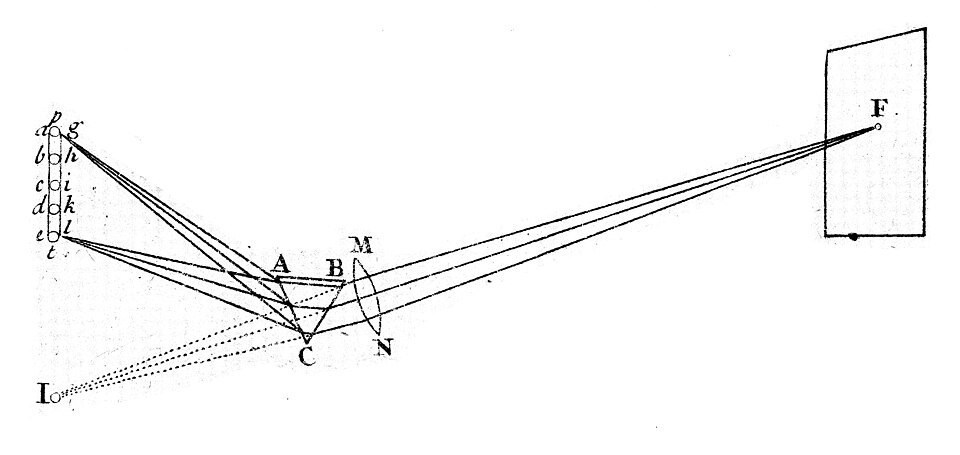 A labeled diagram showing light entering and exiting a prism with angles marked. (Image: CC BY 4.0, via Wikimedia Commons)
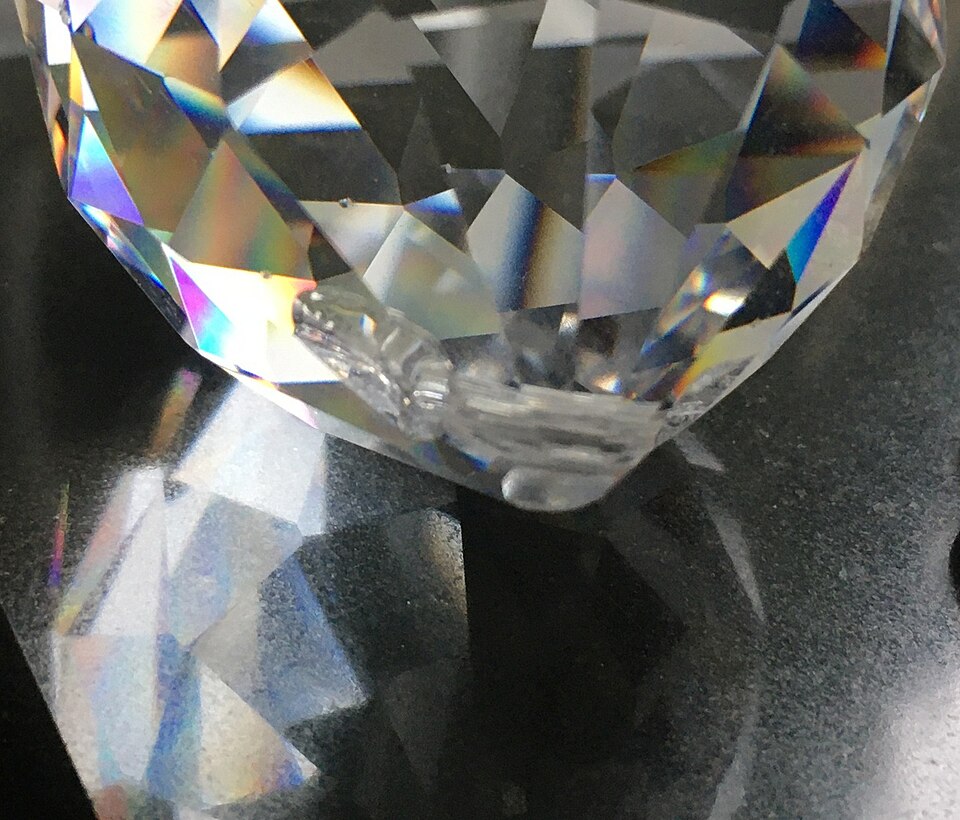 A colored spectrum (VIBGYOR) emerging from a prism. (Image: Pittigrilli, CC BY-SA 4.0, via Wikimedia Commons)
Based on the NEB +2 Science syllabus for Physics (Phy), unit 16.
Discussion
Loading…