BiologyUnit 813 min read
Mutation & Evolution: Causes, Types, Evidence & Theories
Unit 8 of Biology explains how mutations create genetic variation, how natural selection drives evolution, and the key evidence and theories behind Darwin’s and modern evolutionary biology—with solved examples and NEB-style questions.
TAKEAWAYS:
- Mutations are random changes in DNA that can be harmful, neutral, or beneficial, and are the raw material for evolution.
- Natural selection acts on heritable variations to favor traits that improve survival and reproduction.
- Evidence for evolution includes fossils, homologous structures, embryology, and molecular biology (DNA/protein similarities).
- Evolutionary theories range from Darwin’s natural selection to modern synthesis (genetics + natural selection).
- Human impacts like antibiotic resistance and climate change accelerate evolution by creating new selection pressures.
- Speciation occurs when populations diverge genetically and can no longer interbreed, leading to new species.
What is Mutation?
Mutation is a permanent change in the DNA sequence of an organism. These changes can occur in genes (point mutations) or chromosomes (chromosomal mutations). Mutations are random and can happen due to errors in DNA replication or external factors like radiation and chemicals.
Types of Mutations
Mutations can be classified based on their effect on the organism and scale:
mindmap
  root((Mutations))
    Gene Mutations
      Point Mutation
        Substitution
          Silent: No change in amino acid (e.g., UUU → UUC, both code for phenylalanine)
          Missense: Change in one amino acid (e.g., GAA → GUA, changes glutamic acid to valine → sickle cell anemia)
          Nonsense: Premature stop codon (e.g., GAA → UAA → truncated protein)
      Frameshift Mutation
        Insertion: Extra base added (e.g., "THE CAT" → "THT ECA T")
        Deletion: Base removed (e.g., "THE CAT" → "THE CAT" → "THEAT")
    Chromosomal Mutations
      Deletion: Part of chromosome lost (e.g., Cri-du-chat syndrome)
      Duplication: Extra copy of a chromosome segment
      Inversion: Segment reverses (e.g., ABCDE → ABEDC)
      Translocation: Segment moves to another chromosome (e.g., Philadelphia chromosome in leukemia)
Causes of Mutations
Mutations can be caused by:
- Spontaneous errors during DNA replication (e.g., tautomeric shifts in bases).
- Physical agents:
- Radiation (UV light, X-rays, gamma rays) → breaks DNA strands.
- Chemicals (mustard gas, benzene) → alter base pairing.
- Biological agents (viruses, transposons).
Example:
- Sickle cell anemia is caused by a point mutation in the HBB gene (GAG → GTG), replacing glutamic acid with valine in hemoglobin. This changes the shape of red blood cells, causing them to sickle under low oxygen.
How Mutations Affect Organisms
Mutations can have different effects:
| Type of Mutation | Effect on Protein | Example | Outcome |
|---|---|---|---|
| Silent | No change in amino acid | UUU → UUC (both code for phenylalanine) | No effect |
| Missense | Single amino acid change | GAA → GUA (glutamic acid → valine) | Sickle cell anemia |
| Nonsense | Premature stop codon | GAA → UAA | Truncated, non-functional protein |
| Frameshift | Entire reading frame shifts | Insertion/deletion of a base | Non-functional protein |
| Chromosomal | Large-scale DNA loss/gain | Deletion of chromosome 5 (Cri-du-chat) | Severe developmental disorders |
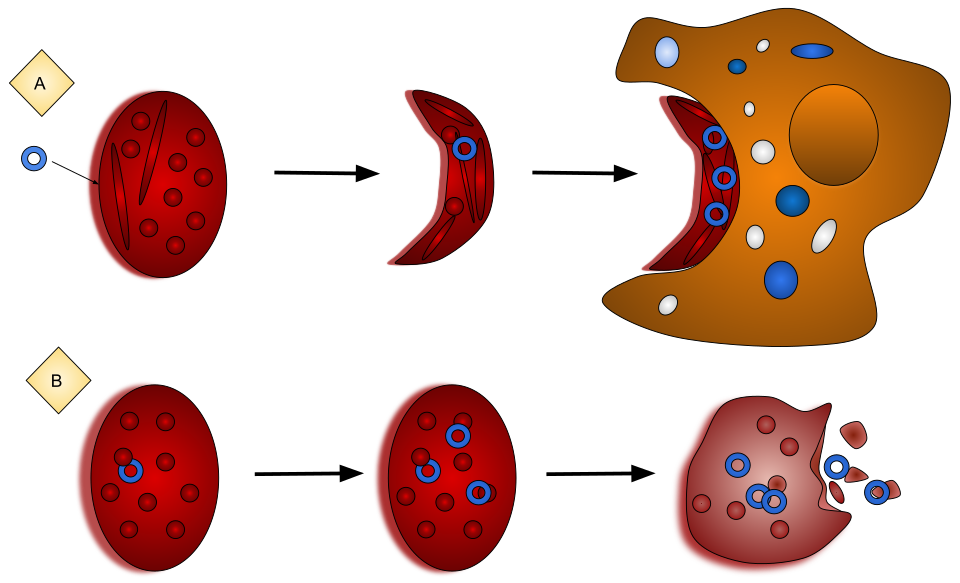 Comparison of normal and sickled red blood cells under a microscope. (Image: Dsheffer02, CC BY-SA 4.0, via Wikimedia Commons)
Evolution: The Process of Change
Evolution is the gradual change in the genetic makeup of a population over generations. It explains the diversity of life on Earth. Key mechanisms include:
- Natural selection (Darwin’s theory).
- Genetic drift (random changes in allele frequencies).
- Gene flow (migration of genes between populations).
- Mutations (source of new alleles).
Darwin’s Theory of Natural Selection
Charles Darwin proposed that evolution occurs through:
- Variation: Individuals in a population have different traits.
- Heredity: Traits are passed from parents to offspring.
- Struggle for existence: More offspring are produced than can survive.
- Survival of the fittest: Organisms with advantageous traits survive and reproduce more.
Example:
- Peppered moths in England:
- Before the Industrial Revolution, light-colored moths were common (camouflaged on lichen-covered trees).
- After pollution killed lichens, dark-colored moths became more common because they were less visible to predators on soot-covered trees.
- This is an example of directional selection (shift toward one extreme trait).
Evidence for Evolution
Scientists have collected five major types of evidence to support evolution:
| Type of Evidence | Description | Example |
|---|---|---|
| Fossil Record | Shows transitional forms between species. | Archaeopteryx (bird-like dinosaur) |
| Homologous Structures | Similar structures in different species due to common ancestry. | Bat wing, human arm, whale flipper |
| Analogous Structures | Similar functions but different origins (convergent evolution). | Bird wing, insect wing |
| Embryology | Similar embryonic development in related species. | Human and fish embryos have pharyngeal slits |
| Molecular Biology | DNA and protein similarities show evolutionary relationships. | Humans share ~98% DNA with chimpanzees |
Mechanisms of Evolution
1. Natural Selection
- Directional selection: Favors one extreme trait (e.g., giraffes with longer necks).
- Stabilizing selection: Favors average traits (e.g., human birth weight).
- Disruptive selection: Favors both extremes (e.g., finches with large or small beaks).
2. Genetic Drift
- Random changes in allele frequencies, especially in small populations.
- Founder effect: Small group colonizes a new area (e.g., Amish population with high incidence of Ellis-van Creveld syndrome).
- Bottleneck effect: Population size is drastically reduced (e.g., cheetahs after near-extinction).
3. Gene Flow
- Movement of genes between populations through migration.
- Example: Pollen transfer between plant populations can introduce new alleles.
4. Mutations
- Provide raw material for evolution by creating new alleles.
- Example: Antibiotic resistance in bacteria arises from mutations in genes targeted by antibiotics.
Speciation: How New Species Form
Speciation occurs when populations of the same species become genetically distinct and can no longer interbreed. Two main modes:
- Allopatric speciation: Populations are geographically separated (e.g., Darwin’s finches on different Galápagos islands).
- Sympatric speciation: Speciation occurs without geographic separation (e.g., polyploid plants like wheat).
Example:
- Galápagos finches:
- Different beak shapes evolved due to different food sources on separate islands.
- Over time, they could no longer interbreed, leading to new species.
Human Evolution and Impact
Human Evolutionary Timeline
Humans (Homo sapiens) evolved from earlier hominins over millions of years:
- Sahelanthropus (~7 million years ago) – Possible earliest hominin.
- Australopithecus (~4 million years ago) – Bipedal, small-brained (e.g., "Lucy").
- Homo habilis (~2.4 million years ago) – First to use stone tools.
- Homo erectus (~1.9 million years ago) – First to migrate out of Africa.
- Homo neanderthalensis (~400,000 years ago) – Close relative of modern humans.
- Homo sapiens (~300,000 years ago) – Modern humans.
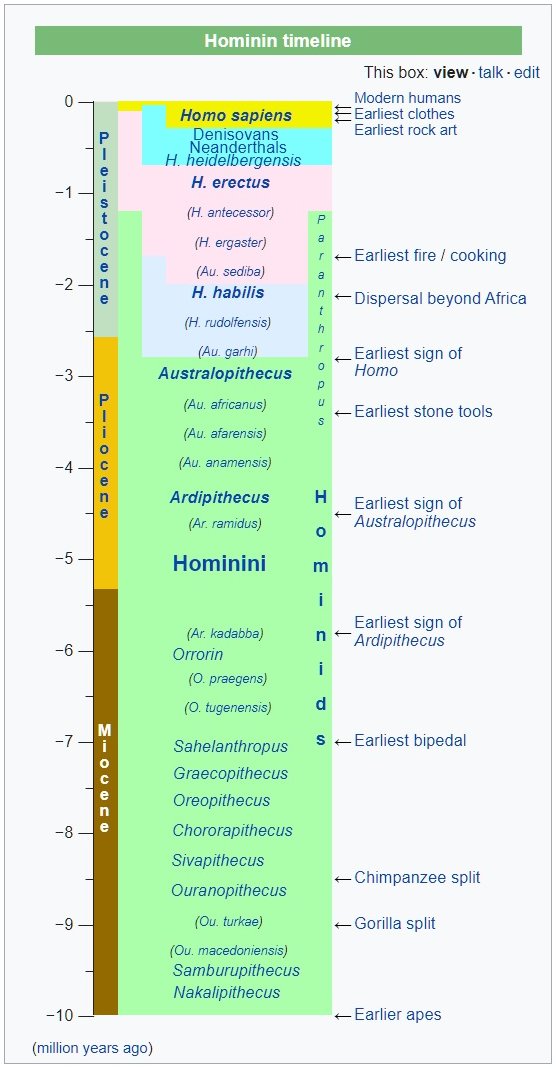 A flowchart showing key hominin species with dates and traits. (Image: Drbogdan, CC BY-SA 4.0, via Wikimedia Commons)
Human Impact on Evolution
Humans accelerate evolution through:
- Artificial selection: Breeding plants/animals for desired traits (e.g., domesticated dogs).
- Antibiotic resistance: Bacteria evolve resistance due to overuse of antibiotics.
- Climate change: Shifts in temperature and habitat force species to adapt or migrate.
- Pesticide resistance: Insects evolve resistance to pesticides (e.g., DDT-resistant mosquitoes).
Example:
- Antibiotic-resistant bacteria:
- Overuse of antibiotics kills sensitive bacteria, leaving resistant ones to reproduce.
- This creates superbugs (e.g., MRSA) that are difficult to treat.
Exam Tip: How to Score Full Marks in NEB Exams
- Define key terms clearly:
- Example: "Mutation is a permanent change in the DNA sequence that can be inherited."
- Use diagrams:
- Label all parts of diagrams (e.g., types of mutations, natural selection curves).
- Compare and contrast:
- Example: "Homologous structures show common ancestry, while analogous structures show convergent evolution."
- Give real-world examples:
- Sickle cell anemia, peppered moths, antibiotic resistance.
- Explain mechanisms step-by-step:
- For natural selection: Variation → Heredity → Struggle → Survival of the fittest.
- Practice NEB-style questions:
- Short answers: "What is the difference between directional and stabilizing selection?"
- Long answers: "Explain how mutations contribute to evolution with examples."
NEB Board-Style Questions and Solutions
Short Answer Questions
Define mutation. Give one example of a genetic disorder caused by a point mutation.
- Answer: Mutation is a permanent change in the DNA sequence. Sickle cell anemia is caused by a point mutation in the HBB gene (GAG → GTG), replacing glutamic acid with valine.
What is natural selection? Name the three types of natural selection.
- Answer:
Natural selection is the process by which organisms with advantageous traits survive and reproduce more. The three types are:
- Directional selection
- Stabilizing selection
- Disruptive selection
- Answer:
Natural selection is the process by which organisms with advantageous traits survive and reproduce more. The three types are:
Differentiate between homologous and analogous structures with examples.
- Answer:
Homologous Structures Analogous Structures Same origin, different function Different origin, same function Example: Bat wing, human arm Example: Bird wing, insect wing
- Answer:
Long Answer Questions
Explain the process of natural selection with the example of peppered moths in England.
- Answer:
Natural selection occurs in four steps:
- Variation: Peppered moths had light and dark color variations.
- Heredity: The color trait was inherited.
- Struggle for existence: Before industrialization, light moths were camouflaged on lichen-covered trees and avoided predators.
- Survival of the fittest: After industrialization, soot killed lichens, making dark moths more camouflaged. Predators ate more light moths, increasing the frequency of dark moths. This is an example of directional selection.
- Answer:
Natural selection occurs in four steps:
Describe the evidence for evolution. How do fossils support the theory of evolution?
- Answer:
Evidence for evolution includes:
- Fossil record: Shows transitional forms (e.g., Archaeopteryx between dinosaurs and birds).
- Homologous structures: Similar bone structures in different species (e.g., pentadactyl limb).
- Embryology: Similar embryonic development (e.g., pharyngeal slits in humans and fish).
- Molecular biology: DNA similarities (e.g., humans share 98% DNA with chimpanzees). Fossils provide a timeline of how species have changed over millions of years, showing intermediate forms that link current species to their ancestors.
- Answer:
Evidence for evolution includes:
Practical/Application Questions
How do mutations lead to antibiotic resistance in bacteria? Explain with an example.
- Answer:
- Bacteria reproduce rapidly, and mutations occur randomly.
- When antibiotics are used, most bacteria die, but a few with resistance mutations survive.
- These resistant bacteria reproduce, passing on the resistance gene.
- Over time, the entire population becomes resistant (e.g., MRSA resistant to methicillin).
- Answer:
Explain the founder effect and bottleneck effect with examples.
- Answer:
- Founder effect: A small group colonizes a new area, carrying only a subset of the original population’s genes. Example: Amish population with high incidence of Ellis-van Creveld syndrome.
- Bottleneck effect: A population’s size is drastically reduced (e.g., by disease or habitat loss), leading to loss of genetic diversity. Example: Cheetahs nearly went extinct, reducing their genetic variation.
- Answer:
Final Tip: Always relate your answers to real-world examples (sickle cell anemia, antibiotic resistance, peppered moths) and diagrams (types of mutations, natural selection curves). This will help you score full marks in NEB exams!
Based on the NEB +2 Science syllabus for Biology (Bio), unit 8.
Discussion
Loading…