BiologyUnit 76 min read
DNA, RNA, Protein Synthesis: Structure, Function & Flow
Unit 7 of Biology explains the molecular basis of life—how DNA stores genetic info, how RNA acts as a messenger, and how proteins are built from genes, with real-world applications in biotechnology and medicine.
TAKEAWAYS:
- DNA’s double-helix structure holds genetic instructions using base pairs (A-T, C-G) and is replicated semi-conservatively.
- RNA comes in three types (mRNA, tRNA, rRNA) and carries out protein synthesis in two stages: transcription (DNA → RNA) and translation (RNA → protein).
- The genetic code is read in triplets (codons) during translation, with start (AUG) and stop codons signaling protein assembly.
- Mutations (substitutions, insertions, deletions) can alter genes, leading to diseases or evolutionary changes.
- Biotechnology uses PCR, gel electrophoresis, and CRISPR to manipulate DNA for medical and agricultural advances.
1. DNA: The Blueprint of Life
DNA (Deoxyribonucleic Acid) is the molecule that carries genetic information in all living organisms. It determines traits like eye color, height, and disease resistance.
Structure of DNA
DNA is made up of nucleotides, each consisting of:
- A phosphate group
- A deoxyribose sugar
- A nitrogenous base (Adenine, Thymine, Cytosine, or Guanine)
The bases pair specifically:
- Adenine (A) pairs with Thymine (T)
- Cytosine (C) pairs with Guanine (G)
This pairing forms a double helix (two strands twisted like a ladder).
graph LR
A["Phosphate"] --> B["Deoxyribose Sugar"]
B --> C["Nitrogenous Base"]
C --> D["Adenine/Thymine"]
C --> E["Cytosine/Guanine"]
D --> F["A-T Pairing"]
E --> G["C-G Pairing"]
F --> H["Double Helix"]
G --> H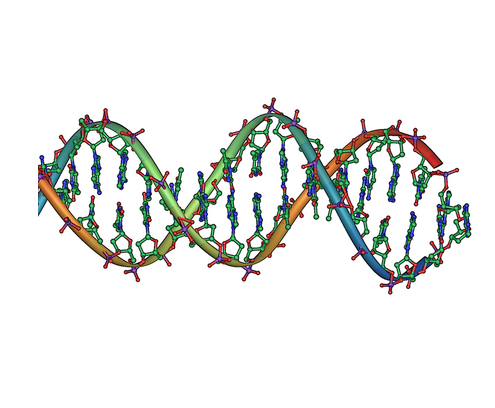 The twisted ladder of life: two strands held together by hydrogen bonds between base pairs. (Image: Jerome Walker, Public domain, via Wikimedia Commons)
How DNA Replicates
DNA makes a copy of itself before cell division. This process is called semi-conservative replication because each new DNA molecule has one old strand and one new strand.
Steps:
- Unwinding: The double helix unwinds, and the two strands separate.
- Base Pairing: Free nucleotides pair with exposed bases (A-T, C-G).
- Joining: Enzymes link the new nucleotides, forming two identical DNA molecules.
Why is this important?
- Ensures genetic information is passed accurately to daughter cells.
- Basis for heredity and evolution.
2. RNA: The Messenger Molecule
RNA (Ribonucleic Acid) is similar to DNA but has:
- Ribose sugar instead of deoxyribose.
- Uracil (U) instead of thymine (T).
- Usually single-stranded.
There are three main types of RNA:
| Type | Function | Location |
|---|---|---|
| mRNA (Messenger RNA) | Carries genetic code from DNA to ribosomes. | Nucleus → Cytoplasm |
| tRNA (Transfer RNA) | Brings amino acids to ribosomes during protein synthesis. | Cytoplasm |
| rRNA (Ribosomal RNA) | Forms ribosomes and helps in protein assembly. | Ribosomes |
3. Protein Synthesis: From DNA to Protein
Protein synthesis happens in two main stages:
- Transcription (DNA → RNA)
- Translation (RNA → Protein)
Transcription: DNA to mRNA
- Occurs in the nucleus.
- An enzyme called RNA polymerase reads DNA and builds mRNA.
- Only one strand of DNA is used as a template.
- The mRNA leaves the nucleus and goes to the ribosome.
Example: If the DNA sequence is TAC GGA CTT, the mRNA sequence will be AUG CCU GAA (U replaces T).
sequenceDiagram
    participant DNA
    participant RNAPolymerase
    participant mRNA
    DNA->>RNAPolymerase: Unwinds DNA
    RNAPolymerase->>mRNA: Builds mRNA (A-U, C-G)
    mRNA->>Ribosome: Moves to cytoplasm
Translation: mRNA to Protein
- Occurs at the ribosome in the cytoplasm.
- mRNA is read in codons (groups of 3 bases).
- Each codon matches a specific amino acid (carried by tRNA).
- The ribosome links amino acids to form a polypeptide chain (protein).
Genetic Code Table (Partial):
| Codon (mRNA) | Amino Acid |
|---|---|
| AUG | Start (Methionine) |
| UUU, UUC | Phenylalanine (Phe) |
| UAA, UAG, UGA | Stop |
| GGG | Glycine (Gly) |
Example: If mRNA is AUG CCU GAA, the amino acids will be:
- AUG → Methionine (Start)
- CCU → Proline
- GAA → Glutamic Acid
The resulting protein is Met-Pro-Glu.
4. Mutations: Changes in DNA
Mutations are permanent changes in DNA sequence. They can be:
- Substitution (one base replaced)
- Insertion (extra base added)
- Deletion (base removed)
Effects of Mutations:
| Type | Example | Effect |
|---|---|---|
| Silent | No change in amino acid | No effect |
| Missense | One amino acid changed | May alter protein function |
| Nonsense | Early stop codon | Truncated (short) protein |
| Frameshift | Insertion/deletion | Completely wrong protein |
Example of Sickle Cell Anemia:
- Normal DNA: GAG (Glutamic Acid)
- Mutated DNA: GTG (Valine)
- Causes red blood cells to become sickle-shaped.
5. Biotechnology Applications
Modern biotechnology uses DNA, RNA, and protein synthesis for:
- PCR (Polymerase Chain Reaction): Makes millions of DNA copies quickly.
- Gel Electrophoresis: Separates DNA fragments by size.
- CRISPR: Edits genes to cure diseases (e.g., sickle cell anemia).
Exam Tip
- Memorize base pairing rules (A-T, C-G in DNA; A-U, C-G in RNA).
- Understand transcription vs. translation (DNA → RNA → Protein).
- Know the genetic code (focus on start/stop codons).
- Practice mutation effects (silent, missense, nonsense, frameshift).
- Relate to real life (e.g., PCR in COVID testing, CRISPR in gene therapy).
NEB Board-Style Questions:
Short Answer:
- What are the three types of RNA, and where are they found?
- Explain semi-conservative replication of DNA in 3 steps.
- What is the difference between transcription and translation?
Long Answer: 4. Describe the process of protein synthesis with a labeled diagram. 5. How can mutations lead to genetic disorders? Give one example.
Practical: 6. If the DNA sequence is ATG CTA GGT, what will be the mRNA and amino acid sequence? 7. Draw a labeled diagram of a nucleotide and explain its components.
Key Takeaway: DNA → RNA → Protein is the central dogma of molecular biology. Master this flow, and you’ll ace the NEB exam! 🚀
Based on the NEB +2 Science syllabus for Biology (Bio), unit 7.
Discussion
Loading…