BiologyUnit 47 min read
Plant Growth & Hormones: Types, Functions & Applications
Unit 4 of Biology explains how plants grow using hormones (auxins, gibberellins, cytokinins, abscisic acid, ethylene) and their roles in root/shoot growth, flowering, fruit ripening, and stress responses. Learn definitions, mechanisms, and real-world uses like weed killers and tissue culture.
What Are Plant Hormones?
Plant hormones (or phytohormones) are chemical messengers that control growth, development, and responses to the environment. Unlike animals, plants do not have a nervous system, so hormones coordinate all processes.
Key Characteristics of Plant Hormones:
- Produced in small amounts but have big effects.
- Can move from one part of the plant to another (e.g., roots to shoots).
- Work together (synergistically) or against each other (antagonistically).
- Affect cell division, elongation, differentiation, and senescence (aging).
Types of Plant Hormones
There are five major plant hormones you must know:
1. Auxins (IAA – Indole-3-Acetic Acid)
Function: Promotes cell elongation, root initiation, and apical dominance (prevents side branches from growing). Sources: Young leaves, shoot tips, seeds. Examples:
- Used in rooting powders for cuttings.
- Weed killers (e.g., 2,4-D) mimic auxins and kill broad-leaved weeds.
graph LR
    A["Auxin (IAA)"] --> B["Stimulates cell elongation"]
    A --> C["Promotes root growth"]
    A --> D["Inhibits lateral buds (apical dominance)"]
    A --> E["Used in tissue culture"]
2. Gibberellins (GA)
Function: Stimulates stem elongation, seed germination, and fruit growth. Sources: Young leaves, roots, seeds. Examples:
- Used to increase fruit size (e.g., grapes, apples).
- Helps dwarf plants grow taller.
graph LR
A["Gibberellins (GA)"] --> B["Stimulates stem growth"]
A --> C["Breaks seed dormancy"]
A --> D["Promotes flowering"]
A --> E["Used in agriculture for larger fruits"]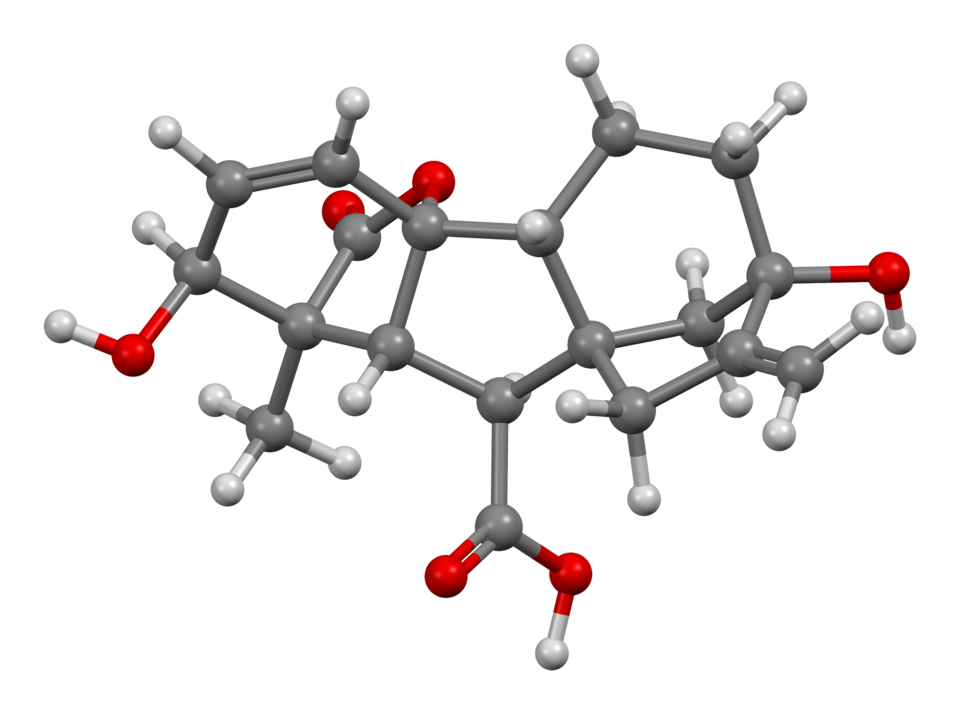 Chemical structure of GA₃ (Gibberellic Acid) (Image: Ben Mills, Public domain, via Wikimedia Commons)
3. Cytokinins (CK)
Function: Promotes cell division, delay senescence (aging), and lateral bud growth. Sources: Root tips, developing seeds. Examples:
- Used in tissue culture to grow plantlets.
- Keeps cut flowers fresh longer.
graph LR
    A["Cytokinins (CK)"] --> B["Stimulates cell division"]
    A --> C["Delays leaf aging"]
    A --> D["Promotes shoot formation"]
    A --> E["Used in micropropagation"]
4. Abscisic Acid (ABA)
Function: Controls stress responses (drought, cold), seed dormancy, and stomatal closure. Sources: Leaves, roots, mature fruits. Examples:
- Helps plants survive drought by closing stomata.
- Prevents premature germination in seeds.
graph LR
A["Abscisic Acid (ABA)"] --> B["Closes stomata (water conservation)"]
A --> C["Induces seed dormancy"]
A --> D["Helps plants survive stress"]
A --> E["Used in drought-resistant crops"] Chemical structure of ABA (Image: Michael D. Turnbull, CC0, via Wikimedia Commons)
5. Ethylene (C₂H₄)
Function: Controls fruit ripening, leaf abscission (falling), and senescence (aging). Sources: Ripening fruits, aging leaves. Examples:
- Used to ripen bananas artificially.
- Helps detach leaves/fruits at the right time.
graph LR
    A["Ethylene (C₂H₄)"] --> B["Speeds up fruit ripening"]
    A --> C["Causes leaf fall"]
    A --> D["Used in post-harvest fruit storage"]
    A --> E["Helps in flower senescence"]
How Plant Hormones Work Together
Hormones do not work alone—they interact to regulate growth.
| Hormone | Promotes | Inhibits | Example Interaction |
|---|---|---|---|
| Auxin | Root growth, cell elongation | Lateral buds (apical dominance) | High auxin → No side branches |
| Gibberellin | Stem growth, seed germination | - | GA + Auxin → Tall plants |
| Cytokinin | Cell division, shoot growth | Senescence | CK + Auxin → More shoots in tissue culture |
| ABA | Stomatal closure, dormancy | Growth (under stress) | Drought → ABA increases → Stomata close |
| Ethylene | Fruit ripening, leaf fall | - | Ethylene + Auxin → Fruit drops |
Applications of Plant Hormones
Agriculture:
- Weed killers (2,4-D mimics auxin).
- Rooting powders (auxin for cuttings).
- Dwarf plant breeding (reducing gibberellin).
Food Industry:
- Artificial ripening (ethylene for bananas, tomatoes).
- Seedless fruits (auxin + gibberellin in seedless watermelons).
Biotechnology:
- Tissue culture (auxin + cytokinin for plant cloning).
- Stress-resistant crops (ABA for drought tolerance).
Horticulture:
- Flowering control (gibberellin for pineapples).
- Delaying senescence (cytokinin for cut flowers).
Solved Example: Apical Dominance
Question: Why does a plant grow taller when its shoot tip is intact, but grows bushier when the tip is cut? Answer:
- The shoot tip produces auxin, which inhibits lateral buds (apical dominance).
- If the tip is removed, auxin levels drop → lateral buds grow → bushier plant.
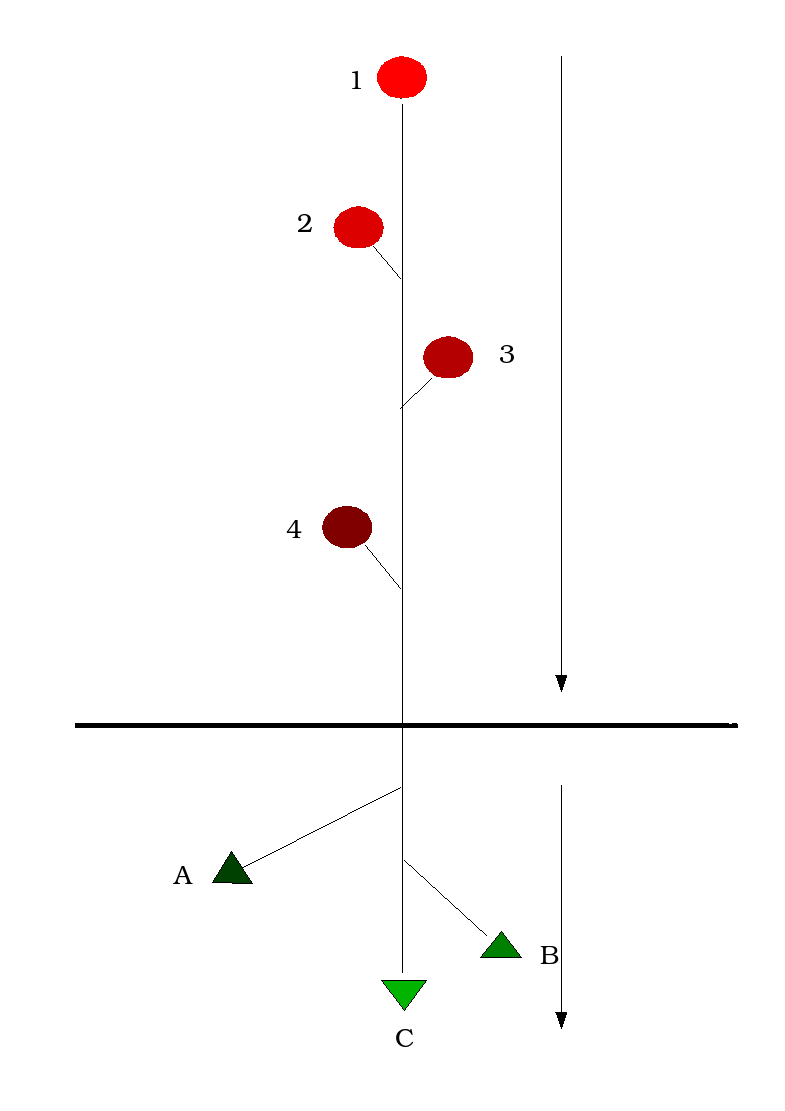 How auxin controls shoot growth (Image: Sten Porse, CC BY-SA 3.0, via Wikimedia Commons)
NEB Board-Style Questions
Short Answer (5 marks each)
Define auxin and explain its role in phototropism.
- Auxin is a plant hormone that promotes cell elongation.
- In phototropism, auxin moves to the shaded side → cells elongate → plant bends toward light.
How does gibberellin help in seed germination?
- Gibberellin breaks seed dormancy by stimulating enzyme production (e.g., amylase) that converts starch to sugar for growth.
What is the role of ethylene in fruit ripening?
- Ethylene triggers ripening by activating enzymes (e.g., cellulase, pectinase) that soften fruit and change color.
Long Answer (10 marks)
Describe the interaction between auxin and cytokinin in tissue culture.
- Auxin promotes root growth; cytokinin promotes shoot growth.
- High auxin:low cytokinin → More roots.
- High cytokinin:low auxin → More shoots.
- Balanced ratio → Whole plantlets.
Explain how abscisic acid helps plants survive drought.
- ABA is produced in roots under drought → signals stomata to close → reduces water loss.
- Also induces seed dormancy to wait for better conditions.
Exam Tip
✅ Memorize:
- Functions of each hormone (e.g., auxin = elongation, ABA = stress).
- Sources (e.g., ethylene from fruits, cytokinin from roots).
- Applications (e.g., 2,4-D = weed killer, GA = dwarf plant treatment).
✅ Compare & Contrast:
- Auxin vs. Gibberellin (both promote growth but in different ways).
- Cytokinin vs. ABA (one delays aging, the other induces dormancy).
✅ Diagrams:
- Draw apical dominance, stomatal closure (ABA), and fruit ripening (ethylene).
- Label hormone sources (e.g., shoot tip for auxin, root for cytokinin).
✅ Real-World Links:
- Farmers use ethylene to ripen bananas.
- Gardeners use auxin rooting powder for cuttings.
- Scientists modify ABA levels for drought-resistant crops.
Final Note: Plant hormones are like a plant’s command center—they control everything from roots to flowers! Master their functions, interactions, and applications for full marks in NEB exams. 🌱📚
Based on the NEB +2 Science syllabus for Biology (Bio), unit 4.
Discussion
Loading…