BiologyUnit 59 min read
Flowering Plant Reproduction: Structures, Processes & Variations
Unit 5 of Biology explores how flowering plants reproduce sexually and asexually, covering flower anatomy, pollination, fertilization, seed/fruit development, and adaptations—with NEB-style questions and solved examples.
Flowering Plant Reproduction: The Basics
Flowering plants (angiosperms) reproduce sexually (via flowers) and asexually (via vegetative parts). This unit focuses on sexual reproduction, which involves:
- Flower structure (male/female parts)
- Pollination (how pollen moves)
- Fertilization (fusion of gametes)
- Seed and fruit formation (development after fertilization)
1. Flower: The Reproductive Organ
A flower is a modified shoot with four main whorls (layers). Each part has a specific role in reproduction.
Structure of a Flower
graph TD
    A["Flower"] --> B["Calyx (Sepals)"]
    A --> C["Corolla (Petals)"]
    A --> D["Androecium (Stamens)"]
    A --> E["Gynoecium (Carpels)"]
    D --> F["Anther (Pollen sac)"]
    D --> G["Filament (Stalk)"]
    E --> H["Stigma (Pollen receiver)"]
    E --> I["Style (Tube)"]
    E --> J["Ovary (Ovules inside)"]
Key Terms
- Bisexual flower: Has both stamens (male) and carpels (female).
- Unisexual flower: Has either stamens (staminate) or carpels (pistillate).
- Complete flower: Has all four whorls (sepals, petals, stamens, carpels).
- Incomplete flower: Lacks one or more whorls (e.g., Cucumber flowers lack petals).
Solved Example: Identify the Parts
Question: In a flower, which part produces pollen, and which part receives it? Answer:
- Pollen is produced in the anther (part of the stamen).
- Pollen is received by the stigma (part of the carpel).
2. Pollination: Transfer of Pollen
Pollination is the transfer of pollen grains from the anther to the stigma. It can be:
- Self-pollination: Pollen from the same flower or another flower of the same plant (e.g., Wheat, Pea).
- Cross-pollination: Pollen from a different plant of the same species (e.g., Sunflower, Mango).
Agents of Pollination
| Agent | Examples | Adaptations in Flowers |
|---|---|---|
| Wind | Grass, Corn, Rice | Light, dry pollen; feathery stigma |
| Water | Water Lily, Vallisneria | Heavy pollen; flowers float on water |
| Insects | Sunflower, Rose, Mustard | Bright colors, nectar, scent, sticky pollen |
| Birds | Bougainvillea, Banana | Red/orange petals, no scent |
| Bats | Agave, Durian | Strong scent at night, large flowers |
Advantages of Cross-Pollination
- Genetic diversity: Offspring are stronger and more adaptable.
- Avoids inbreeding: Reduces chances of weak or diseased plants.
Disadvantages of Self-Pollination
- Less genetic variation: Offspring may be weak or identical.
- Inbreeding depression: Increased risk of genetic disorders.
3. Fertilization: Fusion of Gametes
After pollination, the pollen grain germinates on the stigma and forms a pollen tube that grows down the style to the ovary.
Double Fertilization (Unique to Angiosperms)
- First fertilization:
- A male gamete (from pollen) fuses with the female gamete (egg) in the ovule → forms a zygote (2n).
- Second fertilization:
- Another male gamete fuses with two polar nuclei in the ovule → forms the triploid (3n) endosperm (food for the embryo).
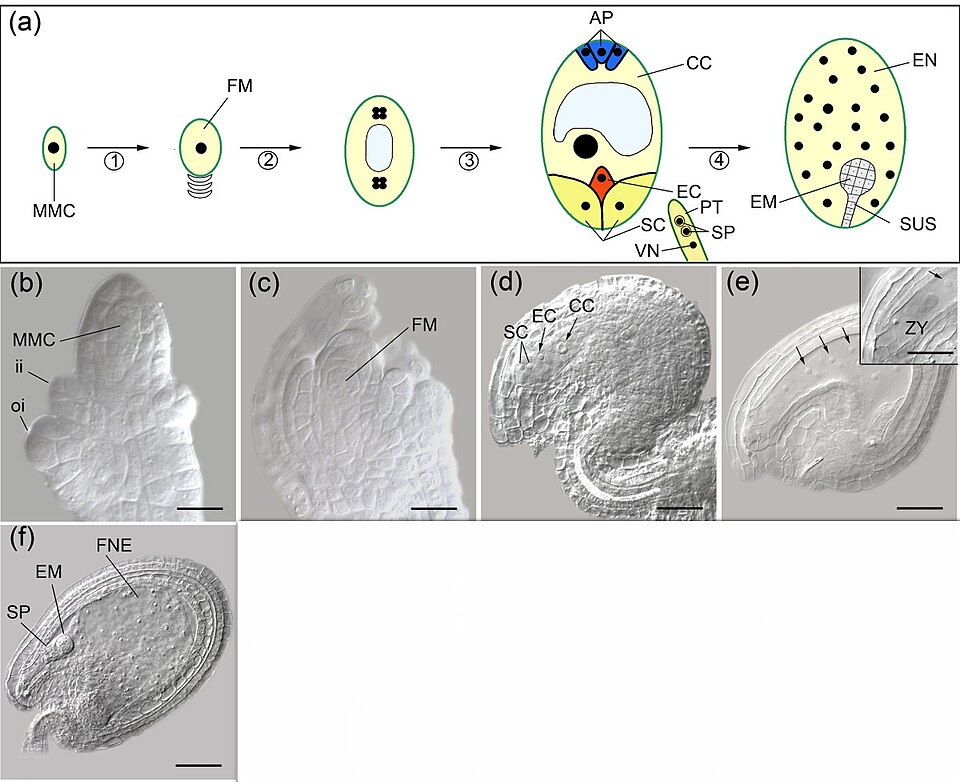 A labeled diagram showing the fusion of male gametes with egg and polar nuclei. (Image: Female_gametophytic_and_early_zygotic_mutant_phenotypes_high, CC BY 2.0, via Wikimedia Commons)
Solved Example: Trace the Path of a Pollen Grain
Question: Describe the journey of a pollen grain from the anther to fertilization. Answer:
- Pollen lands on the stigma.
- It germinates and forms a pollen tube down the style.
- The tube reaches the ovule in the ovary.
- Two sperm cells travel down the tube:
- One fertilizes the egg → forms the zygote.
- The other fertilizes the polar nuclei → forms the endosperm.
4. Seed and Fruit Development
After fertilization:
- The zygote develops into the embryo.
- The ovule becomes the seed.
- The ovary becomes the fruit (protects seeds and aids dispersal).
Parts of a Seed
graph TD
A["Seed"] --> B["Seed Coat (Testa)"]
A --> C["Embryo"]
C --> D["Plumule (Future shoot)"]
C --> E["Radicle (Future root)"]
C --> F["Cotyledon(s) (Seed leaves)"]
A --> G["Endosperm (Food storage)"]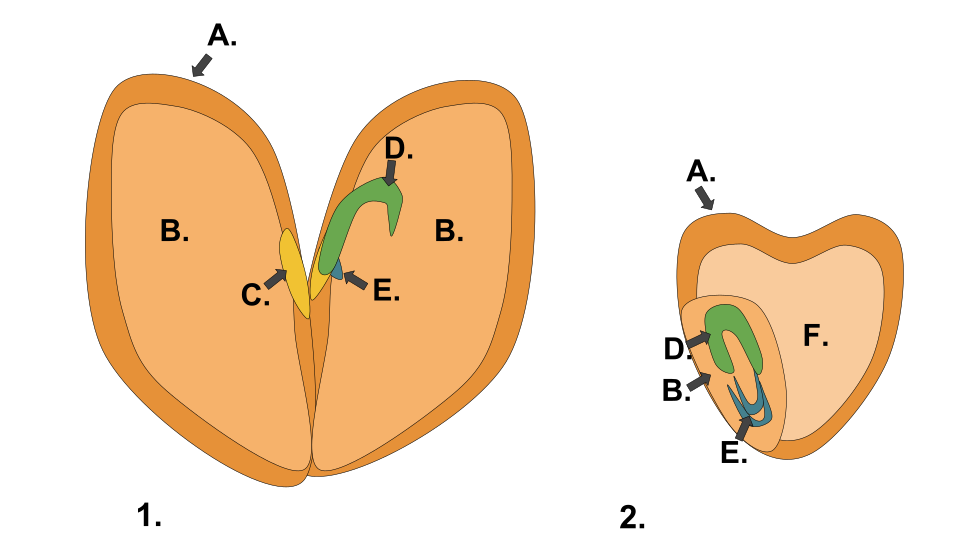 A labeled diagram of a dicot seed (e.g., Pea or Bean). (Image: Cbenson1919, CC BY-SA 3.0, via Wikimedia Commons)
Types of Fruits
| Type | Examples | Characteristics |
|---|---|---|
| Simple Fruit | Apple, Mango, Tomato | Develops from a single ovary |
| Aggregate Fruit | Raspberry, Blackberry | Forms from many ovaries of one flower |
| Multiple Fruit | Pineapple, Fig | Develops from ovaries of many flowers |
| False Fruit | Strawberry, Apple | Flesh is from receptacle, not ovary |
5. Asexual Reproduction in Flowering Plants
Some plants reproduce without seeds via:
- Vegetative propagation:
- Runners (Grass, Strawberry)
- Tubers (Potato)
- Bulbs (Onion, Garlic)
- Cutting/Grafting (Rose, Mango)
Advantages:
- Faster reproduction.
- Offspring are genetically identical (clones).
- Useful for commercial farming (e.g., potatoes, grapes).
Disadvantages:
- No genetic variation → vulnerable to diseases.
- Weaker adaptation to changing environments.
6. Adaptations for Reproduction
Plants have evolved specialized structures to attract pollinators and disperse seeds.
Adaptations for Pollination
| Adaptation | Example | Purpose |
|---|---|---|
| Bright petals | Sunflower | Attract insects/birds |
| Nectar | Orchids | Reward pollinators |
| Scent | Jasmine | Attract night pollinators (moths/bats) |
| Feathery stigma | Corn | Trap wind-borne pollen |
Adaptations for Seed Dispersal
| Method | Example | Mechanism |
|---|---|---|
| Wind | Dandelion, Maple | Light, winged, or hairy seeds |
| Water | Coconut | Buoyant fruit |
| Animals | Apple, Mango | Fleshy fruit eaten; seeds excreted |
| Explosive pods | Pea, Touch-me-not | Seeds ejected forcefully |
Exam Tip: How to Score Full Marks
- Diagrams are mandatory in NEB exams. Always draw and label:
- Flower structure (4 whorls).
- Double fertilization process.
- Seed/fruit development.
- Compare self vs. cross-pollination in tables (advantages/disadvantages).
- Define key terms precisely:
- Pollination vs. Fertilization.
- Zygote vs. Endosperm.
- Apply concepts to examples:
- Why is Mango cross-pollinated? (Birds carry pollen far.)
- Why is Wheat self-pollinated? (Efficient, no need for pollinators.)
- Common mistakes to avoid:
- Confusing pollen tube with style.
- Forgetting that angiosperms have double fertilization.
- Mixing up fruit types (e.g., calling Strawberry a simple fruit).
NEB Board-Style Questions (Practice)
Short Answer Questions
- Differentiate between self-pollination and cross-pollination with one example each.
- What is the role of the endosperm in a seed?
- Name two adaptations of flowers for insect pollination.
Structured Questions
- Draw a labeled diagram of a bisexual flower and mark its male and female reproductive parts.
- Explain the process of double fertilization in angiosperms with the help of a diagram.
- How do wind-pollinated and insect-pollinated flowers differ in structure? Give one example of each.
Long Answer Question
- Describe the development of a seed and fruit after fertilization. Why is fruit formation important for the survival of flowering plants?
Answer Key (For Self-Assessment)
- Self-pollination: Pollen from same flower/plant (e.g., Pea); Cross-pollination: Pollen from different plant (e.g., Sunflower).
- Endosperm provides nutrients to the developing embryo.
- Bright colors, nectar, scent, sticky pollen.
- (Diagram expected with sepals, petals, stamens, carpels labeled.)
- (Diagram + explanation: two sperm cells, one fertilizes egg → zygote; other fertilizes polar nuclei → endosperm.)
- Wind-pollinated: Light pollen, feathery stigma (Corn); Insect-pollinated: Bright petals, nectar (Rose).
- Seed: Zygote → embryo, ovule → seed coat; Fruit: Ovary → fruit (protects seeds, aids dispersal). Important for survival and spread of species.
Based on the NEB +2 Science syllabus for Biology (Bio), unit 5.
Discussion
Loading…