ChemistryUnit 1310 min read
Aldehydes & Ketones: Nomenclature, Reactions & Uses
Unit 13 of Chemistry covers aldehydes and ketones—key carbonyl compounds—explaining their structure, naming, preparation, reactions (nucleophilic addition, oxidation, reduction), and real-world applications like perfumes and pharmaceuticals.
TAKEAWAYS:
- Aldehydes (R-CHO) and ketones (R-CO-R’) differ by their carbonyl carbon’s bonding and reactivity.
- Nucleophilic addition (e.g., with HCN, Grignard reagents) is their defining reaction, forming new carbon-carbon bonds.
- Aldehydes oxidize easily (to carboxylic acids), while ketones resist oxidation under mild conditions.
- Tollens’ and Fehling’s tests distinguish aldehydes from ketones via silver mirror and red precipitate formation.
- Aldehydes and ketones are vital in industry (e.g., formaldehyde in resins) and biology (e.g., glucose metabolism).
1. Introduction: What Are Aldehydes and Ketones?
Aldehydes and ketones are carbonyl compounds—organic molecules containing a C=O (carbonyl) group. They differ in where this group is located:
- Aldehydes: The carbonyl carbon is bonded to at least one hydrogen (R-CHO). Example: Ethanal (CH₃CHO), formaldehyde (HCHO).
- Ketones: The carbonyl carbon is bonded to two carbon atoms (R-CO-R’). Example: Propanone (acetone, CH₃COCH₃).
Why are they important?
- Found in food flavors (vanilla, cinnamon), pharmaceuticals (aspirin), and plastics (formaldehyde in Bakelite).
- Key intermediates in organic synthesis (e.g., making alcohols, acids).
classDiagram
    class Aldehyde {
        +Carbonyl carbon bonded to H
        +General formula: R-CHO
        +Oxidizes to carboxylic acid
        +Example: CH₃CHO (ethanal)
    }
    class Ketone {
        +Carbonyl carbon bonded to 2 carbons
        +General formula: R-CO-R'
        +Resists oxidation (mild conditions)
        +Example: CH₃COCH₃ (propanone)
    }
    Aldehyde --> Ketone : "Both have C=O but differ in bonding"
2. Nomenclature: Naming Aldehydes and Ketones
Use IUPAC rules to name them systematically.
A. Aldehydes
- Find the longest carbon chain containing the -CHO group.
- Replace the -e ending of the alkane with -al.
- Example: CH₃CH₂CHO → Propanal (3 carbons + "-al").
B. Ketones
- Find the longest chain with the C=O group.
- Number the chain to give the carbonyl the lowest possible number.
- Replace -e with -one.
- Example: CH₃COCH₂CH₃ → Butan-2-one (4 carbons, carbonyl on C2).
Common Names (Still Used!)
- Formaldehyde: HCHO (methanal).
- Acetone: CH₃COCH₃ (propanone).
- Benzaldehyde: C₆H₅CHO (from bitter almonds).
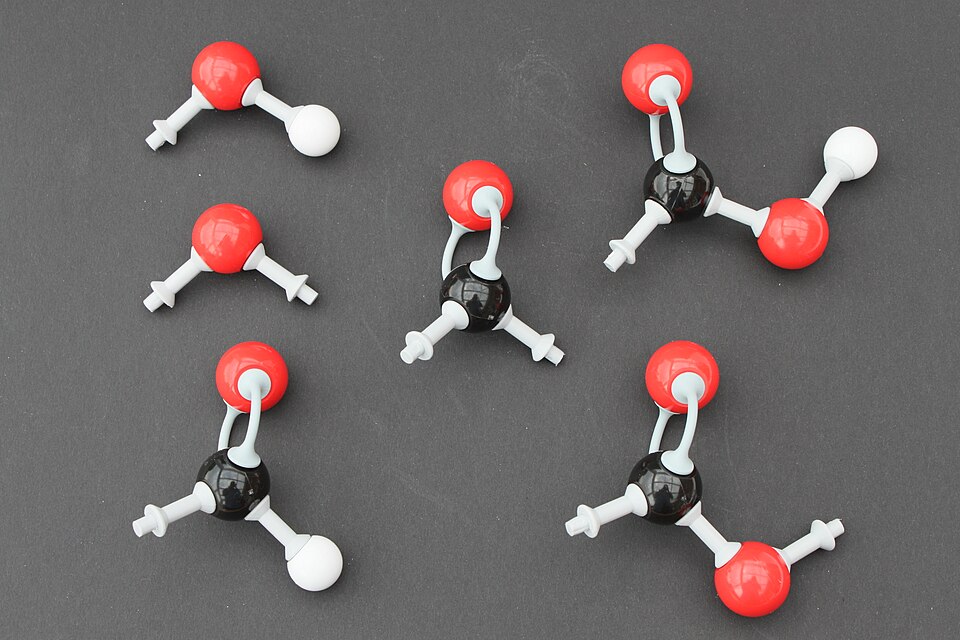 Structural difference between aldehydes and ketones (Image: Bin im Garten, CC BY-SA 3.0, via Wikimedia Commons)
3. Preparation Methods
A. Oxidation of Alcohols
- Primary alcohols → Aldehydes (then further to acids if oxidized strongly).
Reagent: K₂Cr₂O₇/H₂SO₄ (acidified dichromate) or PCC (pyridinium chlorochromate).
Example:
CH₃CH₂OH (ethanol) --[PCC]--> CH₃CHO (ethanal) - Secondary alcohols → Ketones.
Example:
CH₃CH(OH)CH₃ (propan-2-ol) --[K₂Cr₂O₇]--> CH₃COCH₃ (propanone)
B. Ozonolysis of Alkenes
- Cleaves C=C bonds to form aldehydes/ketones.
Example:
CH₃-CH=CH-CH₃ (but-2-ene) --[O₃, Zn/H₂O]--> 2 × CH₃CHO (ethanal)
C. From Alkynes
- Hydration of alkynes (with HgSO₄/H₂SO₄) gives methyl ketones.
Example:
CH≡CH (ethyne) --[H₂O, Hg²⁺]--> CH₃CHO (ethanal)
flowchart TD
    A["Primary Alcohol"] -->|"PCC"| B["Aldehyde"]
    A -->|"K₂Cr₂O₇ (strong)"| C["Carboxylic Acid"]
    D["Secondary Alcohol"] -->|"K₂Cr₂O₇"| E["Ketone"]
    F["Alkene"] -->|"O₃, Zn/H₂O"| G["Aldehyde/Ketone"]
    H["Alkyne"] -->|"H₂O, Hg²⁺"| I["Methyl Ketone"]
4. Physical Properties
| Property | Aldehydes | Ketones |
|---|---|---|
| Boiling Point | Higher than alkanes (dipole-dipole interactions) | Similar to aldehydes of same MW |
| Solubility | Soluble in water (H-bonding with -CHO) | Less soluble (no H-bonding) |
| Smell | Pungent (e.g., formaldehyde stings) | Sweet (e.g., acetone smells like nail polish remover) |
Why the difference?
- Aldehydes can H-bond with water (due to -CHO hydrogen), while ketones cannot.
5. Chemical Reactions
Aldehydes and ketones undergo nucleophilic addition (not substitution!) because the C=O bond is polar (δ⁺ on C, δ⁻ on O).
A. Nucleophilic Addition Reactions
- Addition of Hydrogen Cyanide (HCN)
- Forms hydroxynitriles (cyanohydrins). Example:
CH₃CHO + HCN → CH₃CH(OH)CN (2-hydroxypropanenitrile)Use: Preparing α-hydroxy acids (e.g., lactic acid).
Addition of Grignard Reagents (RMgX)
- Forms alcohols after hydrolysis. Example:
CH₃CHO + CH₃MgBr → CH₃CH(OH)CH₃ (propan-2-ol)Addition of Water (Hydration)
- Catalyzed by acid/base, forms gem-diols (unstable, revert to carbonyl). Example:
CH₃CHO + H₂O ⇌ CH₃CH(OH)₂
flowchart LR
    A["CH₃CHO"] -->|"HCN"| B["CH₃CH(OH)CN"]
    A -->|"CH₃MgBr"| C["CH₃CH(OH)CH₃"]
    A -->|"H₂O"| D["CH₃CH(OH)₂"]
B. Oxidation Reactions
- Aldehydes oxidize easily to carboxylic acids.
Reagents: K₂Cr₂O₇/H₂SO₄, Tollens’ reagent (Ag(NH₃)₂⁺), Fehling’s solution (Cu²⁺).
Example:
CH₃CHO --[Tollens']--> CH₃COOH + Ag (silver mirror) - Ketones resist oxidation (except strong oxidizers like KMnO₄, which cleave the C-C bond).
Test for Aldehydes vs. Ketones:
| Test | Aldehyde Result | Ketone Result |
|---|---|---|
| Tollens’ Test | Silver mirror (Ag) | No reaction |
| Fehling’s Test | Red precipitate (Cu₂O) | No reaction |
| 2,4-DNP Test | Orange precipitate (shared) | Orange precipitate (shared) |
C. Reduction Reactions
- Lithium Aluminium Hydride (LiAlH₄) reduces both to alcohols.
Example:
CH₃CHO --[LiAlH₄]--> CH₃CH₂OH (ethanol) CH₃COCH₃ --[LiAlH₄]--> CH₃CH(OH)CH₃ (propan-2-ol) - Catalytic Hydrogenation (H₂/Ni) also works.
D. Cannizzaro Reaction (Aldehydes Only!)
- No α-hydrogen aldehydes (e.g., formaldehyde) disproportionate in base to give:
- Alcohol (reduced product).
- Carboxylate salt (oxidized product). Example:
2 HCHO --[OH⁻]--> CH₃OH + HCOO⁻
flowchart TD
    A["CH₃CHO"] -->|"LiAlH₄"| B["CH₃CH₂OH"]
    C["CH₃COCH₃"] -->|"LiAlH₄"| D["CH₃CH(OH)CH₃"]
    E["HCHO"] -->|"OH⁻"| F["CH₃OH + HCOO⁻"]
**6. Comparison Table: Key Differences
| Feature | Aldehydes | Ketones |
|---|---|---|
| General Formula | R-CHO | R-CO-R’ |
| Oxidation | Oxidized to carboxylic acids | Resists oxidation (mild) |
| Nucleophilic Attack | More reactive (less steric hindrance) | Less reactive (steric hindrance) |
| Test Reactions | Tollens’/Fehling’s positive | Negative |
| Preparation | Oxidation of primary alcohols | Oxidation of secondary alcohols |
| Smell | Pungent/irritating | Sweet/fruity |
7. Applications in Daily Life
| Compound | Use | Example |
|---|---|---|
| Formaldehyde | Disinfectant, preservative | Embalming fluids, vaccines |
| Acetone | Solvent | Nail polish remover |
| Vanillin | Flavorings | Vanilla extract |
| Citral | Perfumes | Lemon scent |
| Glucose | Energy source | Blood sugar |
8. Solved Examples
Example 1: Nomenclature
Name the following:
- CH₃CH₂CH(CH₃)CHO
- CH₃COCH₂CH₂CH₃
Solution:
- 4-Methylpentanal (5 carbons, -CHO on C1, methyl on C3).
- Pentan-2-one (5 carbons, C=O on C2).
Example 2: Reaction Prediction
What happens when butan-2-one reacts with:
- HCN
- LiAlH₄
Solution:
- 2-Hydroxy-2-methylbutanenitrile (nucleophilic addition).
- 2-Methylpropan-2-ol (reduction to alcohol).
9. NEB Board-Style Questions
Short Answer (5 marks)
- Explain why aldehydes are more reactive than ketones toward nucleophilic addition. Give one example of each.
- Write the IUPAC names of:
- CH₃(CH₂)₃CHO
- (CH₃)₂CHCOCH₃
Long Answer (10 marks)
- Describe the preparation of ethanal from ethanol. How would you distinguish ethanal from propanone using:
- Tollens’ reagent
- Fehling’s solution
- 2,4-DNP reagent
- What is the Cannizzaro reaction? Write the reaction for formaldehyde undergoing this reaction in the presence of NaOH.
Exam Tip
Memorize Tests:
- Tollens’/Fehling’s = Aldehydes only!
- 2,4-DNP = Both aldehydes and ketones (orange precipitate).
Reaction Mechanisms:
- Always show the nucleophile attacking the carbonyl carbon in addition reactions.
Naming Tricks:
- Aldehydes: -al suffix, carbonyl carbon is C1.
- Ketones: -one suffix, give carbonyl the lowest number.
Common Mistakes:
- Don’t confuse oxidation (aldehydes → acids) with reduction (both → alcohols).
- Ketones do not give Tollens’/Fehling’s tests—write "no reaction" if asked!
Industrial Applications:
- Link aldehydes/ketones to plastics (formaldehyde), perfumes (citral), and medicine (aspirin synthesis).
Final Note: Practice drawing mechanisms for nucleophilic additions—they fetch high marks in NEB exams! Use curly arrows to show electron movement.
Based on the NEB +2 Science syllabus for Chemistry (Chem), unit 13.
Discussion
Loading…