ChemistryUnit 1410 min read
Carboxylic Acids & Derivatives: Structure, Reactions & Uses
Unit 14 of Chemistry explores carboxylic acids (formic, acetic), their derivatives (acid chlorides, esters, amides, anhydrides), naming rules, preparation methods, and key reactions like esterification, hydrolysis, and reduction—essential for NEB exams and real-world applications like perfumes and polymers.
TAKEAWAYS:
- Carboxylic acids have the –COOH group and are acidic due to hydrogen ion donation.
- Derivatives (acid chlorides, esters, amides) are formed by replacing –OH or H in –COOH.
- Esterification (acid + alcohol → ester + water) is reversible and used in perfumes.
- Hydrolysis breaks derivatives back into acids/alcohols (acidic/basic conditions matter).
- Reduction converts acids/derivatives to alcohols or aldehydes using LiAlH₄.
- Applications include soaps, dyes, and pharmaceuticals—critical for NEB practicals.
1. Carboxylic Acids: Structure & Properties
Carboxylic acids are organic compounds with the functional group –COOH (carboxyl group). They are polar (due to C=O and O–H bonds) and acidic (donate H⁺ ions).
Key Examples & Naming
| Name | Formula | Structure | Source |
|---|---|---|---|
| Formic acid | HCOOH | Ant stings, bee venom | |
| Acetic acid | CH₃COOH | Vinegar (5–8% solution) | |
| Benzoic acid | C₆H₅COOH | Preservative in foods |
Naming Rules:
- Replace -e in alkane name with -oic acid. Example: CH₃CH₂COOH → Propanoic acid (from propane).
Physical Properties
- Boiling Point: High (due to hydrogen bonding between –COOH groups).
- Solubility: Soluble in water (polar) but less soluble in nonpolar solvents.
- Smell: Pungent (e.g., acetic acid smells like vinegar).
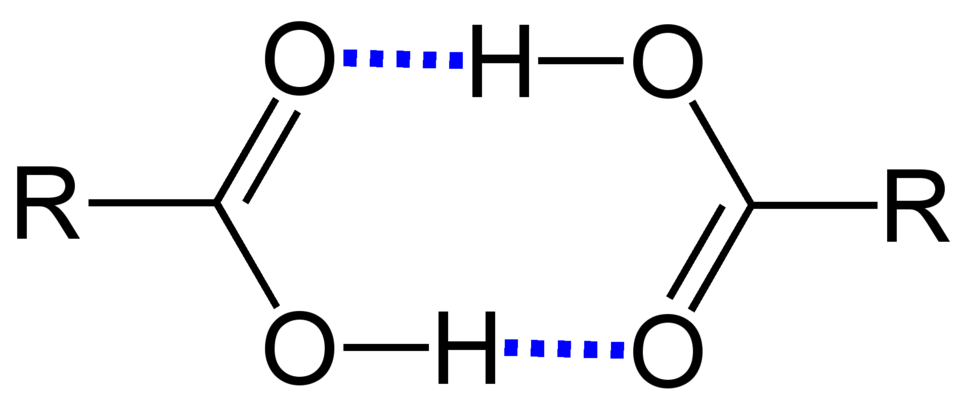 Hydrogen bonds between acetic acid molecules raise boiling points. (Image: Jü, CC0, via Wikimedia Commons)
2. Preparation of Carboxylic Acids
Method 1: Oxidation of Primary Alcohols/Aldehydes
- Reagents: Acidified K₂Cr₂O₇ (orange → green) or KMnO₄ (purple → colorless).
- Example:
flowchart TD
  A["Primary Alcohol (R–CH₂OH)"] -->|[K₂Cr₂O₇/H⁺] B["Aldehyde (R–CHO)"]
  B -->|[K₂Cr₂O₇/H⁺] C["Carboxylic Acid (R–COOH)"]
Method 2: Hydrolysis of Nitriles
- Reagent: Dilute HCl or H₂O (heat).
- Example:
flowchart TD
  A["Nitrile (R–CN)"] -->|[H₂O/H⁺, heat] B["Carboxylic Acid (R–COOH)"]
Method 3: Grignard Reagent + CO₂
- Reagent: CO₂ followed by H₃O⁺.
- Example:
flowchart TD
  A["Grignard (R–MgX)"] -->|[CO₂] B["Carboxylate Salt (R–COO⁻Mg⁺X⁻)"]
  B -->|[H₃O⁺] C["Carboxylic Acid (R–COOH)"]
3. Chemical Reactions of Carboxylic Acids
A. Reaction with Metals (Acidic Nature)
- Example: Acetic acid + Magnesium → Salt + Hydrogen gas.
flowchart TD
  A["CH₃COOH"] + B["Mg"] --> C["(CH₃COO)₂Mg"] + D["H₂"]
B. Esterification (Reaction with Alcohols)
- Reagent: Alcohol + Acid catalyst (H₂SO₄).
- Example: Ethanoic acid + Ethanol → Ethyl ethanoate (smells like fruit).
flowchart TD
  A["CH₃COOH"] + B["C₂H₅OH"] -->|[H⁺, heat] C["CH₃COOC₂H₅"] + D["H₂O"]
C. Reduction to Primary Alcohols
- Reagent: LiAlH₄ (strong reducing agent).
- Example:
flowchart TD
  A["R–COOH"] -->|[LiAlH₄] B["R–CH₂OH"]
D. Reaction with PCl₅/PCl₃ (to Acid Chloride)
- Example:
flowchart TD
  A["R–COOH"] + B["PCl₅"] --> C["R–COCl"] + D["POCl₃ + HCl"]
4. Derivatives of Carboxylic Acids
Derivatives are formed by replacing –OH or H in –COOH. They are less acidic but more reactive than acids.
| Derivative | Structure | Preparation | Reactivity |
|---|---|---|---|
| Acid Chloride | R–COCl | R–COOH + PCl₅ | High (reacts with H₂O, alcohols) |
| Ester | R–COOR' | R–COOH + R'OH (H⁺, heat) | Moderate (hydrolyzes to acid/alcohol) |
| Amide | R–CONH₂ | R–COCl + NH₃ | Low (stable, used in proteins) |
| Anhydride | (R–CO)₂O | 2R–COOH (heat, remove H₂O) | High (reacts with H₂O to form acid) |
 Pyramid showing acid chloride > anhydride > ester > amide in reactivity. (Image: Minihaa, CC0, via Wikimedia Commons)
5. Key Reactions of Derivatives
A. Hydrolysis (Breaking Down)
- Acid Chloride + Water → Acid + HCl
flowchart TD
  A["R–COCl"] + B["H₂O"] --> C["R–COOH"] + D["HCl"]
- Ester + Water → Acid + Alcohol (requires H⁺ or OH⁻ catalyst).
flowchart TD
  A["R–COOR'"] + B["H₂O"] -->|[H⁺/OH⁻] C["R–COOH"] + D["R'OH"]
B. Reduction
- LiAlH₄ reduces all derivatives to alcohols.
flowchart TD
  A["R–COCl"] -->|[LiAlH₄] B["R–CH₂OH"]
  C["R–COOR'"] -->|[LiAlH₄] D["R–CH₂OH + R'OH"]
C. Amide Formation (Nucleophilic Substitution)
- Acid Chloride + Ammonia → Amide + HCl
flowchart TD
  A["R–COCl"] + B["NH₃"] --> C["R–CONH₂"] + D["HCl"]
6. Applications in Daily Life
| Derivative | Use | Example Product |
|---|---|---|
| Esters | Perfumes, flavors | Ethyl acetate (pineapple smell) |
| Amides | Pharmaceuticals, fibers | Nylon-6 (polyamide) |
| Acid Chlorides | Plasticizers, dyes | PVC production |
| Anhydrides | Food preservatives | Acetic anhydride (aspirin synthesis) |
7. NEB Exam Tips
Memorize Naming:
- Always replace -e with -oic acid for acids.
- For derivatives, use -oyl chloride (acid chloride), -oate (ester), -amide (amide).
Reaction Conditions Matter:
- Esterification: Acid catalyst (H₂SO₄), heat.
- Hydrolysis: Acidic (H⁺) or basic (OH⁻) conditions.
- Reduction: LiAlH₄ (strong) vs. NaBH₄ (milder).
Draw Mechanisms for Key Reactions:
- Esterification (protonation of –COOH, nucleophilic attack by alcohol).
- Hydrolysis (nucleophilic attack by H₂O).
Practical Questions:
- Preparation: How to convert ethanol to ethanoic acid? (Oxidation with K₂Cr₂O₇).
- Identification: How to distinguish between acetic acid and ethanol? (Use NaHCO₃ test—acetic acid gives CO₂ bubbles).
Common Mistakes to Avoid:
- Forgetting heat in esterification.
- Confusing acid chloride (R–COCl) with acid anhydride ((R–CO)₂O).
- Not balancing redox reactions (e.g., oxidation of alcohols).
Solved NEB-Style Questions
Q1. Write the IUPAC name of the following compound:
CH₃–CH₂–CH(Cl)–COOH Answer:
- Longest chain: 4 carbons (butanoic acid base).
- Substituent: Chloro (Cl) at 2nd carbon. Final Name: 3-Chlorobutanoic acid
Q2. How will you prepare propanoic acid from ethanol?
Answer:
- Oxidize ethanol to ethanal (using K₂Cr₂O₇/H⁺).
- Further oxidize ethanal to propanoic acid (same reagent).
flowchart TD
  A["C₂H₅OH"] -->|[K₂Cr₂O₇/H⁺] B["CH₃CHO"]
  B -->|[K₂Cr₂O₇/H⁺] C["CH₃COOH"]
Q3. Write the reaction of acetic acid with sodium bicarbonate.
Answer: Acetic acid (weak acid) reacts with NaHCO₃ to give CO₂ gas (effervescence).
flowchart TD
  A["CH₃COOH"] + B["NaHCO₃"] --> C["CH₃COONa"] + D["H₂O"] + E["CO₂"]
Q4. Compare the reactivity of acid chloride, ester, and amide.
Answer:
| Property | Acid Chloride | Ester | Amide |
|---|---|---|---|
| Reactivity | Highest | Moderate | Lowest |
| Hydrolysis Rate | Fast (H₂O) | Slow (H⁺/OH⁻) | Very slow |
| Stability | Unstable | Stable | Very stable |
| Use | Intermediate | Perfumes | Proteins, drugs |
Summary Table for Quick Revision
| Topic | Key Points |
|---|---|
| Structure | –COOH group, polar, hydrogen bonding → high BP. |
| Preparation | Oxidation, hydrolysis of nitriles, Grignard + CO₂. |
| Reactions | Esterification, reduction (LiAlH₄), reaction with metals. |
| Derivatives | Acid chloride > anhydride > ester > amide in reactivity. |
| Applications | Esters (flavors), amides (nylon), acid chlorides (plastics). |
Final Note:
- Carboxylic acids are the parent compounds; their derivatives are more reactive intermediates.
- Esterification is reversible—use excess alcohol to push equilibrium forward.
- LiAlH₄ is a super-reducer—it converts acids/derivatives to alcohols.
Good luck for your NEB exams! Practice drawing mechanisms and naming compounds daily.
Based on the NEB +2 Science syllabus for Chemistry (Chem), unit 14.
Discussion
Loading…