ChemistryUnit 1913 min read
Cement, Paper & Pulp: Manufacturing, Chemistry & Applications
Unit 19 of Chemistry explores the industrial chemistry behind cement (types, manufacturing, testing), paper/pulp production (raw materials, processes, recycling), and their environmental/social impacts—essential for NEB exams with practical and theoretical questions.
TAKEAWAYS:
- Cement is made by heating limestone and clay (1450°C) to form tricalcium silicate (C₃S) and dicalcium silicate (C₂S), which harden when mixed with water via hydration.
- Paper pulp is extracted via mechanical (grinding wood) or chemical (Kraft process using NaOH/Na₂S) methods, with recycled paper now a major source.
- Cement sets faster with gypsum (CaSO₄·2H₂O) added to control flash setting; paper strength depends on hydrogen bonding between cellulose fibers.
- Environmental concerns include cement’s CO₂ emissions (30% of global industrial CO₂) and paper pulp’s sulfur pollution (from Kraft process).
- NEB often tests manufacturing steps, chemical reactions, and comparisons (e.g., Portland vs. rapid-hardening cement).
1. Cement: The Artificial Rock
What is Cement?
Cement is a powdery substance that hardens when mixed with water, forming a strong, durable material. It is the binding agent in concrete, mortar, and plaster. The most common type is Portland cement, named for its resemblance to limestone from Portland, England.
Chemical Composition of Cement
Cement is made from limestone (CaCO₃) and clay (Al₂O₃·2SiO₂·2H₂O). When heated to 1450–1500°C in a rotary kiln, they form clinker—a dark, nodular material containing:
- Tricalcium silicate (C₃S, 3CaO·SiO₂, 50%) → Hardens quickly, gives early strength.
- Dicalcium silicate (C₂S, 2CaO·SiO₂, 25%) → Hardens slowly, gives long-term strength.
- Tricalcium aluminate (C₃A, 3CaO·Al₂O₃, 10%) → Reacts rapidly with water (can cause flash setting).
- Tetracalcium aluminoferrite (C₄AF, 4CaO·Al₂O₃·Fe₂O₃, 10%) → Adds color and reduces cost.
Manufacturing of Cement (Dry Process)
Crushing and Grinding
- Raw materials (limestone + clay) are crushed into fine powder.
- Mixed in the correct ratio (3:1) to form a slurry (wet process) or dry powder (dry process).
Heating in Rotary Kiln
- The mixture is heated to 1450–1500°C in a rotary kiln (a long, inclined cylinder).
- Chemical reactions occur:
- Decomposition of limestone: (releases CO₂, a major pollutant).
- Formation of clinker: (C₃S). (C₂S).
Cooling and Grinding
- Clinker is cooled and ground into fine powder.
- Gypsum (CaSO₄·2H₂O, 2–5%) is added to control setting time (prevents flash setting).
Types of Cement
| Type | Composition | Uses | Advantages |
|---|---|---|---|
| Ordinary Portland Cement (OPC) | Standard C₃S, C₂S, C₃A, C₄AF | General construction (buildings, roads) | Cheap, widely available |
| Rapid-Hardening Cement | Higher C₃S (50–60%) | Cold weather, emergency repairs | Sets faster (3–6 hours) |
| Low-Heat Cement | Lower C₃S, higher C₂S | Massive structures (dams) | Generates less heat during setting |
| White Cement | Low iron content | Decorative work, flooring | Bright white color |
| Hydrophobic Cement | Treated with water-repellent agents | Underground structures, damp areas | Resists moisture |
Setting and Hardening of Cement
When cement mixes with water, hydration occurs:
- Initial Setting (30 min–1 hour)
- C₃A reacts first, forming ettringite (3CaO·Al₂O₃·3CaSO₄·32H₂O), which slows down further reactions.
- Final Setting (6–24 hours)
- C₃S and C₂S react with water to form calcium silicate hydrate (C-S-H), the main strength-giving compound.
- Hardening (Weeks to Years)
- Strength increases due to crystallization and polymerization of C-S-H.
Testing of Cement
NEB often asks about standard tests for cement quality:
- Setting Time Test
- Initial set: Time for Vicat needle to penetrate 5 mm (should be 30 min for OPC).
- Final set: Time for needle to not penetrate (should be 10 hours for OPC).
- Soundness Test
- Checks for unsoundness (expansion after setting, causing cracks).
- Done using Le Chatelier’s apparatus (expansion should be <10 mm).
- Compressive Strength Test
- Mortar cubes (70.7 mm) are tested after 3, 7, and 28 days.
- Minimum strength:
- 3 days: 16 MPa
- 7 days: 22 MPa
- 28 days: 32.5 MPa (for OPC 33 grade).
2. Paper and Pulp: From Trees to Sheets
What is Pulp?
Pulp is a fibrous material obtained from wood, rags, or recycled paper. It is the raw material for making paper.
Sources of Pulp
- Wood Pulp (Most common)
- Softwood (pine, spruce) → Long fibers → Strong paper (newspapers, cardboard).
- Hardwood (eucalyptus, oak) → Short fibers → Smooth paper (writing paper, magazines).
- Rag Pulp (Old cloth)
- Used for high-quality paper (banknotes, maps).
- Recycled Pulp
- Made from waste paper (newspapers, office paper).
- Reduces deforestation but may weaken paper quality.
Methods of Pulp Production
| Method | Process | Advantages | Disadvantages |
|---|---|---|---|
| Mechanical Pulp | Wood chips ground between rotating stones. | Fast, retains fiber length. | Low strength, yellows over time. |
| Chemical Pulp (Kraft Process) | Wood chips boiled in NaOH + Na₂S (white liquor). | High strength, long fibers. | Pollutes water (sulfur compounds). |
| Semi-Chemical Pulp | Partial chemical treatment + mechanical grinding. | Balanced strength and cost. | Moderate pollution. |
| Recycled Pulp | Waste paper broken down in water, impurities removed. | Eco-friendly, cost-effective. | Shorter fibers, weaker paper. |
Kraft Process (Sulfate Process) – Most Common
Digestion
- Wood chips are cooked in a digester with white liquor (NaOH + Na₂S) at 170°C for 3–6 hours.
- Lignin (binder in wood) dissolves, leaving cellulose fibers.
Washing
- Fibers are washed to remove lignin and chemicals.
Bleaching (Optional)
- Chlorine or hydrogen peroxide is used to whiten pulp.
- Paper Making
- Pulp is mixed with water, pressed into sheets, and dried on rollers.
Chemical Reactions in Kraft Process:
- Delignification:
- Recovery of Chemicals: Spent liquor is burned to recover Na₂CO₃, which is converted back to NaOH and Na₂S.
Paper Making Process
- Beating and Refining
- Pulp fibers are beaten to separate and soften them.
- Forming the Sheet
- Pulp is poured onto a moving wire mesh (Fourdrinier machine).
- Water drains, leaving a wet fiber mat.
- Pressing and Drying
- Wet sheet is pressed to remove water, then dried on steam-heated rollers.
- Finishing
- Coating (clay, calcium carbonate) for smoothness.
- Calendering (pressing between rollers) for gloss.
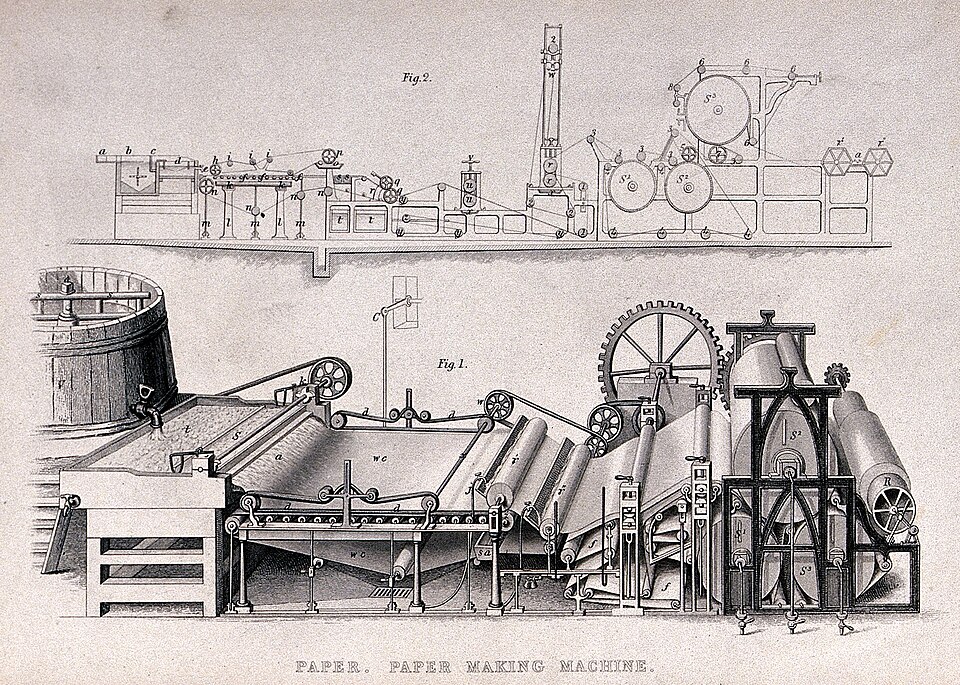 Fourdrinier machine showing wire mesh and roller drying (Image: CC BY 4.0, via Wikimedia Commons)
Types of Paper
| Type | Fiber Source | Uses |
|---|---|---|
| Writing Paper | Hardwood pulp | Letters, notebooks |
| Newspaper | Softwood pulp | Daily newspapers |
| Cardboard | Recycled + mechanical | Packaging, boxes |
| Tissue Paper | Softwood pulp | Toilet paper, napkins |
| Banknote Paper | Rag + cotton pulp | Currency (durable, resistant) |
3. Environmental and Economic Impact
Cement Industry
- Pros:
- Essential for infrastructure (roads, buildings).
- Low-cost building material.
- Cons:
- High CO₂ emissions (1 ton of cement → ~900 kg CO₂).
- Energy-intensive (kiln heating uses fossil fuels).
- Quarrying destroys landscapes.
Solution:
- Use fly ash (from coal plants) or slag (from steel industry) as cement additives.
- Develop low-CO₂ cements (e.g., geopolymer cement using industrial waste).
Paper Industry
- Pros:
- Recyclable (reduces deforestation).
- Biodegradable (unlike plastic).
- Cons:
- Deforestation (if not recycled).
- Water pollution (Kraft process releases sulfur compounds).
- Energy-intensive (drying paper uses a lot of heat).
Solution:
- Recycle paper (saves 20–30% energy).
- Use alternative fibers (bamboo, hemp, agricultural waste).
- Close-loop systems (recover chemicals in Kraft process).
Exam Tip: How to Score Full Marks in NEB
Manufacturing Steps
- Always write sequential steps (e.g., "limestone → kiln → clinker → grinding").
- Use flowcharts for paper/pulp processes.
Chemical Equations
- NEB loves balanced equations (e.g., limestone decomposition, Kraft process).
- Example:
Comparisons
- Compare types of cement (OPC vs. rapid-hardening) or pulp methods (mechanical vs. chemical).
- Use tables (as shown above).
Applications and Problems
- Link properties to uses (e.g., "C₃S hardens fast → good for cold weather").
- Discuss environmental impacts (CO₂, deforestation).
Diagrams
- Draw rotary kiln, Fourdrinier machine, or cement hydration structure.
- Label all parts (e.g., "Preheater," "Cooler," "Grinding mill").
NEB Board-Style Questions (Practice)
Short Answer (5 marks)
- Explain the dry process of cement manufacturing with a labeled diagram.
- What is the Kraft process? Write the chemical reactions involved in delignification.
- Why is gypsum added to cement? What happens if it is not added?
Long Answer (10 marks)
- Describe the manufacturing of paper from wood pulp. Explain the environmental impacts of the paper industry and suggest three solutions to reduce pollution.
- Compare Ordinary Portland Cement (OPC) and Rapid-Hardening Cement with respect to:
- Composition
- Setting time
- Uses
- Advantages
Numerical (5 marks)
- A cement sample sets in 20 minutes initially and 8 hours finally in a Vicat test. Is it sound? Justify with the standard values.
- Calculate the CO₂ emitted when 500 kg of limestone (CaCO₃) is decomposed to form cement. (Molar mass: CaCO₃ = 100 g/mol, CO₂ = 44 g/mol).
Final Summary
| Topic | Key Points |
|---|---|
| Cement | Made from limestone + clay → C₃S, C₂S → hydration → strength. Gypsum controls setting. |
| Paper Pulp | Wood → mechanical/chemical pulp → bleaching → paper. Kraft process uses NaOH/Na₂S. |
| Environment | Cement: CO₂ emissions. Paper: deforestation, water pollution. Solutions: recycle, use alternatives. |
| NEB Focus | Manufacturing steps, chemical reactions, comparisons, environmental impact. |
Remember:
- Cement = Clinker + Gypsum → Hydration → Strength.
- Paper = Pulp + Water → Pressing + Drying → Sheets.
- Exams test: Processes, chemicals, comparisons, and real-world impacts.
Good luck for your NEB exams! 🚀
Based on the NEB +2 Science syllabus for Chemistry (Chem), unit 19.
Discussion
Loading…