ChemistryUnit 2017 min read
Fertilizers & Polymers: Types, Uses & Environmental Impact
Unit 20 of Chemistry explores how fertilizers boost crop growth and how polymers revolutionize materials science, covering their classification, preparation, properties, and real-world applications with solved examples and NEB-style questions.
TAKEAWAYS:
- Fertilizers are classified into organic, inorganic, and biofertilizers, each with unique sources and benefits for soil health.
- Nitrogenous fertilizers (e.g., urea, ammonium sulfate) are essential for plant protein synthesis but can cause eutrophication if overused.
- Polymers are giant molecules formed by addition (chain-growth) or condensation (step-growth) polymerization, with examples like polyethylene (plastic bags) and nylon (fabrics).
- Thermoplastic polymers (e.g., PVC) can be remelted, while thermosetting polymers (e.g., Bakelite) harden permanently.
- Biodegradable polymers (e.g., PLA from corn starch) reduce plastic pollution but have limited strength.
- NEB exams test preparation methods, environmental impacts, and applications—always link theory to real-world examples (e.g., urea’s role in agriculture, Kevlar’s use in bulletproof vests).
1. Fertilizers: The Food for Plants
Fertilizers are chemical substances added to soil to supply essential nutrients (N, P, K, Ca, Mg, S) for plant growth. Without them, crops would lack energy for growth, leading to stunted plants and low yields.
Why Do Plants Need Fertilizers?
Plants absorb nutrients through their roots, but soil nutrients deplete over time due to:
- Crop harvesting (removes nutrients like N, P, K).
- Leaching (rain washes away soluble nutrients like nitrates).
- Microorganisms consuming organic matter.
Key Nutrients in Fertilizers:
| Nutrient | Role in Plants | Common Fertilizer Sources |
|---|---|---|
| Nitrogen (N) | Builds proteins, chlorophyll | Urea, Ammonium sulfate, Ammonium nitrate |
| Phosphorus (P) | Helps root growth, energy transfer | Superphosphate, DAP (Diammonium phosphate) |
| Potassium (K) | Regulates water balance, disease resistance | Potassium chloride (Muriate of Potash) |
| Calcium (Ca) | Strengthens cell walls, prevents blossom-end rot | Gypsum (CaSO₄·2H₂O), Lime (CaO) |
| Magnesium (Mg) | Part of chlorophyll | Epsom salt (MgSO₄·7H₂O) |
Types of Fertilizers
Fertilizers are classified based on their source and composition:
classDiagram
    class Fertilizer {
        +Supply nutrients to soil
    }
    class Organic {
        +From plant/animal waste
        +Improves soil structure
        +Examples: Compost, Farmyard manure, Vermicompost
    }
    class Inorganic {
        +Synthetic chemicals
        +Fast-acting but can harm soil
        +Examples: Urea, Ammonium sulfate, Superphosphate
    }
    class Biofertilizer {
        +Living microorganisms
        +Eco-friendly, long-term benefits
        +Examples: Rhizobium (N-fixer), Blue-green algae
    }
    Fertilizer <|-- Organic
    Fertilizer <|-- Inorganic
    Fertilizer <|-- Biofertilizer
A. Organic Fertilizers
- Source: Plant/animal waste (e.g., cow dung, compost, bone meal).
- Advantages:
- Improve soil structure and water retention.
- Release nutrients slowly, reducing leaching.
- Eco-friendly and cheap.
- Disadvantages:
- Slow-acting (takes weeks/months to decompose).
- May contain pathogens (e.g., E. coli in fresh manure).
- Example: Vermicompost (worm castings) is rich in nitrogen and phosphorus.
Solved Example: Why is farmyard manure (FYM) preferred over synthetic fertilizers for organic farming? Answer: FYM contains humus, which improves soil aeration and microbial activity. It also provides secondary nutrients (Ca, Mg, S) that synthetic fertilizers lack. However, it must be well-decomposed before use to avoid burning plant roots.
B. Inorganic (Mineral) Fertilizers
- Source: Chemically synthesized (e.g., urea, ammonium nitrate).
- Advantages:
- Quick nutrient release (plants absorb them fast).
- High nutrient content (e.g., urea is 46% nitrogen).
- Easy to store and transport.
- Disadvantages:
- Soil acidification (e.g., ammonium ions → H⁺ ions).
- Eutrophication (excess nitrates → algal blooms → oxygen depletion in water).
- Kills beneficial soil microbes if overused.
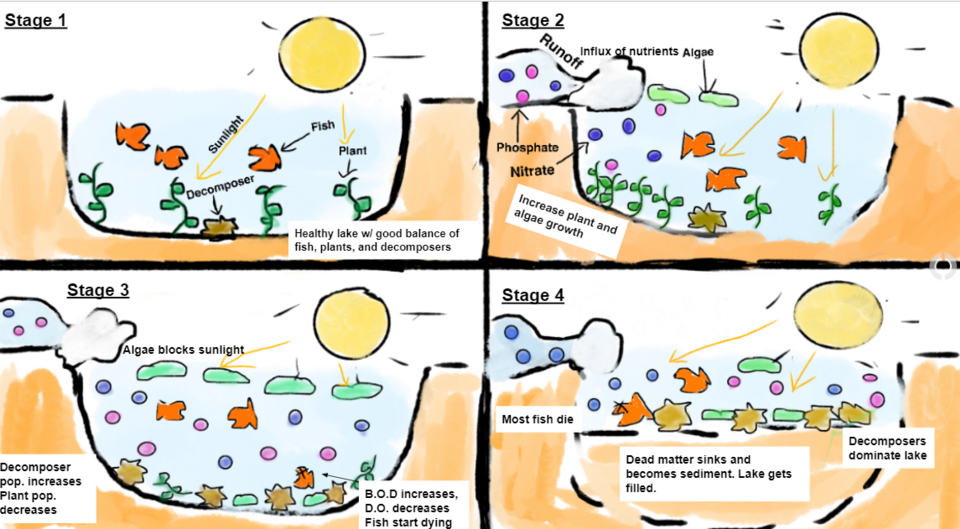 A flowchart showing: Excess fertilizers → Runoff into water → Algal bloom → Decomposition → Oxygen depletion → Fish kill. (Image: Echow12345, CC BY-SA 4.0, via Wikimedia Commons)
Solved Example: Calculate the amount of nitrogen (N) supplied by 50 kg of urea (NH₂CONH₂, molar mass = 60 g/mol, N = 28 g/mol). Solution:
- Moles of urea = .
- Moles of N per urea = 2 (since NH₂CONH₂ has 2 N atoms).
- Total N = . Answer: 50 kg urea supplies 23.33 kg nitrogen.
C. Biofertilizers
- Source: Living organisms (bacteria, fungi, cyanobacteria).
- Types:
- Rhizobium: Fixes nitrogen in legume roots (e.g., peas, beans).
- Azotobacter: Free-living nitrogen-fixer in soil.
- Blue-green algae (BGA): Fixes nitrogen in paddy fields.
- Mycorrhiza: Fungal association that enhances phosphorus uptake.
Advantages:
- Eco-friendly (no chemical pollution).
- Long-term soil health (increases microbial activity).
- Cost-effective (cheaper than synthetic fertilizers).
Disadvantages:
- Slow action (takes time to establish).
- Sensitive to soil pH (works best in neutral soil).
Environmental Impact of Fertilizers
| Issue | Cause | Solution |
|---|---|---|
| Soil Acidification | Ammonium fertilizers → H⁺ ions | Use lime (CaO) to neutralize acidity. |
| Eutrophication | Nitrate runoff → Algal blooms | Use controlled doses, biofertilizers. |
| Greenhouse Gases | N₂O from fertilizers | Apply nitrification inhibitors. |
| Soil Salinization | Overuse of KCl, CaCl₂ | Use gypsum to flush out excess salts. |
2. Polymers: The Backbone of Modern Materials
Polymers are large molecules made by repeating small units (monomers). They are everywhere—from plastic bags to artificial limbs!
Classification of Polymers
mindmap
  root((Polymers))
    Natural
      Rubber
      Cellulose
      Proteins
    Semi-synthetic
      Cellulose nitrate
      Vulcanized rubber
    Synthetic
      Addition
        Polyethylene
        PVC
      Condensation
        Nylon
        Bakelite
    Biodegradable
      PLA
      Starch-based
    Non-biodegradable
      Polystyrene
      Polypropylene
A. Natural vs. Synthetic Polymers
| Feature | Natural Polymers | Synthetic Polymers |
|---|---|---|
| Source | Plants/animals (e.g., rubber, wool) | Lab-made (e.g., nylon, polyester) |
| Biodegradability | Biodegradable (e.g., cellulose) | Mostly non-biodegradable (e.g., plastic) |
| Properties | Limited strength, variable quality | Customizable (strong, flexible, heat-resistant) |
| Examples | Starch, silk, natural rubber | PVC, Bakelite, Teflon |
B. Types of Polymerization
Polymers are formed by two main processes:
- Addition (Chain-Growth) Polymerization
- Mechanism: Monomers with double bonds (alkenes) add repeatedly.
- Example: Ethene → Polyethylene (used in plastic bags).
- Initiator: Peroxides or UV light.
- No byproduct (100% monomer converts to polymer).
Reaction:
n CH₂=CH₂ → [-CH₂-CH₂-]ₙ (Polyethylene)
Condensation (Step-Growth) Polymerization
- Mechanism: Monomers lose small molecules (H₂O, NH₃, HCl) to link.
- Example: Nylon-6,6 (from hexamethylenediamine + adipic acid).
- Byproduct: Water or alcohol is released.
Reaction:
n HOOC-(CH₂)₄-COOH + n H₂N-(CH₂)₆-NH₂ → [-OC-(CH₂)₄-CO-NH-(CH₂)₆-NH-]ₙ + (2n-1) H₂O
C. Thermoplastic vs. Thermosetting Polymers
| Property | Thermoplastic | Thermosetting |
|---|---|---|
| Melting Point | Softens on heating (reusable) | Hardens permanently (cannot remelt) |
| Examples | PVC, Polystyrene, Polyethylene | Bakelite, Melamine, Epoxy resins |
| Uses | Bottles, pipes, toys | Electrical switches, car brakes, adhesives |
| Recyclability | Recyclable | Non-recyclable |
Solved Example: Why is Bakelite used for making electrical switches but not plastic bags? Answer: Bakelite is a thermosetting polymer—once molded, it cannot be remelted, making it heat-resistant (safe for switches). Plastic bags need flexibility and recyclability, so thermoplastic polymers like polyethylene are used instead.
D. Biodegradable Polymers
These polymers break down naturally by microbes, reducing pollution.
| Type | Source | Example | Use |
|---|---|---|---|
| Starch-based | Corn, potatoes | Starch-PLA blend | Disposable cutlery |
| PHA (Polyhydroxyalkanoates) | Microbial fermentation | Bioplastics | Food packaging |
| Cellulose-based | Wood pulp | Cellophane | Wrapping films |
Advantages:
- Reduce landfill waste.
- Lower carbon footprint (from renewable sources).
Disadvantages:
- Weaker than synthetic polymers.
- Expensive to produce.
3. Important Polymers and Their Uses
| Polymer | Monomer | Type | Uses |
|---|---|---|---|
| Polyethylene (PE) | Ethene (CH₂=CH₂) | Thermoplastic | Plastic bags, bottles |
| Polyvinyl Chloride (PVC) | Vinyl chloride (CH₂=CHCl) | Thermoplastic | Pipes, cables, flooring |
| Polystyrene (PS) | Styrene (C₆H₅-CH=CH₂) | Thermoplastic | Disposable cups, insulation |
| Nylon-6,6 | Hexamethylenediamine + Adipic acid | Condensation | Clothing, ropes, parachutes |
| Bakelite | Phenol + Formaldehyde | Thermosetting | Electrical insulators, phone casings |
| Teflon (PTFE) | Tetrafluoroethylene | Thermoplastic | Non-stick cookware |
| Polyester (PET) | Ethylene glycol + Terephthalic acid | Condensation | Bottles, fibers (e.g., polyester shirts) |
4. Environmental Impact of Polymers
| Issue | Cause | Solution |
|---|---|---|
| Plastic Pollution | Non-biodegradable polymers | Use bioplastics, recycling, ban single-use plastics. |
| Microplastics | Breakdown of plastic waste | Filter water, use microplastic-free cosmetics. |
| Oil Dependency | Most polymers from petroleum | Bio-based polymers (e.g., PLA from corn). |
| Toxic Additives | BPA, phthalates in plastics | Regulate chemicals, use safer alternatives. |
Solved Example: How does burning plastic waste contribute to air pollution? Answer: Plastics release toxic gases like:
- Carbon monoxide (CO) → Poisons blood.
- Dioxins → Cause cancer.
- Hydrochloric acid (HCl) → Corrodes lungs.
- Black carbon (soot) → Worsens respiratory diseases.
Solution: Recycle plastics or use waste-to-energy plants with filters.
Exam Tip: How to Score Full Marks in NEB Exams
NEB questions on Fertilizers and Polymers often test:
- Definitions & Classifications (e.g., "Differentiate between thermoplastic and thermosetting polymers").
- Preparation Methods (e.g., "How is nylon-6,6 prepared?").
- Environmental Impacts (e.g., "What is eutrophication? How can it be prevented?").
- Applications (e.g., "Why is PVC used for pipes?").
- Calculations (e.g., "Calculate % nitrogen in urea").
Common Mistakes to Avoid:
- ❌ Mixing organic/inorganic fertilizers (e.g., calling urea "organic").
- ❌ Forgetting byproducts in condensation polymerization (e.g., missing H₂O in nylon).
- ❌ Ignoring environmental impacts (always mention pollution or sustainability in answers).
NEB-Style Questions & Answers:
Q1. (Short Answer) What is the role of Rhizobium in agriculture? Answer: Rhizobium is a biofertilizer that forms symbiotic nodules on legume roots, fixing atmospheric nitrogen (N₂) into ammonia (NH₃), which plants use to make proteins and chlorophyll. This reduces the need for synthetic nitrogen fertilizers.
Q2. (Long Answer) Explain the preparation of Bakelite. How does it differ from polyethylene in terms of properties and uses? Answer: Preparation of Bakelite: Bakelite is a thermosetting polymer formed by the condensation polymerization of phenol and formaldehyde in the presence of an acid catalyst (e.g., HCl). The reaction proceeds in two stages:
- Novolac stage (linear polymer, soluble in solvents).
- Resole stage (cross-linked, hardens permanently).
Differences from Polyethylene:
| Property | Bakelite | Polyethylene |
|---|---|---|
| Type | Thermosetting | Thermoplastic |
| Melting | Cannot remelt (hardens permanently) | Can be remelted (reusable) |
| Strength | Hard, brittle | Flexible, tough |
| Uses | Electrical switches, phone casings | Plastic bags, pipes, bottles |
Q3. (Calculation) Calculate the percentage of nitrogen in ammonium sulfate [(NH₄)₂SO₄]. (Atomic masses: N=14, H=1, S=32, O=16) Solution:
- Molar mass of (NH₄)₂SO₄ = (14 + 4) × 2 + 32 + (16 × 4) = 132 g/mol.
- Mass of N = 2 × 14 = 28 g.
- % N = . Answer: 21.21% nitrogen.
Summary Table: Key Points at a Glance
| Topic | Key Idea | Example |
|---|---|---|
| Fertilizers | Supply N, P, K for plant growth | Urea (N), Superphosphate (P) |
| Organic Fertilizers | Improve soil, slow-release | Farmyard manure, compost |
| Inorganic Fertilizers | Fast-acting, risk of pollution | Ammonium nitrate, DAP |
| Biofertilizers | Microbes fix nutrients naturally | Rhizobium, Azotobacter |
| Addition Polymer | Monomers add without byproducts | Polyethylene from ethene |
| Condensation Polymer | Monomers lose H₂O/NH₃ to link | Nylon from diamine + diacid |
| Thermoplastic | Remeltable, recyclable | PVC, Polystyrene |
| Thermosetting | Hardens permanently | Bakelite, Melamine |
| Biodegradable Polymers | Break down naturally | PLA, PHA |
Final Revision Checklist
Before the exam, ensure you can: ✅ Name 3 organic and 3 inorganic fertilizers. ✅ Explain how Rhizobium works. ✅ Differentiate addition and condensation polymerization. ✅ List 2 thermoplastic and 2 thermosetting polymers. ✅ Describe one environmental problem caused by plastics and its solution. ✅ Calculate % nitrogen in a fertilizer (e.g., urea, ammonium sulfate).
Good luck! 🚀 With this structured approach, you’ll ace the NEB exam with confidence.
Based on the NEB +2 Science syllabus for Chemistry (Chem), unit 20.
Discussion
Loading…