ChemistryUnit 158 min read
Nitro Compounds: Structure, Prep, Reactions & Uses
Unit 15 of Chemistry explores nitro compounds—organic molecules with nitro groups (–NO₂)—covering their structure, preparation, reactions (reduction, electrophilic substitution), and industrial applications like explosives and dyes.
TAKEAWAYS:
- Nitro compounds contain the nitro group (–NO₂) bonded to carbon, prepared via nitration (HNO₃ + H₂SO₄) or nucleophilic substitution.
- Reduction converts nitro groups to amines (–NH₂) via Sn/HCl or LiAlH₄, crucial for dye and drug synthesis.
- Electrophilic substitution occurs at the meta position due to the –NO₂ group’s electron-withdrawing effect.
- Nitrobenzene is a key industrial intermediate for aniline and explosives like TNT.
- Toxicity and environmental impact limit their use; safer alternatives are sought in modern chemistry.
1. What Are Nitro Compounds?
Nitro compounds are organic molecules where a nitro group (–NO₂) replaces a hydrogen atom in a hydrocarbon. The nitro group consists of a nitrogen atom double-bonded to two oxygen atoms (N=O with a single bond to the third oxygen).
graph LR
    A["Nitro Group\n(-NO₂)"] --> B["Nitrogen\n(central atom)"]
    A --> C["Two Oxygen\natoms\n(double-bonded)"]
    B -->|"Single bond"| D["Carbon\n(in organic chain)"]
    C -->|"Single bond"| D
Key Features:
- Structure: The nitro group is planar and polar due to the electronegativity of oxygen.
- Bonding: Nitrogen forms a sigma bond with carbon and two pi bonds with oxygens.
- Hybridization: Nitrogen is sp²-hybridized, creating a trigonal planar geometry.
2. Preparation of Nitro Compounds
Nitro compounds are primarily synthesized via electrophilic aromatic substitution (nitration) or nucleophilic substitution (for aliphatic compounds).
A. Nitration of Aromatic Compounds (Benzene)
Reagents: Concentrated nitric acid (HNO₃) + concentrated sulfuric acid (H₂SO₄). Mechanism:
- Formation of the Electrophile (NO₂⁺): HNO₃ + 2H₂SO₄ → NO₂⁺ + H₃O⁺ + 2HSO₄⁻ (Sulfuric acid protonates nitric acid to generate the nitronium ion, NO₂⁺.)
- Electrophilic Attack: NO₂⁺ attacks the benzene ring, forming a sigma complex (arenium ion).
- Deprotonation: The sigma complex loses a proton (H⁺) to restore aromaticity, yielding nitrobenzene.
sequenceDiagram
    participant HNO3 as HNO₃
    participant H2SO4 as H₂SO₄
    participant Benzene as Benzene
    HNO3->>H2SO4: + 2H₂SO₄
    H2SO4-->>HNO3: NO₂⁺ + H₃O⁺
    NO₂⁺->>Benzene: Electrophilic attack
    Benzene-->>NO₂⁺: Sigma complex
    Sigma complex-->>Benzene: Lose H⁺
    Benzene-->>Benzene: Nitrobenzene (C₆H₅NO₂)
B. Nucleophilic Substitution (Aliphatic Compounds)
For alkyl halides (e.g., chloroethane), nitro group substitution occurs via: Reagents: NaNO₂ (sodium nitrite) in polar solvents (e.g., DMSO). Example: CH₃CH₂Cl + NaNO₂ → CH₃CH₂NO₂ (nitroethane) + NaCl
3. Physical and Chemical Properties
A. Physical Properties
- Solubility: Polar nitro group increases solubility in water (e.g., nitrobenzene is slightly soluble).
- Boiling Point: Higher than hydrocarbons due to dipole-dipole interactions.
- Smell: Pungent, often unpleasant (e.g., nitrobenzene smells like bitter almonds).
B. Chemical Properties
Nitro compounds undergo:
- Reduction to Amines: –NO₂ → –NH₂ (using Sn/HCl, LiAlH₄, or catalytic hydrogenation). Example: C₆H₅NO₂ (nitrobenzene) + 3Sn + 6HCl → C₆H₅NH₂ (aniline) + 3SnCl₂ + 2H₂O
Electrophilic Substitution (Meta-Directing): The –NO₂ group is meta-directing in benzene due to its electron-withdrawing nature. Example: Nitration of nitrobenzene yields m-dinitrobenzene (not o- or p-).
Coupling Reactions (Azo Dyes): Nitroso compounds (–N=O) can couple with amines to form azo dyes (used in textiles).
graph TD
    A["Nitrobenzene\n(C₆H₅NO₂)"] -->|"Reduction"| B["Aniline\n(C₆H₅NH₂)"]
    A -->|"Electrophilic Substitution"| C["m-Dinitrobenzene"]
    A -->|"Coupling"| D["Azo Dyes"]
4. Reduction of Nitro Compounds
Reduction converts –NO₂ to –NH₂ (amines), critical for pharmaceuticals and dyes.
Methods:
| Reducing Agent | Conditions | Product | Example |
|---|---|---|---|
| Tin (Sn) + HCl | Heat | Amines | Nitrobenzene → Aniline |
| Lithium Aluminum Hydride (LiAlH₄) | Ether solvent, room temp | Amines | Nitroethane → Ethylamine |
| Catalytic Hydrogenation | Ni or Pd catalyst, H₂(g) | Amines | TNT → Toluidine (partial reduction) |
Worked Example: Reduce nitrobenzene to aniline using Sn/HCl. Solution:
- Write the half-reactions:
- Oxidation: Sn → Sn²⁺ + 2e⁻
- Reduction: C₆H₅NO₂ + 6H⁺ + 6e⁻ → C₆H₅NH₂ + 2H₂O
- Balance electrons and combine: 3Sn + C₆H₅NO₂ + 6HCl → 3SnCl₂ + C₆H₅NH₂ + 2H₂O
5. Industrial Applications
| Compound | Use | Example |
|---|---|---|
| Nitrobenzene | Aniline production (dyes) | Indigo dye precursor |
| TNT (Trinitrotoluene) | Explosive | Military and mining |
| Nitroglycerin | Dynamite | Controlled blasting |
| Picric Acid | Yellow dye, explosives | Historical military use |
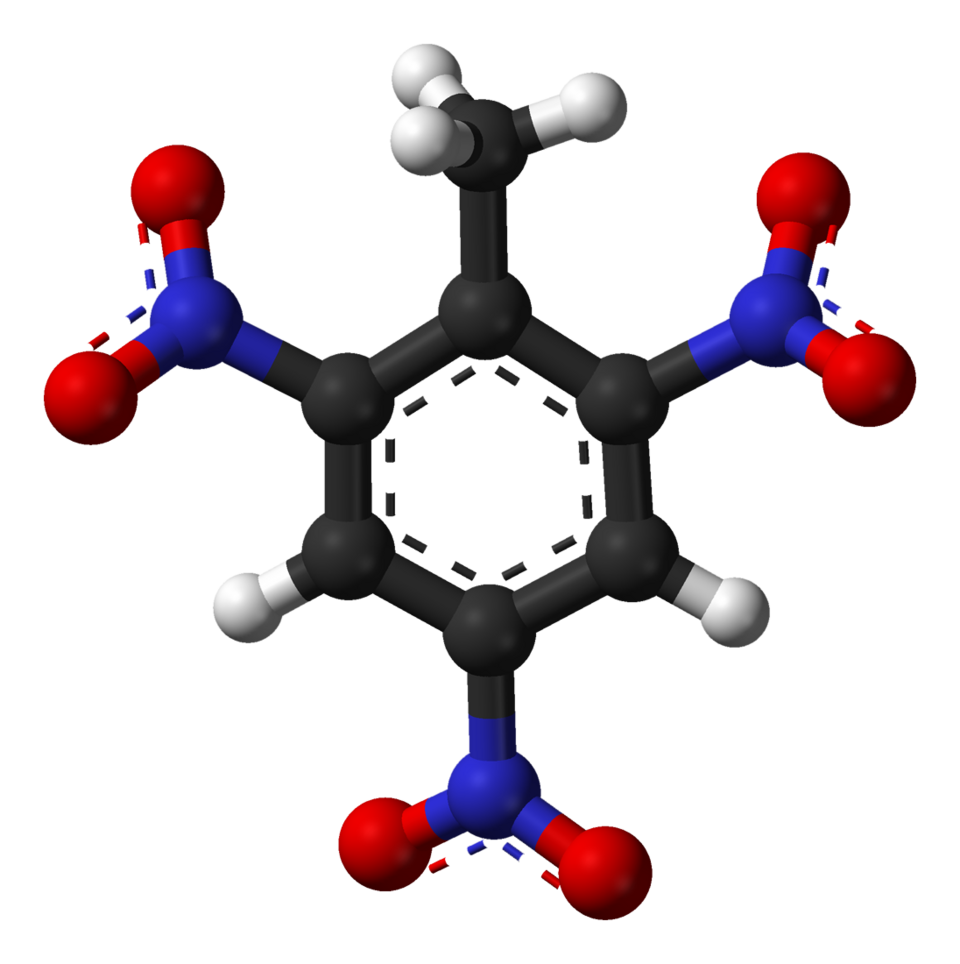 2,4,6-Trinitrotoluene (explosive nitro compound) (Image: Ben Mills, Public domain, via Wikimedia Commons)
6. Toxicity and Environmental Impact
- Health Risks: Nitro compounds are toxic (e.g., nitrobenzene causes methemoglobinemia).
- Environmental Hazards: Persistent in soil/water; biodegradation is slow.
- Safety: Handle with gloves/ventilation; dispose via controlled incineration.
7. Comparison: Nitro vs. Nitroso Compounds
| Feature | Nitro (–NO₂) | Nitroso (–N=O) |
|---|---|---|
| Oxidation State | Nitrogen: +3 | Nitrogen: +2 |
| Stability | More stable | Less stable, reactive |
| Reactivity | Undergoes reduction/electrophilic substitution | Forms azo dyes |
| Example | Nitrobenzene | Nitrosobenzene (C₆H₅NO) |
Exam Tip
- Mechanisms: Always show the nitronium ion (NO₂⁺) in nitration mechanisms.
- Directing Effects: Remember –NO₂ is meta-directing; draw resonance structures to explain.
- Reduction Products: Predict the amine product from nitro compounds (e.g., nitroethane → ethylamine).
- Applications: Link nitro compounds to explosives (TNT), dyes (azo compounds), and pharmaceuticals (aniline).
- NEB-Style Questions:
- "Why is nitrobenzene less reactive than benzene in electrophilic substitution?" Answer: The –NO₂ group withdraws electrons, reducing electron density in the ring.
- "Write the reaction of nitrobenzene with Sn/HCl." Answer: C₆H₅NO₂ + 3Sn + 6HCl → C₆H₅NH₂ + 3SnCl₂ + 2H₂O.
Practice Questions (NEB Style):
- Explain why nitrobenzene undergoes electrophilic substitution at the meta position.
- How would you prepare nitroethane from chloroethane? Write the reaction.
- Draw the resonance structures of the nitro group and explain its electron-withdrawing effect.
- What are the uses of nitroglycerin? Mention one safety precaution during its handling.
Based on the NEB +2 Science syllabus for Chemistry (Chem), unit 15.
Discussion
Loading…