ChemistryUnit 47 min read
Thermochemistry: Energy, Enthalpy, Hess’s Law & Applications
Unit 4 of Chemistry explores how energy changes in chemical reactions—calorimetry, enthalpy calculations, Hess’s Law, bond energies, and real-world applications like fuels and food energy. Learn with visuals, solved examples, and NEB-style questions.
TAKEAWAYS:
- Energy in chemistry is measured as heat (q) in reactions, called enthalpy (ΔH).
- Exothermic reactions release heat (ΔH < 0), while **endothermic** reactions absorb heat (ΔH > 0).
- Hess’s Law lets you calculate ΔH for complex reactions using simpler steps.
- Bond energy and standard enthalpies help predict reaction energy changes.
- Calorimetry measures heat changes in labs (e.g., coffee-cup calorimeters).
- Applications include fuels, nutrition (calories), and industrial processes.
1. Thermochemistry Basics: Energy and Chemical Reactions
Chemical reactions involve energy changes. Some reactions release energy (like burning wood), while others absorb energy (like photosynthesis). Thermochemistry studies these energy changes.
Key Terms:
- System: The part of the universe we study (e.g., a reaction mixture).
- Surroundings: Everything else (e.g., air, container).
- Heat (q): Energy transferred due to temperature difference.
- Work (w): Energy used to move matter (e.g., gas expansion).
- Internal Energy (U): Total energy of a system (kinetic + potential).
- Enthalpy (H): Heat content at constant pressure (ΔH = q at constant P).
Exothermic vs. Endothermic Reactions
flowchart TD
A["Exothermic Reaction"] -->|"ΔH < 0"| B["Releases heat\n(Feels hot)"]
C["Endothermic Reaction"] -->|"ΔH > 0"| D["Absorbs heat\n(Feels cold)"]
A --> E["Example: Combustion\nC + O₂ → CO₂ + heat"]
C --> F["Example: Photosynthesis\nCO₂ + H₂O + energy → C₆H₁₂O₆"]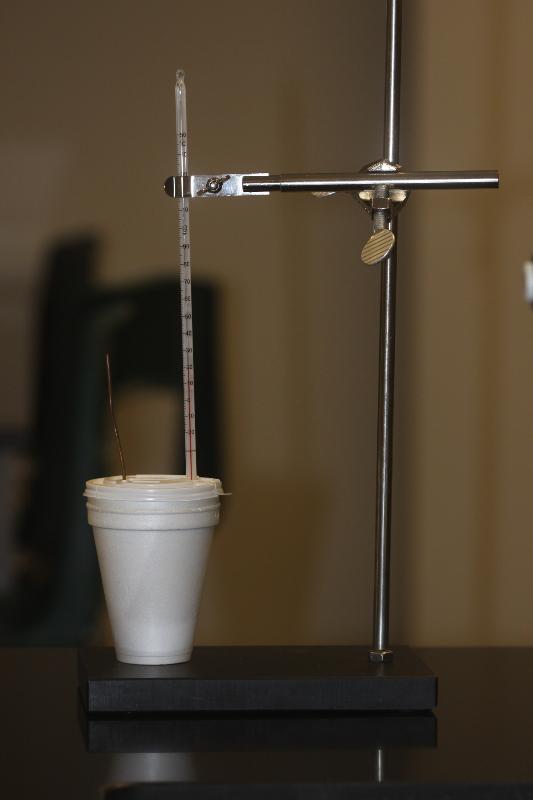 A simple device to measure heat changes in reactions. (Image: Community College Consortium for Bioscience Credentials, CC BY 3.0, via Wikimedia Commons)
2. Measuring Energy Changes: Calorimetry
Calorimetry measures heat (q) released or absorbed in reactions. The most common tool is the coffee-cup calorimeter.
How It Works:
- A reaction occurs in a styrofoam cup (insulated to prevent heat loss).
- The temperature change (ΔT) of water is measured.
- Use the formula:
- = heat (J)
- = mass of water (g)
- = specific heat capacity of water (4.18 J/g·°C)
- = temperature change (°C)
Example: Burning a Candle
A 0.5 g candle burns, raising 100 g of water from 20°C to 30°C. Solution: Since the reaction releases heat, (exothermic).
3. Enthalpy Change (ΔH) and Standard States
- Enthalpy change (ΔH) is the heat absorbed/released at constant pressure.
- Standard enthalpy (ΔH°) is measured under:
- 1 atm pressure
- 25°C (298 K)
- 1 M concentration (for solutions)
Types of Enthalpy Changes:
| Type | Symbol | Example | ΔH Sign |
|---|---|---|---|
| Formation (ΔHₓ°f) | ΔHₓ°f | C + O₂ → CO₂ | Negative |
| Combustion (ΔHₓ°c) | ΔHₓ°c | CH₄ + 2O₂ → CO₂ + 2H₂O | Negative |
| Neutralization (ΔHₓ°n) | ΔHₓ°n | HCl + NaOH → NaCl + H₂O | Negative |
| Solution (ΔHₓ°sol) | ΔHₓ°sol | NaCl(s) → Na⁺(aq) + Cl⁻(aq) | Positive |
4. Hess’s Law: Calculating ΔH for Complex Reactions
Hess’s Law states:
The total enthalpy change for a reaction is the same, regardless of the pathway.
Steps to Use Hess’s Law:
- Write the target reaction.
- Find simpler reactions whose ΔH values are known.
- Adjust coefficients to match atoms.
- Add or subtract ΔH values.
Example: Calculate ΔH° for C + 2H₂ → CH₄
Given:
- C + O₂ → CO₂, ΔH° = -393.5 kJ
- H₂ + ½O₂ → H₂O, ΔH° = -285.8 kJ
- CH₄ + 2O₂ → CO₂ + 2H₂O, ΔH° = -890.3 kJ
Solution: Reverse the formation of CH₄ and add: Now add: Total ΔH° = -393.5 + (-571.6) + 890.3 = -74.8 , \text{kJ}
5. Bond Energy and Enthalpy Changes
- Bond energy is the energy needed to break 1 mole of bonds in gas phase.
- ΔH = Σ (bond energies of bonds broken) – Σ (bond energies of bonds formed)
Example: Calculate ΔH for H₂ + Cl₂ → 2HCl
Given bond energies:
- H–H = 436 kJ/mol
- Cl–Cl = 242 kJ/mol
- H–Cl = 431 kJ/mol
Solution:
6. Applications of Thermochemistry
A. Fuels and Energy Production
- Combustion reactions release energy (e.g., gasoline, coal).
- Calorific value = heat released per gram of fuel.
B. Food and Nutrition (Calories)
- 1 Calorie (kcal) = 4.18 kJ
- Example: A 50 g chocolate bar has ~250 Calories → 250 × 4.18 = 1045 kJ.
C. Industrial Processes
- Endothermic reactions (e.g., Haber process for ammonia) require energy input.
- Exothermic reactions (e.g., cement production) release heat.
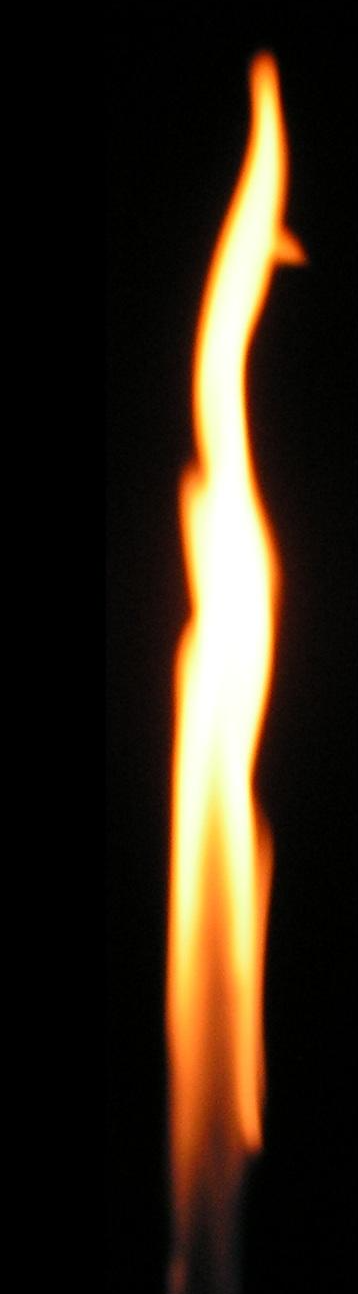 A real example of an exothermic reaction (combustion). (Image: Arthur Jan Fijałkowski, CC BY-SA 3.0, via Wikimedia Commons)
7. NEB-Style Questions and Solutions
Short Answer Questions
Define enthalpy of formation.
- Answer: The heat change when 1 mole of a compound is formed from its elements in standard states.
Why is the enthalpy of neutralization for strong acids and bases always the same?
- Answer: Because the reaction is always:
Numerical Problems
Calculate the enthalpy change for: Given:
- S + O₂ → SO₂, ΔH° = -296.8 kJ
- 2S + 3O₂ → 2SO₃, ΔH° = -726.0 kJ
Solution: Reverse the first equation and add: Total ΔH° = +593.6 – 726.0 = -132.4 kJ
Conceptual Questions
- Why is ice melting an endothermic process?
- Answer: Because it absorbs heat from surroundings to break hydrogen bonds (ΔH > 0).
Exam Tip
✅ For NEB exams:
- Memorize standard enthalpy values (e.g., ΔH°f of H₂O, CO₂).
- Practice Hess’s Law with multi-step problems.
- Label units (kJ, kJ/mol) in numerical answers.
- Understand real-world applications (fuels, food energy).
- Draw energy diagrams for exothermic/endothermic reactions.
Final Note: Thermochemistry is about energy flow in reactions. Master calorimetry, Hess’s Law, and bond energies to solve any problem! 🔥📊
Based on the NEB +2 Science syllabus for Chemistry (Chem), unit 4.
Discussion
Loading…