ChemistryUnit 313 min read
Chemical Kinetics: Rates, Factors, Mechanisms & Catalysis
Unit 3 of Chemistry explains how fast reactions happen (reaction rates), what affects their speed (temperature, concentration, catalysts), and how reactions proceed step-by-step (mechanisms). Learn with real experiments, graphs, and NEB-style questions.
TAKEAWAYS:
- Reaction rate depends on collision frequency and activation energy—only collisions with enough energy and proper orientation work.
- Rate laws (rate = k[A]^m[B]^n) show how concentration affects speed, but exponents (m, n) must be found experimentally.
- First-order reactions have a constant half-life, while zero-order rates are independent of concentration.
- Catalysts lower activation energy but aren’t consumed; enzymes are biological catalysts.
- Arrhenius equation (k = Ae^(-Ea/RT)) links temperature, activation energy, and rate constant.
- NEB exams test: calculations (half-life, rate constants), interpreting graphs, and explaining real-world applications (e.g., drug design, industrial processes).
What is Chemical Kinetics?
Chemical kinetics studies how fast reactions occur and the steps involved. Unlike thermodynamics (which tells if a reaction happens), kinetics answers:
- How quickly reactants turn into products?
- What factors speed up or slow down a reaction?
- What’s the mechanism (pathway) of the reaction?
Why does it matter?
- Industry: Optimizing fertilizer production or drug synthesis.
- Everyday life: Why food spoils faster in heat or why catalysts in cars reduce pollution.
- NEB exams: 20–30% of questions involve calculations (rate laws, half-life) or graph interpretation.
flowchart TD
    A["Reaction Occurs"] -->|"Collisions"| B["Effective Collisions?"]
    B -->|"Yes: Enough energy + proper orientation"| C["Products Form"]
    B -->|"No: Too weak or wrong angle"| D["No Reaction"]
    C --> E["Faster Rate"]
    D --> F["Slower Rate"]
Key Idea: Only effective collisions (with energy ≥ activation energy Ea and correct orientation) lead to products.
1. Reaction Rate: How Fast?
Definition: The speed of a reaction is how quickly reactants disappear or products appear. Mathematically:
- Negative sign for reactants (they decrease over time).
- Example: For , the rate can be written as:
Average vs. Instantaneous Rate
| Type | Definition | Example |
|---|---|---|
| Average rate | Change over a time interval. | Rate from t=0 to t=10s. |
| Instantaneous rate | Rate at a specific moment (slope of tangent). | Rate at t=5s (from the graph). |
Worked Example: For the reaction , [A] drops from 0.8 M to 0.4 M in 20 seconds. Calculate the average rate. Solution:
2. Rate Laws: How Concentration Affects Speed
The rate law shows how reactant concentrations affect the rate:
- k: Rate constant (depends on temperature, catalyst).
- m, n: Order of reaction (must be found experimentally, not from the equation!).
How to Find the Order?
Method 1: Initial Rate Method Compare rates when changing one reactant’s concentration while keeping others constant.
Example: For , we get:
| Experiment | [A] (M) | [B] (M) | Rate (M/s) |
|---|---|---|---|
| 1 | 0.1 | 0.1 | 0.02 |
| 2 | 0.2 | 0.1 | 0.08 |
| 3 | 0.1 | 0.2 | 0.04 |
Steps:
- Compare Exp 1 and 2: [A] doubles, rate ×4 → order w.r.t. A = 2 (since ).
- Compare Exp 1 and 3: [B] doubles, rate ×2 → order w.r.t. B = 1.
- Rate law: .
Method 2: Integrated Rate Laws (for zero, first, second order—see next section).
3. Order of Reactions and Half-Life
The order determines how the rate changes with concentration.
| Order | Rate Law | Units of k | Half-Life (t₁/₂) | Graph: [A] vs. Time |
|---|---|---|---|---|
| Zero | Rate = k[A]^0 = k | M/s | Straight line (slope = -k) | |
| First | Rate = k[A] | s⁻¹ | Exponential decay (curve) | |
| Second | Rate = k[A]^2 | M⁻¹s⁻¹ | Hyperbola (curves upward) |
Key Points:
- Zero-order: Rate doesn’t depend on [A]. Example: Enzyme-catalyzed reactions at high substrate concentration.
- First-order: Half-life is constant (independent of initial concentration). Example: Radioactive decay.
- Second-order: Half-life depends on [A]₀. Example: Some gas-phase reactions.
Worked Example: First-Order Half-Life
For a first-order reaction, if minutes, how long to reach 12.5% of the initial concentration? Solution:
- After 1 half-life (10 min): 50% remains.
- After 2 half-lives (20 min): 25% remains.
- After 3 half-lives (30 min): 12.5% remains. Answer: 30 minutes.
Worked Example: Second-Order Rate Constant
For a second-order reaction, [A]₀ = 0.5 M and s. Find . Solution:
4. Factors Affecting Reaction Rate
Four main factors control how fast a reaction goes:
| Factor | Effect on Rate | Example |
|---|---|---|
| Concentration | Higher [reactants] → more collisions → faster rate. | Adding more HCl speeds up Zn + HCl → ZnCl₂ + H₂. |
| Temperature | Higher T → more kinetic energy → more effective collisions. | Cooking food faster in hot oil. |
| Catalyst | Lowers activation energy (Ea). | MnO₂ speeds up H₂O₂ decomposition. |
| Surface Area | More surface → more collisions (for solids). | Powdered sugar dissolves faster than cubes. |
Temperature and the Arrhenius Equation
The Arrhenius equation links temperature, Ea, and rate constant k:
- A: Frequency factor (how often molecules collide).
- Ea: Activation energy (minimum energy needed).
- R: Gas constant (8.314 J/mol·K).
- T: Temperature in Kelvin.
Key Idea: A small increase in T doubles the rate for many reactions (rule of thumb: +10°C → ×2 rate).
Worked Example: If Ea = 50 kJ/mol, how does k change when T increases from 300 K to 310 K? Solution: Calculate the ratio . Using : Answer: Rate increases by ~2× (as expected).
5. Reaction Mechanisms: How Reactions Happen
Most reactions occur in multiple steps (elementary reactions). The rate-determining step (RDS) is the slowest step—it controls the overall rate.
Example: The reaction has this mechanism:
- (slow, RDS)
- (fast)
Key Points:
- The rate law comes from the RDS:
- Intermediates (like NO₃) are formed and consumed but don’t appear in the overall equation.
6. Catalysis: Speeding Up Reactions
Catalysts increase the rate by:
- Lowering Ea (providing an alternative pathway).
- Being regenerated at the end (not consumed).
| Type | Example | How It Works |
|---|---|---|
| Homogeneous | H⁺ in ester hydrolysis. | Catalyst is in the same phase as reactants. |
| Heterogeneous | Pt in H₂ + O₂ → H₂O. | Catalyst is a solid; reactants are gases/liquids. |
| Enzymes | Amylase breaking down starch. | Biological catalysts with active sites. |
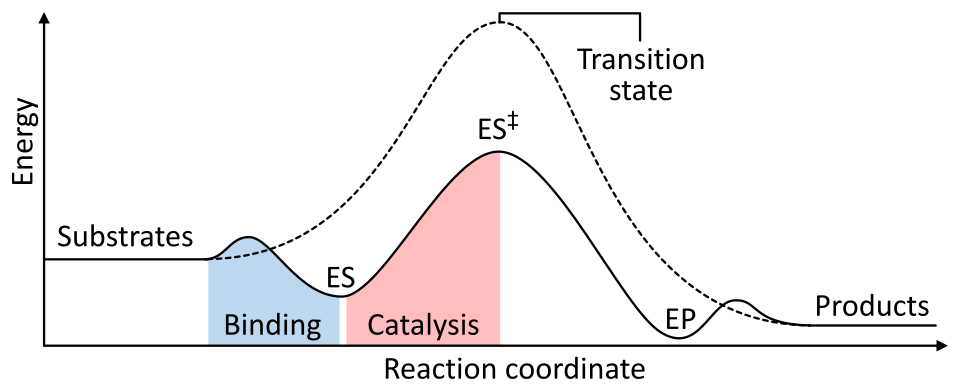 Shows substrate binding to active site, lowering Ea. (Image: Thomas Shafee, CC BY 4.0, via Wikimedia Commons)
Worked Example: Catalyst Effect
A reaction has Ea = 80 kJ/mol without a catalyst and 50 kJ/mol with a catalyst. How many times faster is the reaction at 300 K? Solution: Use the Arrhenius equation ratio: Answer: The reaction is 22,000× faster with the catalyst!
Exam Tip: How to Score Full Marks in NEB Questions
Rate Laws:
- Always write the rate law in terms of reactants (e.g., Rate = k[A]^m[B]^n).
- Never assume orders from the balanced equation—experiments decide orders!
Graphs:
- Zero-order: Straight line with slope = -k.
- First-order: Exponential decay (ln[A] vs. time is a straight line).
- Second-order: Curve that flattens (1/[A] vs. time is a straight line).
Half-Life:
- For first-order, is constant.
- For second-order, .
Arrhenius Equation:
- Remember: Higher Ea → slower reaction.
- Use the ratio method for temperature changes (no need to calculate A).
Mechanisms:
- Identify the slow step—it determines the rate law.
- Intermediates cancel out in the overall equation.
NEB Board-Style Questions
Short Answer (5 marks)
- For the reaction , the following data was collected:
[A] (M) Rate (M/s) 0.1 0.02 0.2 0.08 Determine: a) The order of the reaction with respect to A. b) The rate constant k. c) The rate when [A] = 0.3 M.
Solution: a) Order = 2 (rate ×4 when [A] ×2). b) Rate = k[A]² → 0.02 = k(0.1)² → k = 2 M⁻¹s⁻¹. c) Rate = 2 × (0.3)² = 0.18 M/s.
Long Answer (10 marks)
- Explain the effect of temperature on the rate of a reaction using collision theory and the Arrhenius equation. How would doubling the temperature from 300 K to 600 K affect the rate constant k if Ea = 60 kJ/mol?
Solution:
- Collision Theory: Higher T → molecules move faster → more collisions → more effective collisions (higher energy > Ea).
- Arrhenius Equation: . For T₁ = 300 K, T₂ = 600 K: Answer: k increases by ~121× (not ×2, because the effect is exponential!).
Graph Interpretation (5 marks)
- The graph below shows [A] vs. time for a reaction. Determine: a) The order of the reaction. b) The half-life. c) The rate constant k.
Solution: a) First-order (exponential decay). b) is the time when [A] = [A]₀/2 (read from graph, e.g., 10 s). c) Use → .
Summary Table for Quick Revision
| Concept | Key Equation | Example |
|---|---|---|
| Rate Law | Rate = k[A]^m[B]^n | Rate = k[NO]²[O₂] for NO + O₂ → NO₂ |
| First-Order Half-Life | Radioactive decay (constant t₁/₂) | |
| Arrhenius Equation | Doubling T can ×1000 the rate! | |
| Catalyst Effect | Lowers Ea | Enzymes in digestion |
Final Advice for NEB Exams
- Memorize: Rate laws, half-life formulas, and the Arrhenius equation.
- Practice: Solve problems for zero, first, and second-order reactions.
- Draw graphs: Label axes correctly (e.g., ln[A] vs. time for first-order).
- Real-world links: Relate kinetics to drug design, food preservation, and industrial processes.
Good luck! 🚀
Based on the NEB +2 Science syllabus for Chemistry (Chem), unit 3.
Discussion
Loading…