ChemistryUnit 112 min read
Volumetric Analysis: Titrations, Indicators, Errors & Calculations
Unit 1 of Chemistry teaches how to measure solution concentrations precisely using titrations, standard solutions, and indicators—essential skills for labs and exams. Learn types of titrations, calculations, and common mistakes to avoid.
TAKEAWAYS:
- Volumetric analysis measures concentrations by reacting known volumes of solutions.
- Titrations use indicators to detect the endpoint (color change) of a reaction.
- Primary standards are pure, stable solids used to prepare standard solutions.
- Errors like parallax, burette reading mistakes, and reaction slowness affect accuracy.
- NEB exams test calculations, titration curves, and identifying correct indicators.
What is Volumetric Analysis?
Volumetric analysis is a method to determine the concentration of a solution by reacting it with another solution of known concentration (called a standard solution). The reaction must be fast and complete (stoichiometric). The key tool is the burette (a graduated glass tube with a stopcock).
flowchart TD
    A["Unknown Solution (Analyte)"] -->|"Add to Conical Flask"| B["Titration Setup"]
    C["Standard Solution (Known Conc.)"] -->|"From Burette"| B
    B -->|"Indicator Added"| D["Endpoint: Color Change"]
    D -->|"Volume Recorded"| E["Calculate Concentration"]
Why is it important?
- Used in quality control (e.g., checking acidity in food).
- Helps in medicine (e.g., drug dosage).
- Essential in industrial processes (e.g., water treatment).
Key Terms You Must Know
| Term | Definition | Example |
|---|---|---|
| Titration | Process of adding a standard solution to an unknown solution dropwise. | Acid-base titration. |
| Endpoint | Point where the indicator changes color (reaction completes). | Phenolphthalein turns pink. |
| Equivalence Point | Theoretical point where moles of reactants are stoichiometric. | Not always visible; detected by indicator. |
| Standard Solution | Solution with exact known concentration. | NaOH prepared from Na₂CO₃. |
| Primary Standard | Pure solid used to make standard solutions (no titration needed). | K₂Cr₂O₇, Na₂CO₃. |
| Secondary Standard | Solution standardized against a primary standard. | HCl titrated with Na₂CO₃. |
| Indicator | Substance that changes color at the endpoint. | Methyl orange, phenolphthalein. |
Types of Titrations
Volumetric analysis covers four main types. Each has a specific use and indicator.
1. Acid-Base Titration
Reaction: Neutralization between an acid and a base. Example: Titrating HCl (acid) with NaOH (base). Indicator Choices:
- Phenolphthalein (colorless → pink, pH ~8–10).
- Methyl orange (red → yellow, pH ~3–4).
pie
    title Acid-Base Titration Curve
    "Start (Acidic)" : 30
    "Buffer Region" : 20
    "Equivalence Point (pH ~7)" : 20
    "Excess Base (Basic)" : 30
Why the jump in pH?
- Near the equivalence point, even a tiny addition of base causes a large pH change (steep curve). This is where the indicator changes color.
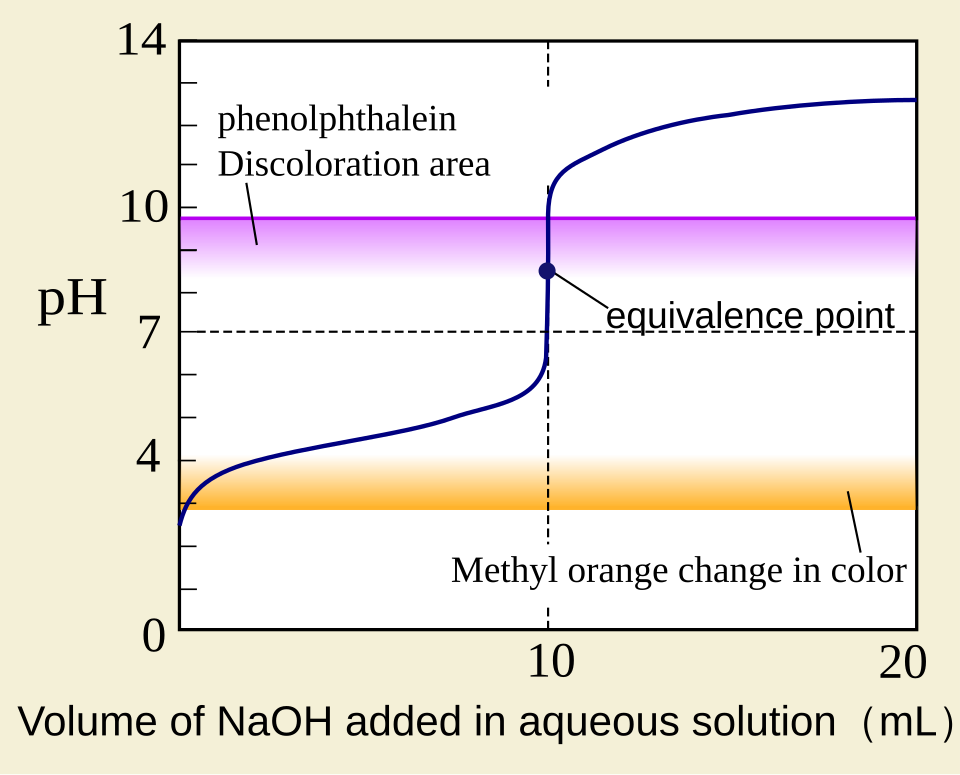 A typical titration curve showing pH vs. volume of base added, with phenolphthalein’s color change region marked. (Image: すじにくシチュー, Johannes Kalliauer, CC0, via Wikimedia Commons)
2. Redox Titration
Reaction: Electron transfer (oxidation-reduction). Example: Titrating Fe²⁺ (iron(II)) with KMnO₄ (potassium permanganate). Indicator: Usually no indicator needed (KMnO₄ is purple; endpoint is the first permanent pink color).
Balanced Reaction:
Why KMnO₄?
- It’s self-indicating (purple in excess).
- Works in acidic medium (H₂SO₄ added).
3. Precipitation Titration
Reaction: Formation of an insoluble salt. Example: Titrating AgNO₃ (silver nitrate) with NaCl (sodium chloride) to form AgCl (white precipitate). Indicator: Potassium chromate (K₂CrO₄) turns red when excess Ag⁺ is present (forms Ag₂CrO₄).
4. Complexometric Titration
Reaction: Formation of a colored complex. Example: Titrating Ca²⁺ or Mg²⁺ with EDTA (ethylenediaminetetraacetic acid). Indicator: Eriochrome Black T (color changes from red to blue at endpoint).
Why EDTA?
- Binds 1:1 with metal ions (e.g., Ca²⁺ + EDTA → [Ca-EDTA]²⁻).
- Used in water hardness testing.
Standard Solutions and Primary Standards
Standard Solution: A solution with a known exact concentration. Primary Standard: A pure solid used to prepare standard solutions without titration.
| Primary Standard | Why? | Example Use |
|---|---|---|
| Na₂CO₃ | Stable, high molar mass (less error in weighing). | Standardizing HCl. |
| K₂Cr₂O₇ | Stable, soluble, used in redox titrations. | Standardizing Fe²⁺ solutions. |
| Oxalic acid (H₂C₂O₄) | Pure, crystalline, reacts 1:1 with KMnO₄. | Redox titrations. |
Secondary Standards: Solutions whose concentration is found by titrating against a primary standard. Example: HCl is often a secondary standard (prepared from concentrated HCl, then titrated with Na₂CO₃).
How to Perform a Titration (Step-by-Step)
- Rinse the burette with the standard solution (to remove water).
- Fill the burette with the standard solution (note initial volume).
- Add ~25 mL of unknown solution to a conical flask + 2–3 drops of indicator.
- Titrate slowly (swirl the flask) until the endpoint (color change).
- Record the final burette volume.
- Repeat 2–3 times for accuracy (results should be within 0.1 mL).
Calculations in Volumetric Analysis
The key formula: Where:
- = concentration of standard solution (mol/L).
- = volume of standard solution used (L).
- = concentration of unknown solution (mol/L).
- = volume of unknown solution (L).
Worked Example 1: Acid-Base Titration Problem: 25.0 mL of HCl is titrated with 0.1 M NaOH. The endpoint is reached at 28.5 mL of NaOH. Find the concentration of HCl.
Solution:
- Moles of NaOH used = .
- Since HCl and NaOH react 1:1, moles of HCl = 0.00285 mol.
- Concentration of HCl = .
Answer: The concentration of HCl is 0.114 M.
Worked Example 2: Redox Titration Problem: 10.0 mL of Fe²⁺ solution is titrated with 0.02 M KMnO₄. The endpoint is at 15.0 mL of KMnO₄. Find the concentration of Fe²⁺.
Balanced Reaction:
Solution:
- Moles of KMnO₄ = .
- From the equation, 1 mole KMnO₄ reacts with 5 moles Fe²⁺. So, moles of Fe²⁺ = .
- Concentration of Fe²⁺ = .
Answer: The concentration of Fe²⁺ is 0.15 M.
Common Errors and How to Avoid Them
| Error | Cause | Solution |
|---|---|---|
| Parallax Error | Reading burette at an angle. | Read at eye level with a white tile. |
| Burette Not Rinsed | Water dilutes the standard solution. | Rinse with standard solution before use. |
| Slow Reaction | Reaction takes too long to complete. | Heat gently (if safe) or use a catalyst. |
| Indicator Choice | Wrong indicator (e.g., methyl orange for strong base). | Use phenolphthalein for strong acid-base titrations. |
| Incomplete Reaction | Side reactions or impurities. | Use fresh solutions and distilled water. |
Indicators in Volumetric Analysis
Indicators change color at a specific pH range (their transition range). Choose one whose transition range matches the equivalence point pH of your titration.
| Indicator | Color Change | pH Range | Best For |
|---|---|---|---|
| Phenolphthalein | Colorless → Pink | 8–10 | Strong acid-strong base |
| Methyl Orange | Red → Yellow | 3–4 | Strong acid-weak base |
| Bromothymol Blue | Yellow → Blue | 6–8 | Weak acid-weak base |
| K₂CrO₄ (Precip.) | No color → Red | N/A | AgNO₃-NaCl titration |
NEB Board-Style Questions (Practice!)
Short Answer (2 marks each)
- Why is Na₂CO₃ preferred over NaOH as a primary standard?
- What is the purpose of an indicator in titration?
- How does the equivalence point differ from the endpoint?
- Name two redox titrations and their indicators.
Long Answer (5–7 marks)
Describe the procedure for standardizing a HCl solution using Na₂CO₃. Include:
- Apparatus needed.
- Indicator used.
- Calculations for concentration.
A 20.0 mL sample of H₂SO₄ is titrated with 0.1 M NaOH. The endpoint is at 30.0 mL. Calculate:
- Moles of NaOH used.
- Concentration of H₂SO₄ (assuming 1:2 reaction).
Why is KMnO₄ used as a self-indicator in redox titrations? Explain with an example.
Exam Tip: How to Score Full Marks
- Understand the Reaction: Always write the balanced equation before calculations.
- Units Matter: Report concentrations in mol/L (M) and volumes in mL or L (convert carefully!).
- Indicator Choice: Justify why you picked a specific indicator (e.g., "Phenolphthalein is used because the equivalence point pH is ~9").
- Error Analysis: If asked about accuracy, mention parallax, rinsing, and reaction speed.
- Graphs: For titration curves, label:
- X-axis: Volume of titrant.
- Y-axis: pH (for acid-base) or potential (for redox).
- Equivalence point and endpoint.
Common Mistakes to Avoid:
- Forgetting to convert mL to L in calculations.
- Using the wrong stoichiometric ratio (e.g., assuming 1:1 when it’s 1:2).
- Ignoring significant figures (e.g., 28.5 mL has 3 sig figs).
Summary Table: Key Points at a Glance
| Topic | Key Idea | Example |
|---|---|---|
| Primary Standard | Pure solid, no titration needed. | Na₂CO₃, K₂Cr₂O₇. |
| Standard Solution | Known concentration, used in burette. | 0.1 M NaOH. |
| Indicator | Changes color at endpoint. | Phenolphthalein (pink at pH 9). |
| Acid-Base Titration | Neutralization reaction. | HCl + NaOH → NaCl + H₂O. |
| Redox Titration | Electron transfer, often self-indicating. | KMnO₄ + Fe²⁺. |
| Calculations | (adjust for stoichiometry). | 0.1 M × 25 mL = ? M × 30 mL. |
Final Checklist Before Exam
✅ Can you name 4 types of titrations and their indicators? ✅ Do you know how to prepare a standard solution from a primary standard? ✅ Can you balance redox equations (e.g., KMnO₄ + Fe²⁺)? ✅ Do you convert mL to L correctly in calculations? ✅ Can you identify errors in a titration procedure?
Good luck! Volumetric analysis is all about precision and practice—keep titrating! 🧪🔬
Based on the NEB +2 Science syllabus for Chemistry (Chem), unit 1.
Discussion
Loading…